Solar Energy Savings
How Much Can You Save with Solar Energy in India?
2026-05-20T00:00:00.000Z•8
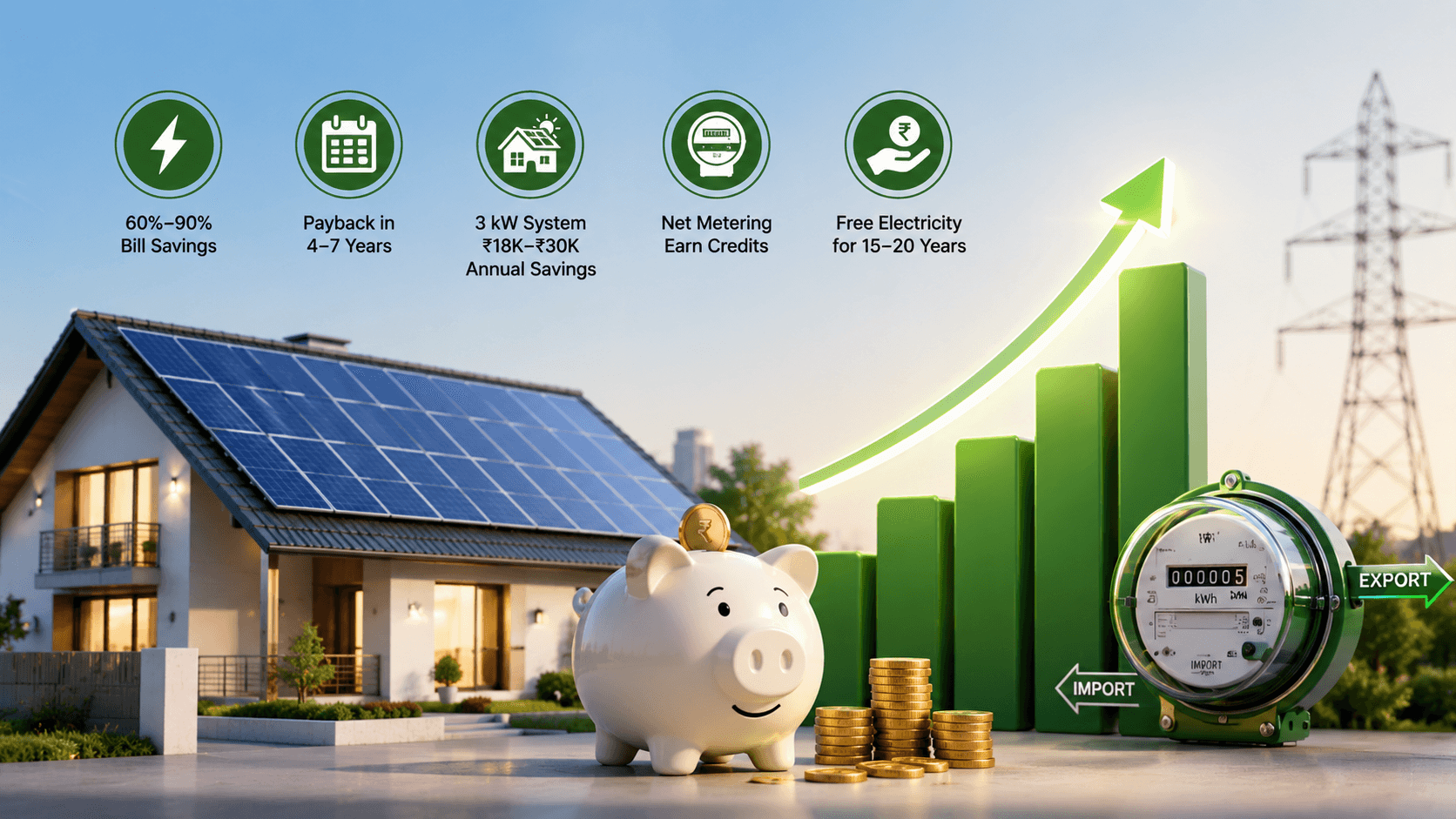
Most homeowners switching to solar save between 60% and 90% on their monthly electricity bills, with the full investment recovering in 4 to 7 years depending on their city, consumption, and solar system size.
That is not a marketing claim. That is the math.
Solar panels can cut your electricity bill by 60% to 90% every month
Average payback period in India ranges from 4 to 7 years
A 3 kW home system typically saves Rs. 18,000 to Rs. 30,000 per year
Net metering lets you earn credits for extra power you send to the grid
After payback, the next 15 to 20 years are nearly free electricity
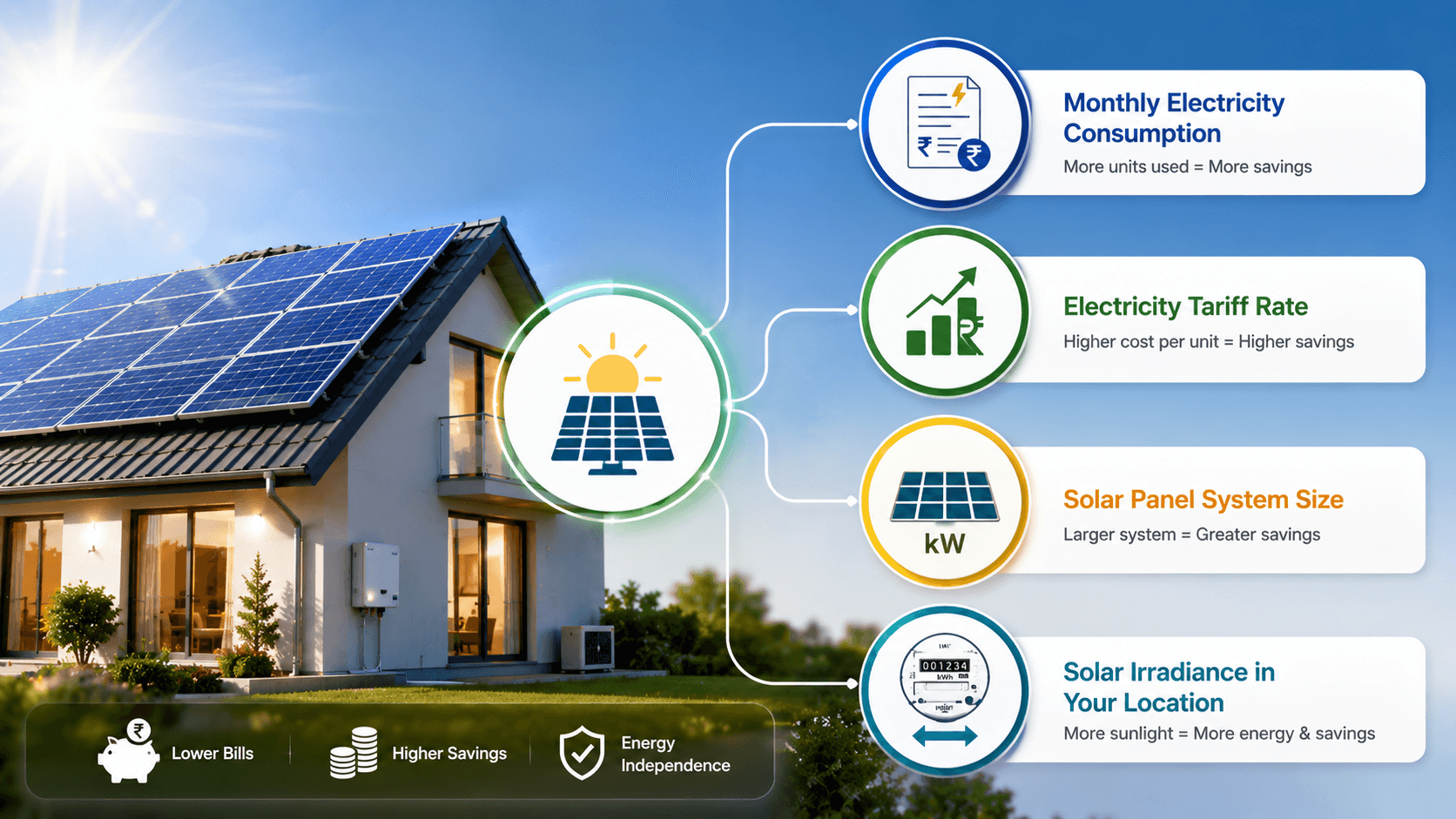
Your solar savings depend on four core factors:
Your current electricity bill
Your city's sunlight hours
System size installed
Whether you use net metering.
None of these work in isolation. A family in Rajasthan paying Rs. 5,000 per month will see very different savings than someone in Mumbai paying the same amount, simply because Rajasthan gets more sunlight hours per day.
Monthly electricity consumption
(units used per month)
Electricity tariff rate
(cost per unit in your state)
Solar panel system size
(measured in kW)
Solar irradiance in your location
(sunlight hours per day)
If you want to understand the upfront investment before calculating savings, read our solar panel cost in India guide.
A 3 kW rooftop solar system can eliminate 60% to 75% of a typical Indian household's electricity bill every single month.
Household profile: Family of 4, monthly consumption of 300 units, electricity tariff Rs. 8 per unit, city with 5 peak sun hours daily.
Item | Without Solar | With Solar |
Monthly units consumed | 300 units | 300 units |
Units generated by 3 kW system | 0 | ~450 units/month |
Units exported to grid | 0 | ~150 units (net metered) |
Effective bill | Rs. 2,400 | Rs. 300 to Rs. 600 |
Monthly saving | Rs. 1,800 to Rs. 2,100 |
That is an annual saving of Rs. 21,600 to Rs. 25,200 from a single 3 kW system.
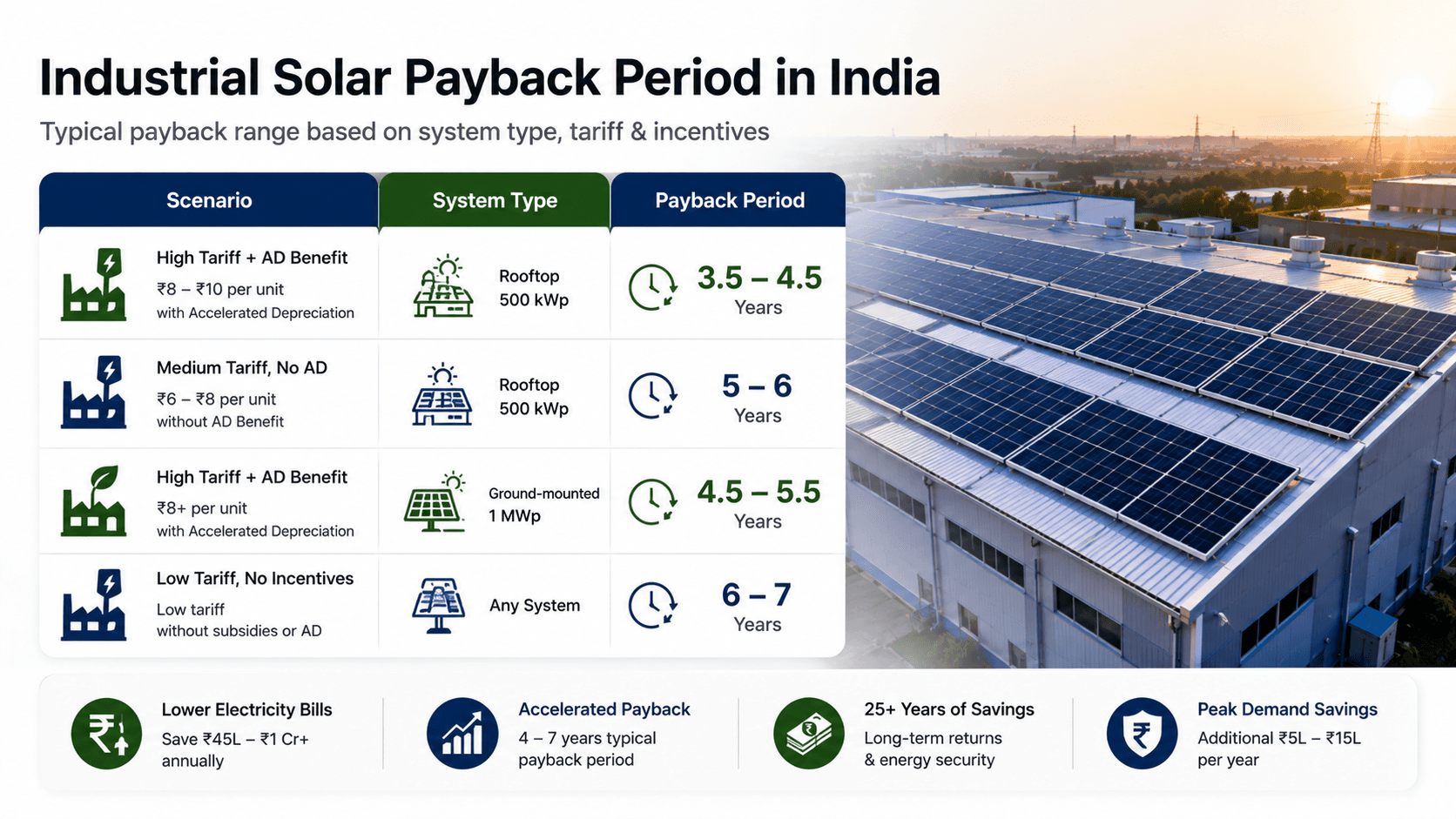
In India, most residential solar systems pay back their full installation cost in 4 to 7 years, after which the electricity generated is essentially free.
Metric | Example Value | What It Means |
System size | 3 kW | Suitable for a typical 2 to 3 BHK home |
Gross installation cost | ₹1.2 lakh to ₹1.8 lakh | Common residential price range before final design variation earthwavetech+1 |
Subsidy impact | Up to ₹78,000 | Lowers the upfront cost for eligible residential systems earthwavetech+1 |
Net system cost after subsidy | ₹1.5 lakh | Example used for payback calculation |
Annual electricity savings | ₹22,000 | Amount saved by reducing grid power use |
Payback period | 6.8 years | ₹1,50,000 ÷ ₹22,000 = 6.8 years |
Panel lifespan | 25 years or more | Power continues after payback with only small maintenance costs earthwavetech+1 |
Free electricity period after payback | About 18 years | 25 years minus 6.8 years, excluding minor maintenance |
Investment return | Better than fixed deposits for many users | Because savings continue for years after break-even |
A 3 kW rooftop solar system typically costs between Rs. 1.2 lakh and Rs. 1.8 lakh after applying government subsidies.
System cost after subsidy: Rs. 1.5 lakh (example)
Annual savings: Rs. 22,000 per year
Payback period: 1,50,000 / 22,000 =
6.8 years
After that payback point, you are generating power that costs you nothing. Solar panels last 25 years. That means 18+ years of near-free electricity.
For a deeper city wise break-even estimate, check solar payback period India 2026.
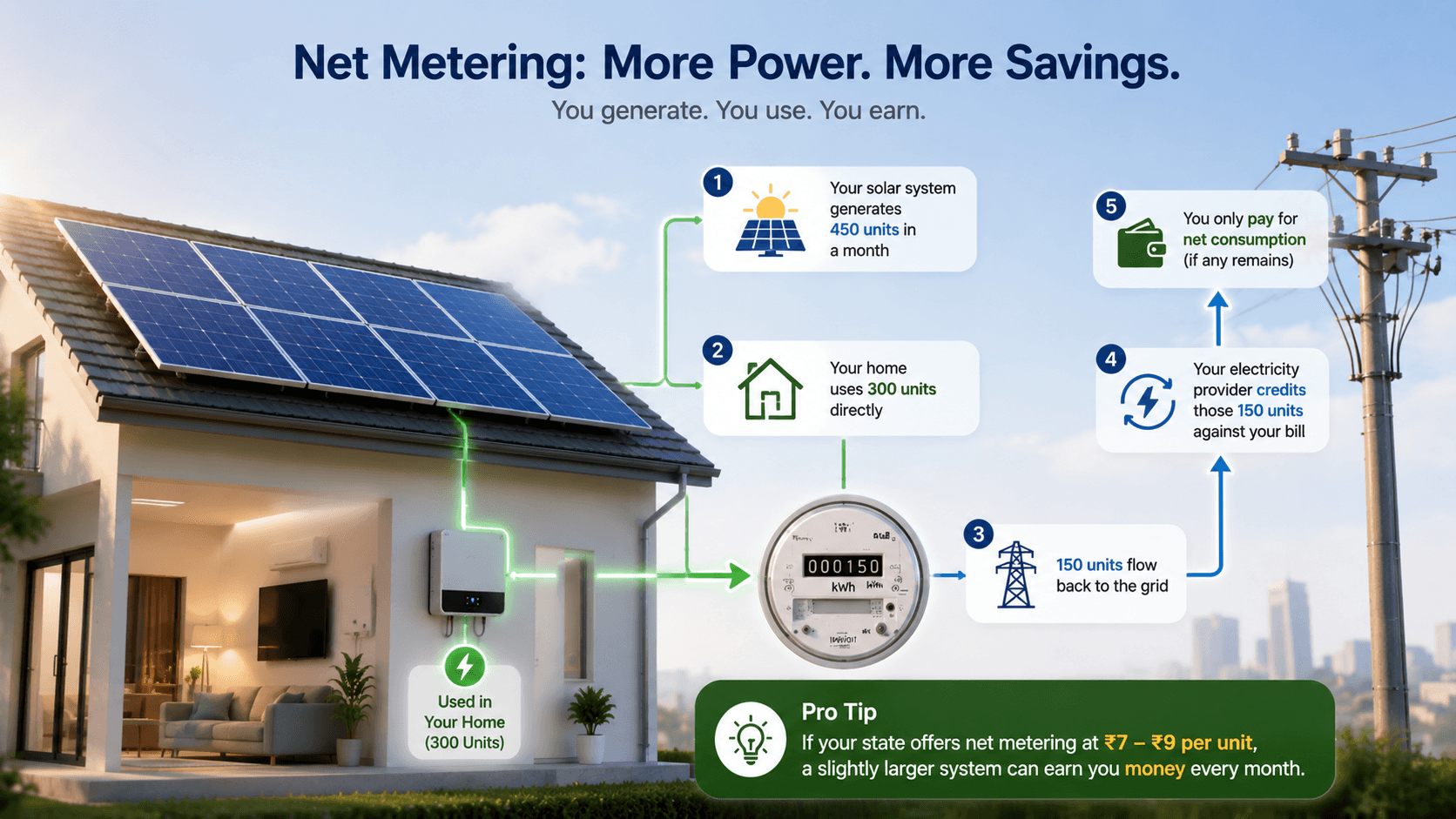
Net metering lets you sell unused solar power back to the grid, converting your rooftop into a small revenue source during off-peak hours.
When your solar panels produce more electricity than your home uses (usually midday when everyone is out), that excess power flows back into the grid. Your electricity meter runs backwards.
You earn credits that offset your bill.
How net metering works in practice:
Your solar system generates 450 units in a month
Your home uses 300 units directly
150 units flow back to the grid
Your electricity provider credits those 150 units against your bill
You only pay for net consumption (if any remains)
Net metering is currently available in most Indian states. Check your state electricity board's policy to confirm the buy-back rate in your area.
If you are still comparing pros and cons, read advantages and limitations of solar energy
Pro tip: If your state offers net metering at Rs. 7 to Rs. 9 per unit, a system slightly larger than your consumption actually earns you money on your bill every month.
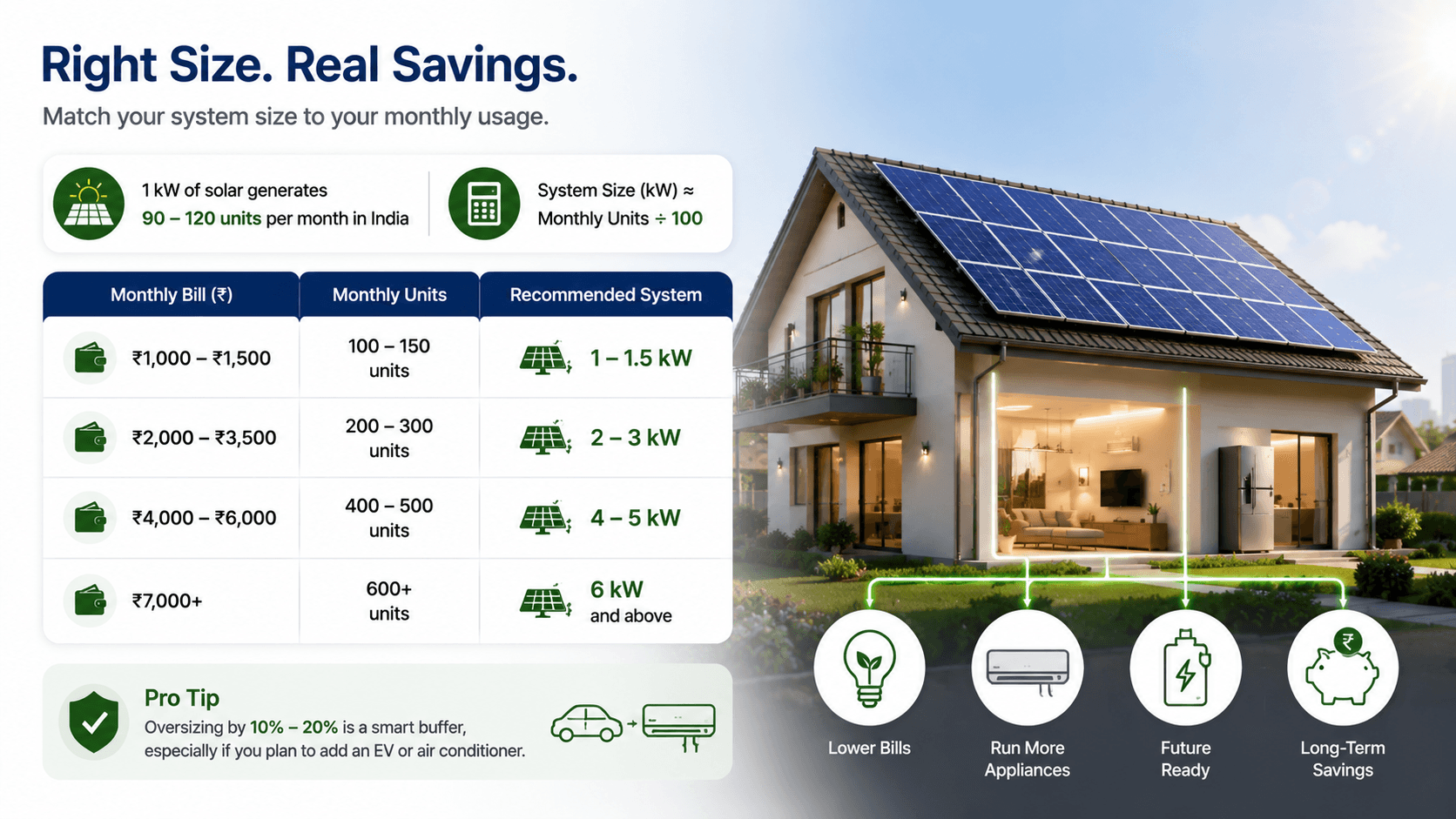
The right solar panel system size matches your monthly consumption, not just your roof space.
1 kW of solar generates roughly 90 to 120 units per month in India
Divide your monthly consumption by 100 to get your approximate system size in kW
Monthly Bill | Monthly Units | Recommended System |
Rs. 1,000 to Rs. 1,500 | 100 to 150 units | 1 to 1.5 kW |
Rs. 2,000 to Rs. 3,500 | 200 to 300 units | 2 to 3 kW |
Rs. 4,000 to Rs. 6,000 | 400 to 500 units | 4 to 5 kW |
Rs. 7,000+ | 600+ units | 6 kW and above |
Oversizing by 10% to 20% is a smart buffer, especially if you plan to add an EV or air conditioner in the next few years.
Businesses looking for stronger ROI can explore commercial solar electricity cost savings and commercial solar solutions reducing energy costs.
India's PM Surya Ghar Yojana scheme offers subsidies of up to Rs. 78,000 for residential rooftop solar installations, which directly reduces your payback period.
As of 2024 to 2025, central government subsidies for on-grid residential solar:
1 to 2 kW systems: Rs. 30,000 per kW subsidy
2 to 3 kW systems: Rs. 18,000 per kW subsidy (for the additional kW)
Above 3 kW: Flat subsidy capped at Rs. 78,000 total
These subsidies apply to grid-connected systems only. Off-grid or hybrid systems have separate provisions depending on the scheme.
Many states offer additional subsidies on top of the central scheme. This can push your effective subsidy to Rs. 90,000 or more in some states.
Lower upfront cost means faster payback. Faster payback means more years of pure savings.
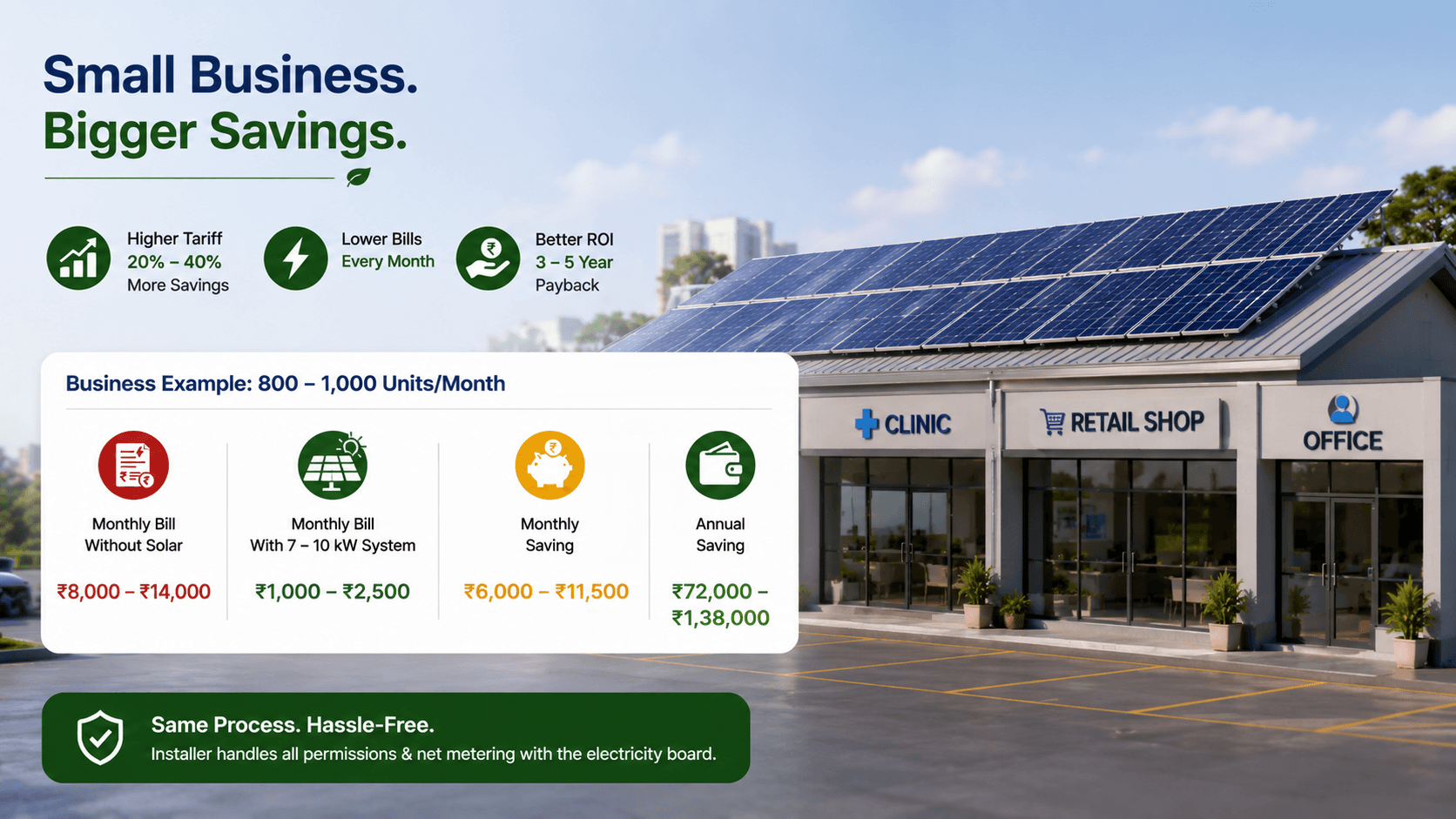
Small businesses and commercial establishments see higher solar savings than households because their electricity tariffs are typically 20% to 40% higher.
Commercial electricity in India usually costs Rs. 10 to Rs. 14 per unit. Residential rates average Rs. 6 to Rs. 9 per unit.
A small clinic, office, or retail shop consuming 800 to 1,000 units per month:
Monthly bill without solar: Rs. 8,000 to Rs. 14,000
Monthly bill with a 7 to 10 kW system: Rs. 1,000 to Rs. 2,500
Monthly saving: Rs. 6,000 to Rs. 11,500
Annual saving: Rs. 72,000 to Rs. 1,38,000
Payback on commercial systems often comes in 3 to 5 years because of the higher tariff rate savings. That is a compelling ROI for any small business owner watching monthly overhead costs.
Wait, does commercial solar require special permission?
In most cases, the process is the same as residential. Your solar installer handles the net metering application and grid synchronization with the electricity board.
Homeowners can explore **rooftop solar systems for homes in India** to understand system options and installation support.
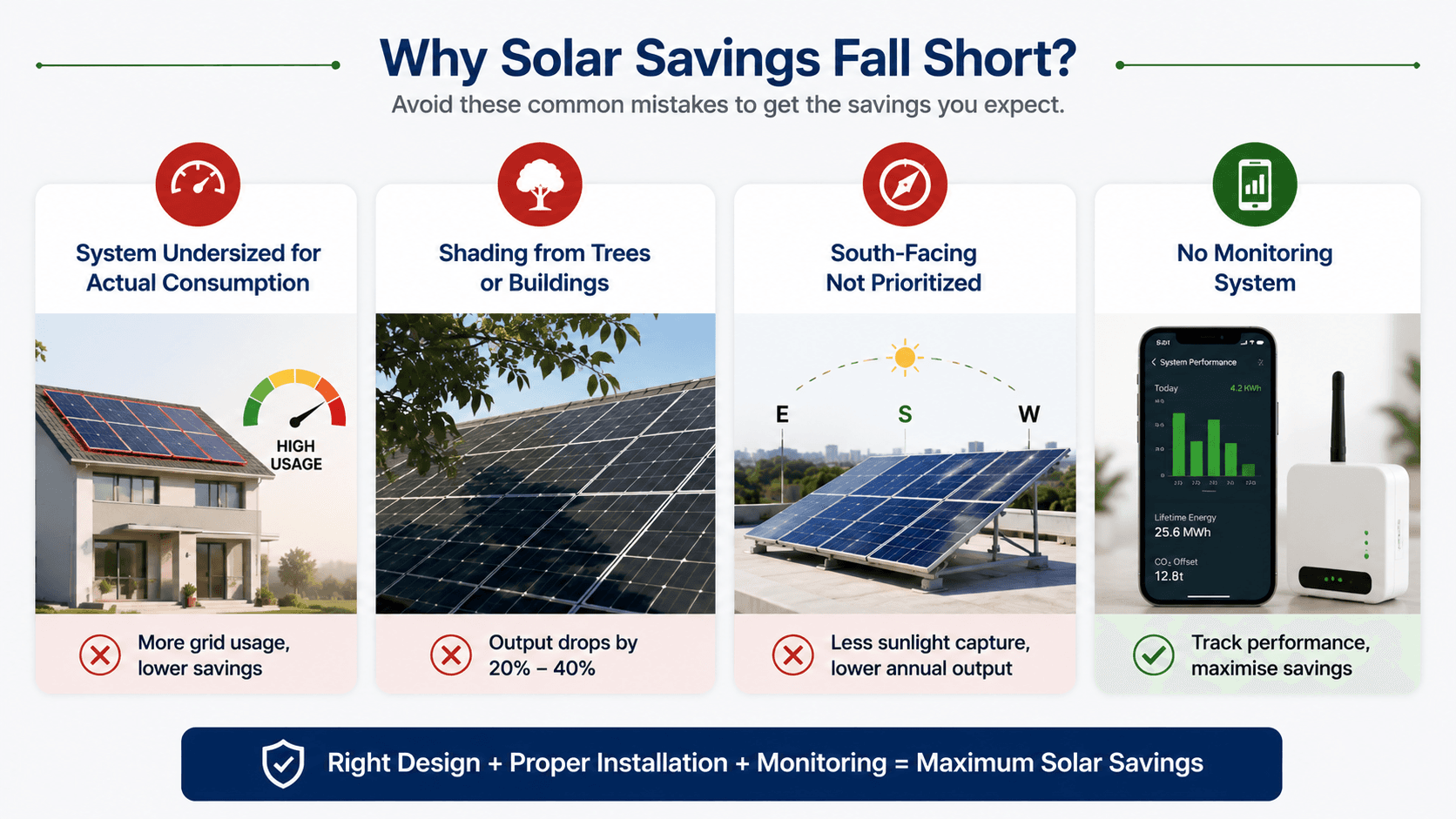
Solar systems underperform savings expectations when they are undersized, shaded, or incorrectly oriented during installation.
The three most common reasons people feel disappointed with their solar savings:
System undersized for actual consumption:
If your usage grows and your system was sized for old consumption patterns, you will still draw heavily from the grid.
Shading from trees or buildings:
Even partial shading on a few panels can reduce total output by 20% to 40% if microinverters or power optimizers are not used.
South-facing not prioritized:
In India, panels facing south with a 15 to 25 degree tilt generate maximum annual output. Rooftop constraints sometimes compromise this.
No monitoring system:
Without a monitoring app, you would not know if output drops due to soiling, inverter issues, or a faulty panel.
If you want a home focused solution, see residential solar system installation for homes in India.
Earthwave is a trusted solar energy company that designs, installs, and maintains rooftop solar systems for homes, apartments, and small businesses across India.
What separates Earthwave from generic solar vendors is their commitment to saving-focused system design. They do not just install panels.
They analyze your actual electricity bills, roof orientation, shading patterns, and local sunlight data before recommending a system size.
Free
assessment
for homes and commercial properties
Custom system design
based on actual consumption data
Complete installation
including mounting, wiring, inverter, and net metering application
Government subsidy assistance
to help you claim PM Surya Ghar Yojana and state-level benefits
After-sales maintenance and monitoring
with remote performance tracking
EMI financing options
so you can start saving from day one without a large upfront payment
Whether you live in an independent house or a housing society apartment, Earthwave has installation solutions that work within building regulations and society approvals.
Solar is financially worth it if your monthly electricity bill is above Rs. 1,500 and your roof gets unobstructed sunlight for at least 4 hours per day.
Is your monthly electricity bill above Rs. 1,500?
Does your roof face south, east, or west with minimal shading?
Are you planning to stay in or own the property for at least 5 years?
If you answered yes to all three, solar will almost certainly deliver positive ROI for you.
If you rent your apartment, check with your housing society. Many societies now allow individual flat owners to install balcony solar or contribute to a rooftop society solar project where savings are shared proportionally.
A: Most Indian homeowners save Rs. 1,500 to Rs. 5,000 per month depending on their system size and electricity tariff. A 3 kW system covering 70% to 80% of your usage is the most common starting point for meaningful monthly savings.
A: The typical payback period for residential solar in India is 4 to 7 years after applying government subsidies. After that, the electricity you generate costs you nothing for the remaining 15 to 20 years of panel life.
A: Yes. Apartment residents can install balcony-mounted solar panels or participate in rooftop group installations organized by their housing society. Earthwave offers apartment-specific assessment and installation options to help residents navigate society approvals and split the savings.
A: Net metering is a policy that credits you for excess solar power you send back to the electricity grid. When your panels produce more than you consume, those extra units reduce your bill further. It essentially makes your electricity meter run both ways and can bring monthly bills close to zero.
A: Yes. Under the PM Surya Ghar Yojana scheme, Indian homeowners can receive central government subsidies up to Rs. 78,000 for residential rooftop solar installations. Many states offer additional subsidies on top of this. Earthwave handles the full subsidy application process on your behalf.
Solar energy savings are real, measurable, and significant. A properly sized system designed for your actual consumption can cut your electricity bill by 60% to 90%, pay itself back in under 7 years, and deliver nearly free power for two decades after that.
The key is accurate sizing, professional installation, and using every available subsidy to reduce your upfront cost.
Ready to see your exact solar savings numbers? Book a free rooftop assessment with Earthwave today. Their team will calculate your site-specific savings, recommend the right system size, and guide you through every subsidy available in your state.
Your electricity bill is a monthly cost you can turn into a monthly saving. Start that shift today.
FAQS
Can't find the answer you're looking for? Our team is here to help.
SUBSCRIBE NEWSLETTER
Switching to solar is easier than you think. Let us guide you to cleaner, more affordable energy.
