Best Solar EPC Company
How to Choose the Best Solar EPC for Your Business
2026-02-20T00:00:00.000Z•8
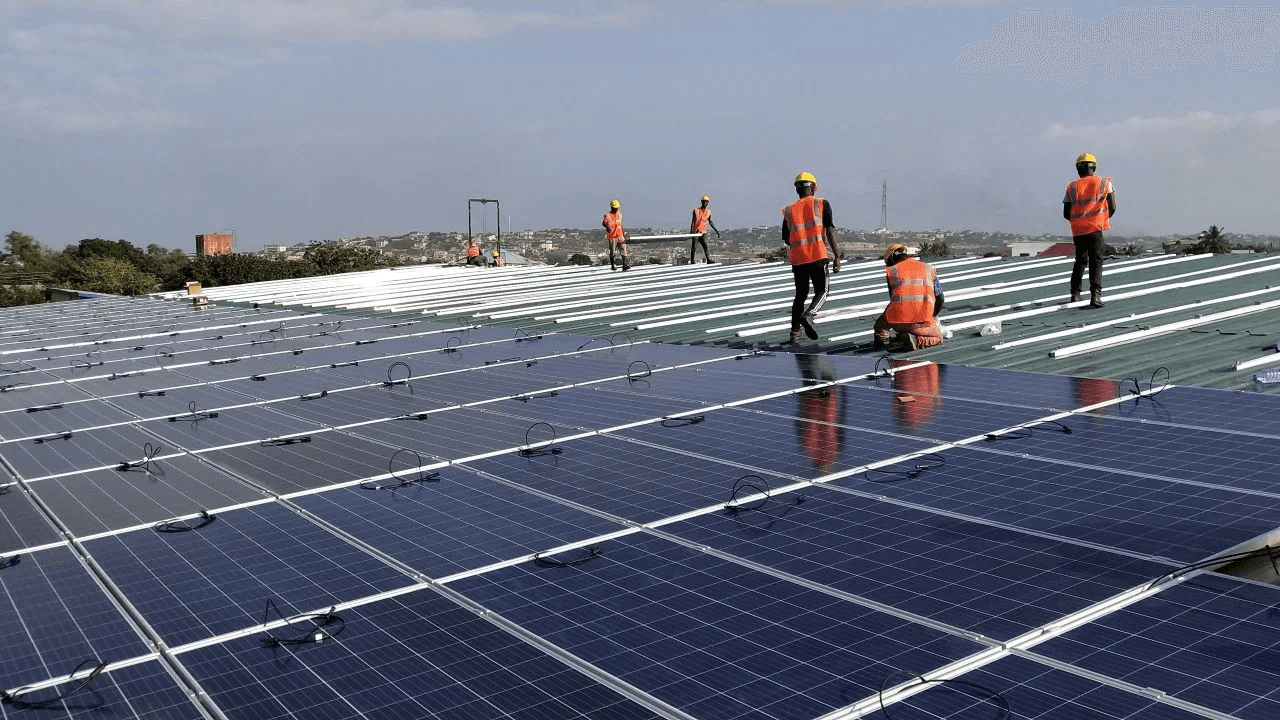
Choosing the right solar EPC (Engineering, Procurement, and Construction) company in India requires evaluating technical expertise, financial stability, component quality, proven track record
comprehensive O&M support, and transparent pricing to ensure maximum ROI and 25+ years of reliable performance.
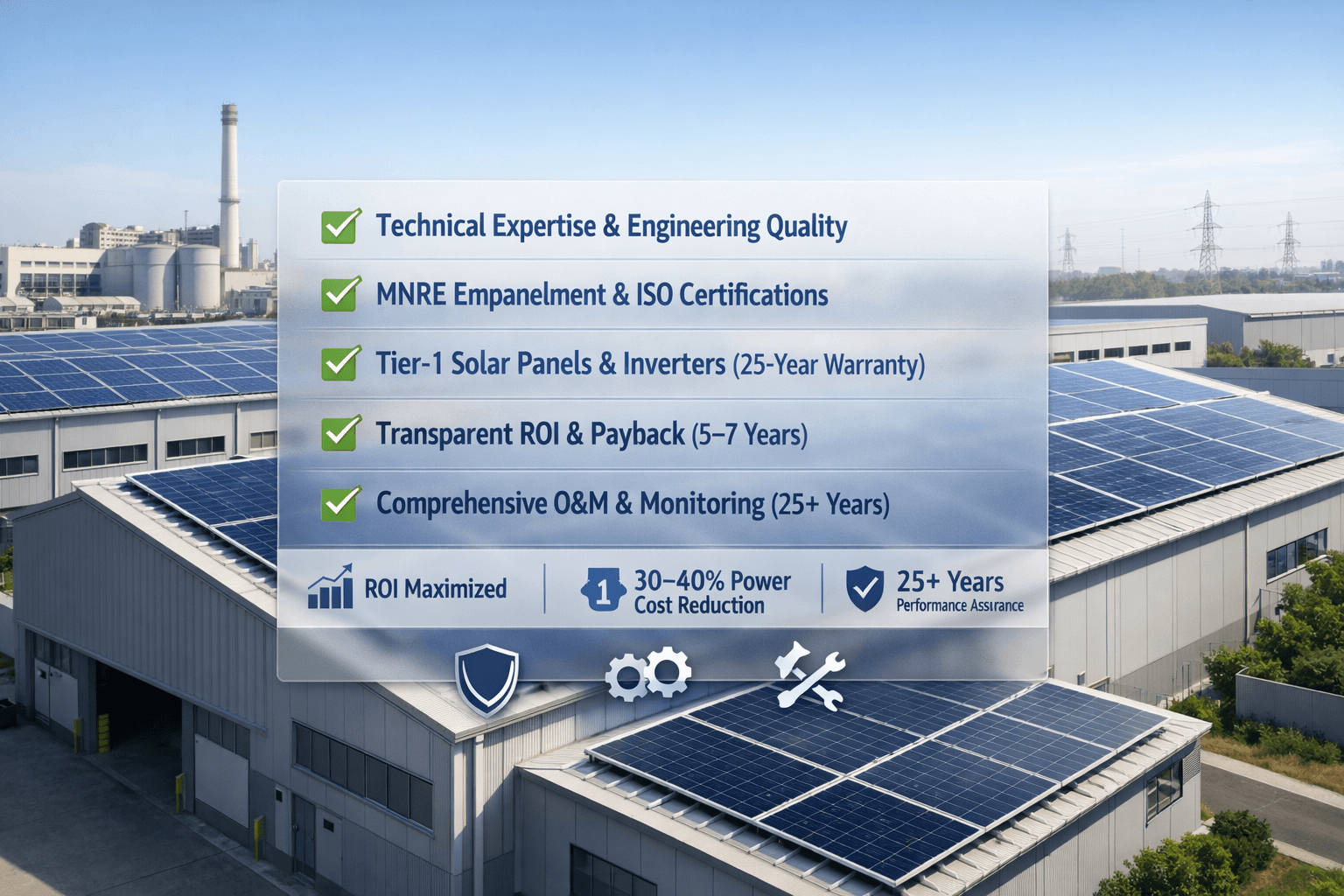
Verify the EPC company's track record with at least 50+ MW installed capacity and similar-scale projects in your industry
Check for MNRE empanelment, ISO certifications, and Tier-1 component suppliers with minimum 25-year panel and 10-year inverter warranties
Ensure end-to-end service capability including design, approvals, installation, grid connection, and long-term O&M with monitoring systems
Demand transparent ROI calculations showing 5-7 year payback periods and 30-40% electricity cost reduction with detailed financial modeling
Evaluate their financial health, client testimonials, safety standards, and post-installation support before signing contracts
Solar EPC (Engineering, Procurement, Construction) companies deliver complete turnkey solutions through three phases:
Engineering:
Site assessment and system design
Load analysis and shadow studies
Performance calculations and optimization
Procurement:
Component sourcing (panels, inverters, structures)
Quality verification and warranty documentation
Construction:
Professional installation with certified teams
Grid integration, testing, and commissioning
Final approvals and handover
Why It Matters: Single-point accountability eliminates coordination headaches between multiple vendors, reducing project delays and miscommunication by 70%.
Don't trust marketing claims. Demand proof.
Minimum Requirements:
At least 5 years in commercial solar installations
Minimum 50 MW cumulative installed capacity
10+ projects in your industry segment (manufacturing/IT/hospitality)
Operational projects you can physically visit
Ask for client contacts, not just testimonials. Call 3-4 existing customers and ask about post-installation support quality.
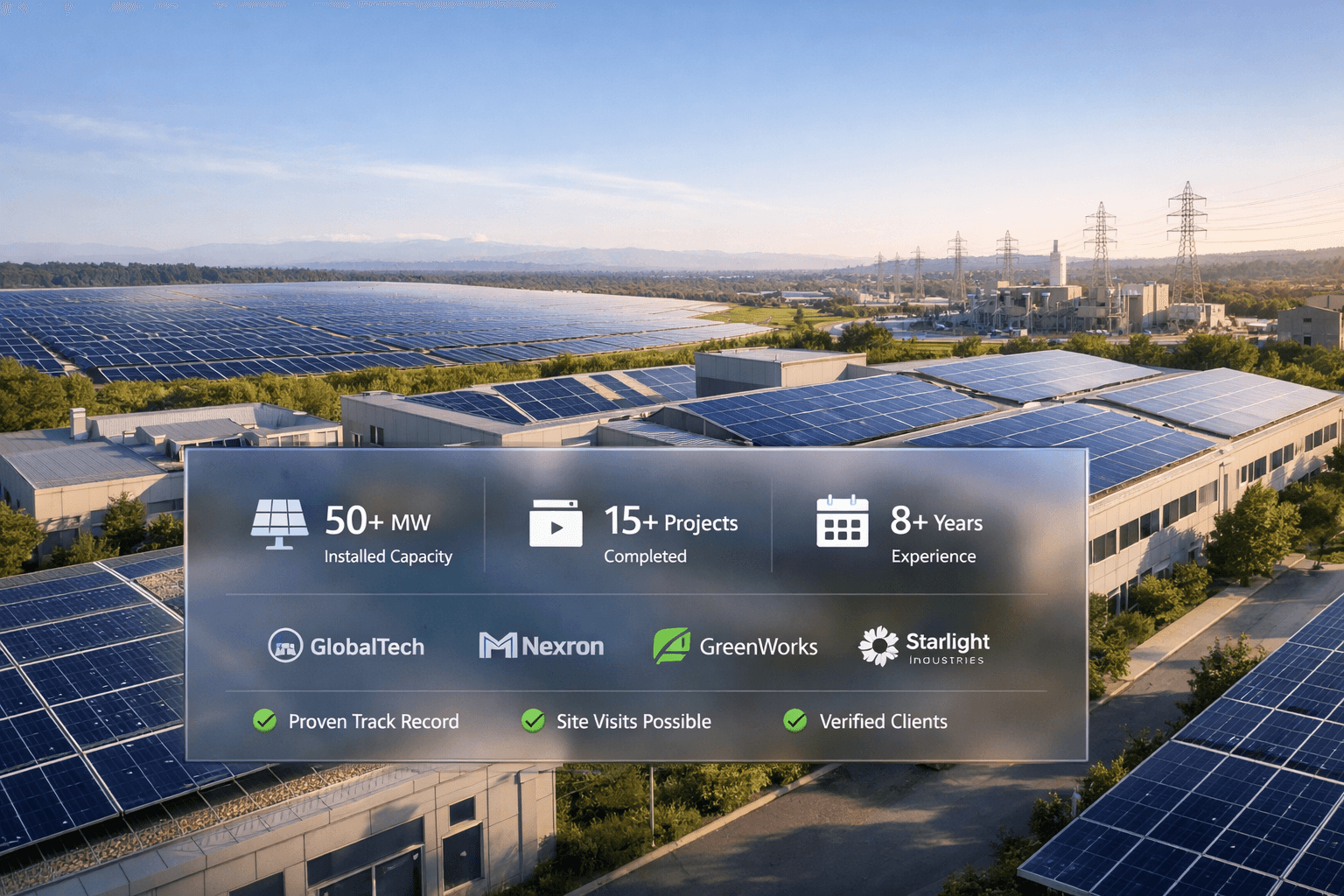
Projects like the 80 MW ground mount installations and 2 MW commercial rooftop systems demonstrate scale capability. Verify if they've handled similar capacity and complexity as your requirement.
Red Flag: Companies outsourcing design work cannot customize solutions for your specific needs.
What to Verify:
In-house design and engineering team
Site-specific shadow analysis capability
Load optimization experience
Multi-MPPT inverter design knowledge
Battery storage integration skills (if needed)
Ask to see detailed engineering drawings from previous projects. Quality EPC companies provide component-level specifications with transparent quotations showing every item from A to Z.
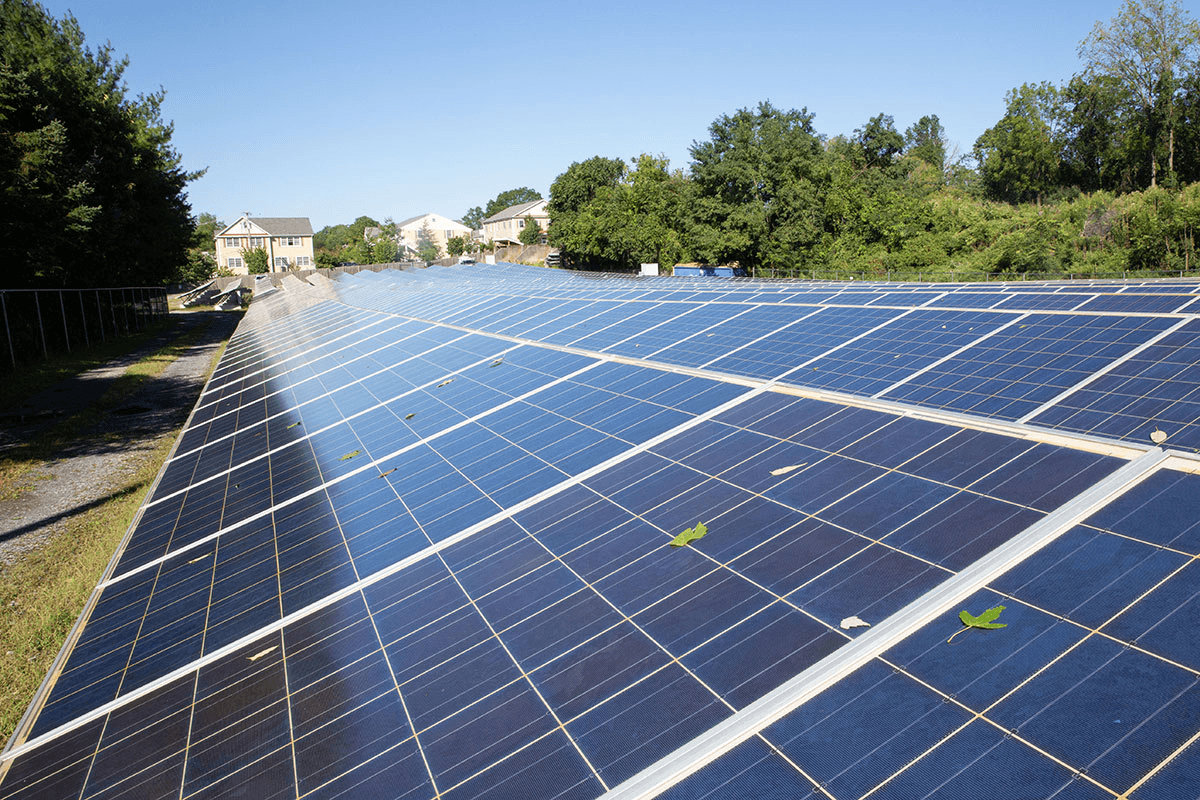
Your system's 25-year performance depends entirely on component quality.
Panel Requirements:
Tier-1 manufacturers only (Longi, JA Solar, Trina, Jinko)
Minimum 21% efficiency rating
Maximum 0.45% annual degradation
25-year linear performance warranty (not just product warranty)
Inverter Standards:
Minimum 97% efficiency (top systems achieve 98.6%)
10-year manufacturer warranty minimum
Real-time monitoring capability
Proven service network in India
Learn more about selecting the right inverter capacity and technology for your commercial setup.
Ask your EPC: "Who supplies your panels and inverters?" Then verify directly with those manufacturers about warranty support.
This protects you from legal and financial risks down the road.
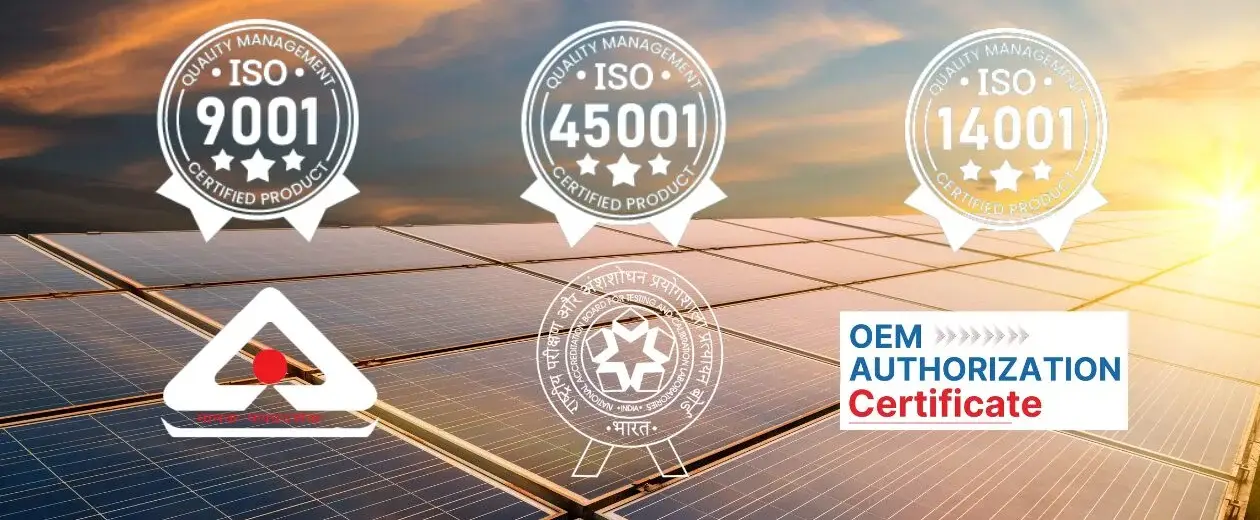
Must-Have Certifications:
MNRE empanelment for subsidy eligibility
ISO 9001 (Quality Management)
ISO 50001 (Energy Management)
BIS certification for components
Valid electrical contractor license
State DISCOM approvals
Companies handling documentation end-to-end, including subsidy claims, DISCOM updates, and grid approvals, save you 60-90 days of bureaucratic delays.
An EPC company going bankrupt in year 3 leaves you with zero warranty support.
Financial Health Indicators:
Minimum 5 years of profitable operations
Positive cash flow statements
Bank credit lines for project financing
Professional indemnity insurance
Performance guarantee bonds
Request financial references. Established players like those with 9+ years in renewable energy and partnerships with organizations like Mahindra Sustain demonstrate stability.
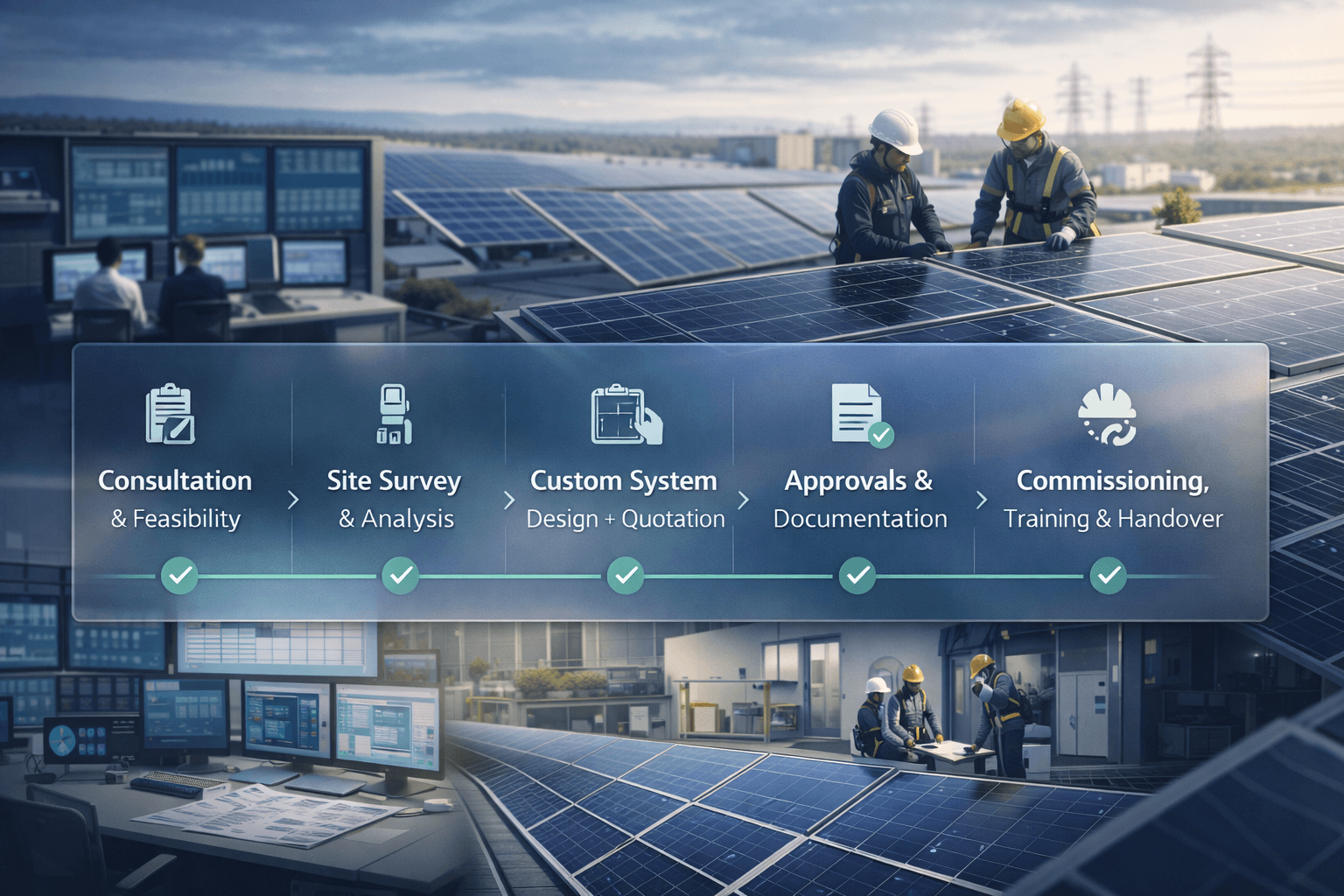
Quality EPC companies don't skip steps. Look for a proven 6-stage process that covers:
Pre-Installation (Steps 1-4):
Initial consultation with energy audit and feasibility study
Detailed site survey (roof capacity, shading, electrical setup)
Custom system design with transparent, itemized quotations
Complete documentation handling (subsidies, DISCOM approvals, net metering)
Execution & Handover (Steps 5-6):
Professional installation with certified technicians and safety protocols
Minimal disruption through phased scheduling during off-peak hours
Thorough commissioning with grid integration testing
Staff training and monitoring system activation
Discover how EPC companies assess and design commercial solar systems for maximum efficiency.
What to Ask: "Walk me through your end-to-end process from first call to final handover. Who handles approvals and documentation?"
Installation is just 10% of the journey. The remaining 90% is operations.
Essential O&M Features:
Long-term Annual Maintenance Contracts (AMC)
Real-time SCADA monitoring systems
Smartphone app for performance tracking
Preventive maintenance schedules
24-48 hour response time commitments
Spare parts availability
Advanced systems offer AI-driven predictive maintenance, alerting you to issues before they cause downtime. Monitoring systems should track generation, savings, and carbon reduction in real-time.
Delays cost money. Every month of delay equals one month of lost savings.
Realistic Timelines:
500 kW rooftop: 45-60 days
1-2 MW commercial: 90-120 days
5+ MW ground mount: 150-180 days
Explore our completed commercial and industrial projects with verified timelines and capacities.
Ask for milestone-based execution plans. Quality EPCs complete residential installations in a few days with minimal disruption and commercial projects in phased approaches.
Business decisions require board-level financial justification.
What Your EPC Should Provide:
Detailed payback period calculations (typically 5-7 years)
NPV and IRR analysis
25-year cash flow projections
Cost reduction estimates (30-40% typical for commercial)
Sensitivity analysis for different scenarios
Read our detailed guide on CAPEX vs. RESCO: Which Solar Financing Model is Right for Your Business? to determine which approach maximizes your tax benefits and cash flow.
For corporate clients, ESG metrics matter as much as ROI.
ESG Support Services:
Carbon footprint reduction quantification
ESG reporting assistance for annual reports
CDP disclosure support
RE100 commitment tracking
ISO 50001 certification guidance
Green building certification assistance
Leading EPCs help clients achieve sustainability ratings improvements and Science-Based Targets alignment.
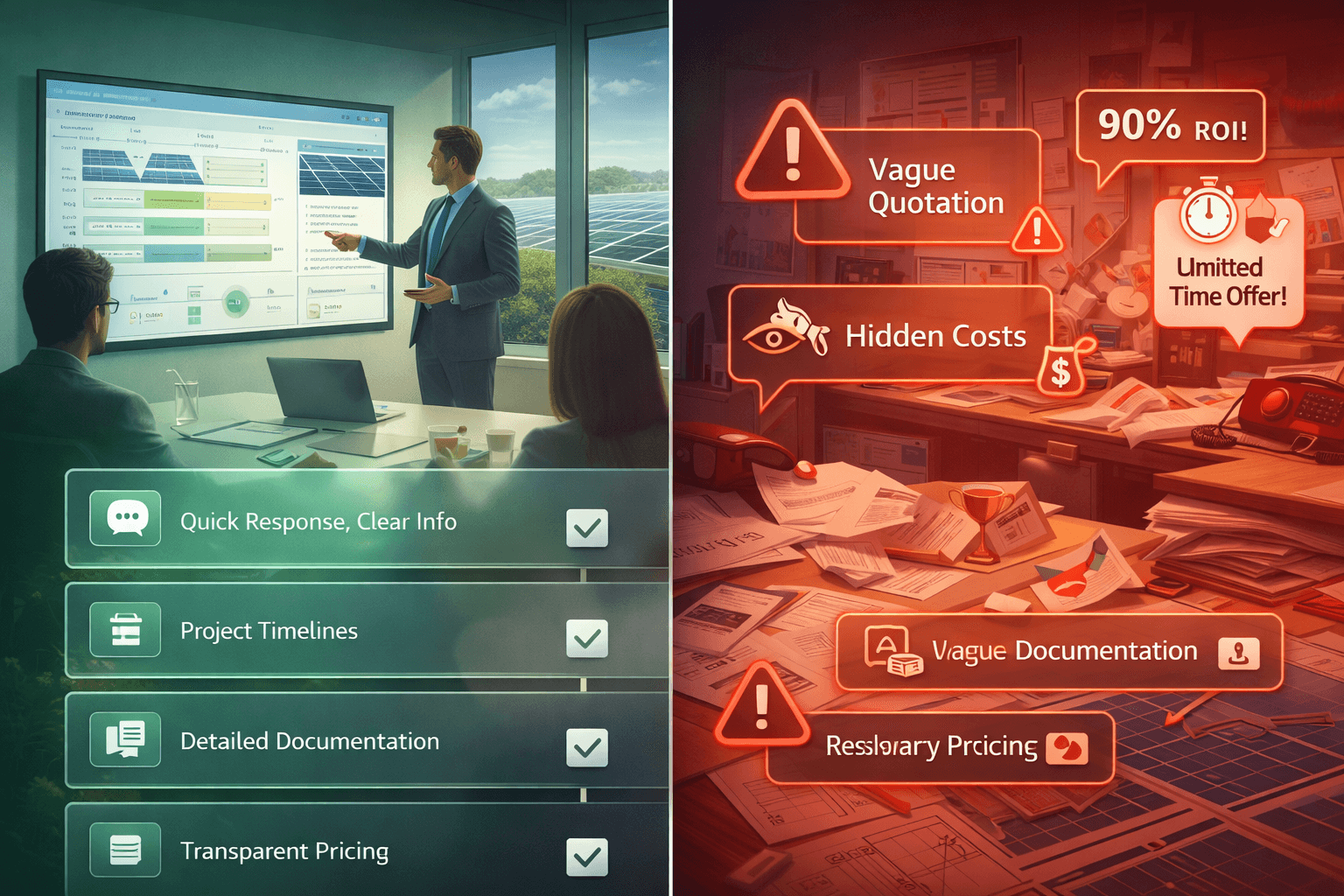
Poor communication kills projects.
What to Observe:
Response time to initial inquiries
Clarity in explaining technical concepts
Willingness to share detailed documentation
Transparency about challenges and limitations
Single point of contact assignment
Companies stating "no sales pressure, just honest guidance" and "transparent pricing with no hidden costs" demonstrate customer-first approaches.
Immediate Disqualifiers:
Pricing 30%+ below market average (quality compromise)
No verifiable project references
Outsourcing critical design work
Vague warranty terms
Unrealistic performance promises
Pressure tactics for immediate signing
No clarity on post-installation support
How many MW have you commissioned in the last 3 years?
Can you provide 5 reference projects with client contacts in my industry?
What panel and inverter brands do you use, and why those specifically?
Do you have in-house engineering teams or outsource design work?
What is your typical payback period for projects similar to mine?
What warranties cover installation workmanship versus component defects?
What is your guaranteed O&M response time, and how do you handle emergency breakdowns?
How do you minimize business disruption during installation?
Pro Tip: Companies that hesitate or provide vague answers to these questions should be eliminated immediately.
Score each shortlisted EPC on:
Experience and track record (0-10)
Technical capability (0-10)
Component quality (0-10)
Financial stability (0-10)
O&M commitment (0-10)
Pricing competitiveness (0-10)
Communication quality (0-10)
Reference validation (0-10)
Total scores above 70/80 indicate strong candidates.
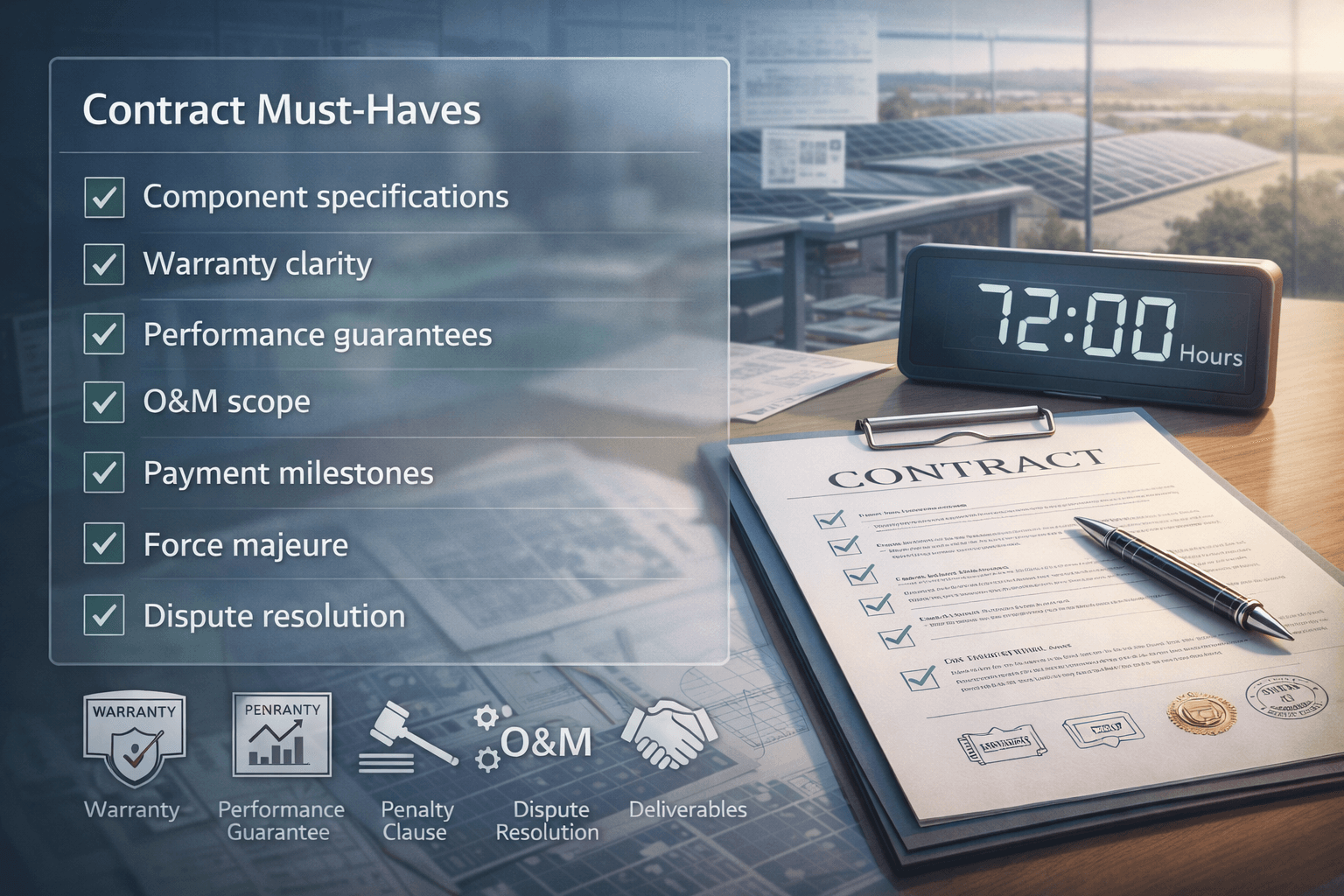
After meeting with an EPC company, wait 72 hours before signing. This cooling-off period helps you avoid pressure tactics and make rational decisions based on your checklist evaluation.
Before signing, ensure your contract includes:
Detailed component specifications with model numbers
Clear warranty terms for each component
Performance guarantees with penalty clauses
O&M scope and response times
Payment milestones tied to deliverables
Force majeure clauses
Dispute resolution mechanisms
Ready to choose your solar EPC partner? Use this 12-point checklist to evaluate vendors systematically.
Your Next Steps:
Request detailed proposals from 3-4 qualified EPCs
Score each company using the comparison matrix (aim for 70+ out of 80)
Visit their operational project sites
Call their existing commercial clients for honest feedback
Need Expert Support? Look for EPC providers offering end-to-end services from initial consultation to long-term O&M, with transparent pricing, certified installations, and verifiable project portfolios.
The right partner ensures your solar investment delivers consistent returns throughout its 25-year lifespan.
For commercial projects above 500 kW, look for EPCs with at least 50 MW cumulative installed capacity and 10+ similar-scale projects in your industry. This ensures they have the technical and financial capability to handle your installation without execution risks.
Demand minimum 25-year linear performance warranty from Tier-1 panel manufacturers, ensuring at least 80% capacity after 25 years. Additionally, get 10-year product defect warranty and separate installation workmanship warranty from your EPC for 5-10 years.
Most commercial solar projects in India achieve payback in 5-7 years, depending on electricity tariffs, capacity utilization, and system quality. Projects in high-tariff states like Maharashtra or with heavy daytime consumption see faster payback of 4-5 years.
Choose CAPEX if you have available capital and want to own the asset, claiming depreciation benefits and maximum long-term savings. Opt for PPA (Power Purchase Agreement) if you prefer zero upfront investment and fixed per-unit rates lower than grid tariff, though total savings over 25 years will be less.
MNRE empanelment is critical if you plan to claim any government subsidies or incentives, as only MNRE-registered vendors qualify. Even without subsidies, MNRE listing indicates the company has met basic quality and financial criteria, reducing your vendor risk significantly
FAQS
Can't find the answer you're looking for? Our team is here to help.
SUBSCRIBE NEWSLETTER
Switching to solar is easier than you think. Let us guide you to cleaner, more affordable energy.
