Solar for Factories
Solar for Factories: Cut Power Costs by 40%
2026-02-20T00:00:00.000Z•8
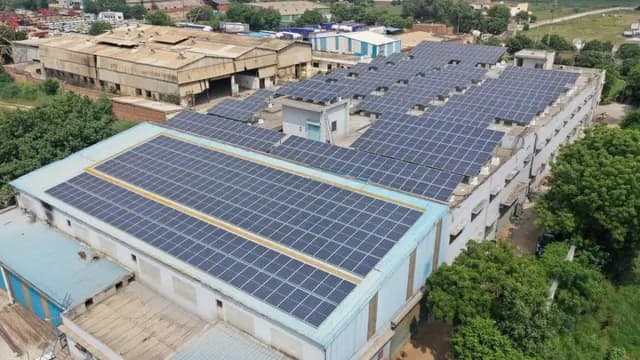
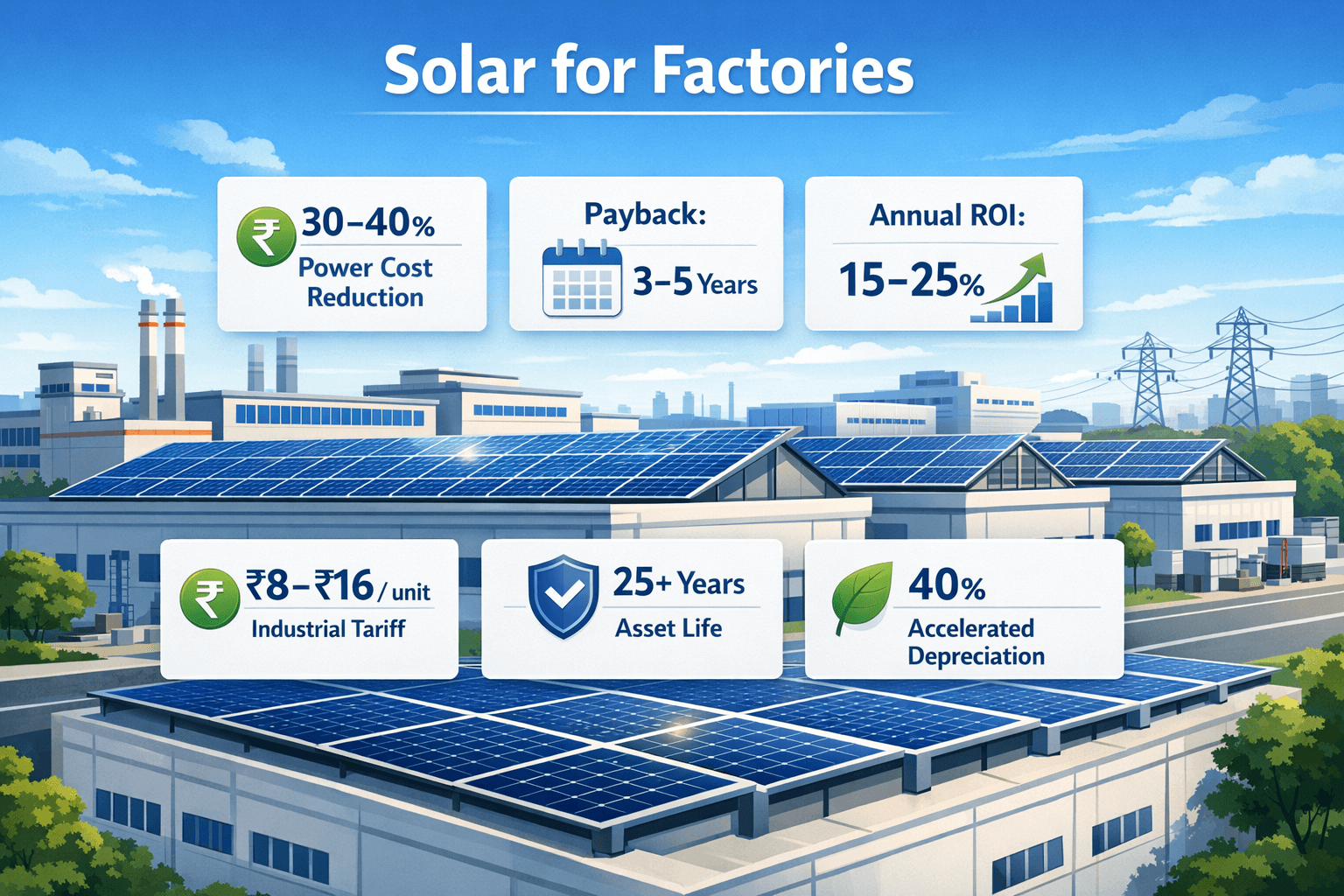
Manufacturing units can reduce power expenses by 30% to 40% through commercial solar installations, with payback periods ranging from 3 to 5 years and annual ROI between 15% and 25%.
Professional installation completes in 4 to 6 weeks with zero disruption to ongoing production operations
Average payback period is 3 to 5 years with 25+ years of operational life
Industrial electricity tariffs in India range from ₹8 to ₹16 per unit
Wave inverters deliver up to 98.6% efficiency for commercial applications
Factories qualify for 40% accelerated depreciation, reducing tax liability significantly
This analysis draws from real commercial solar projects including 2 MW installations at manufacturing facilities and 170 kW textile units successfully deployed in Gujarat.
With electricity tariffs rising 6% to 8% annually and manufacturing margins under pressure, 2025 presents the optimal window for solar adoption.
The insights presented are based on verified installation data, current industrial tariff structures, and financial modeling from operational commercial systems across energy-intensive industries.

Industrial electricity represents 15% to 40% of total manufacturing costs depending on the sector. Commercial tariffs have reached ₹12 to ₹16 per unit in many regions, with additional demand charges adding 20% to 30% to monthly bills.
Grid electricity costs increase year after year with no ceiling. A factory spending ₹12 lakhs monthly faces ₹1.44 crore in annual power expenses.
Over five years, this exceeds ₹7.2 crore before accounting for rate hikes.
Explore
rooftop solar benefits for commercial facilities
to understand long-term cost stability advantages
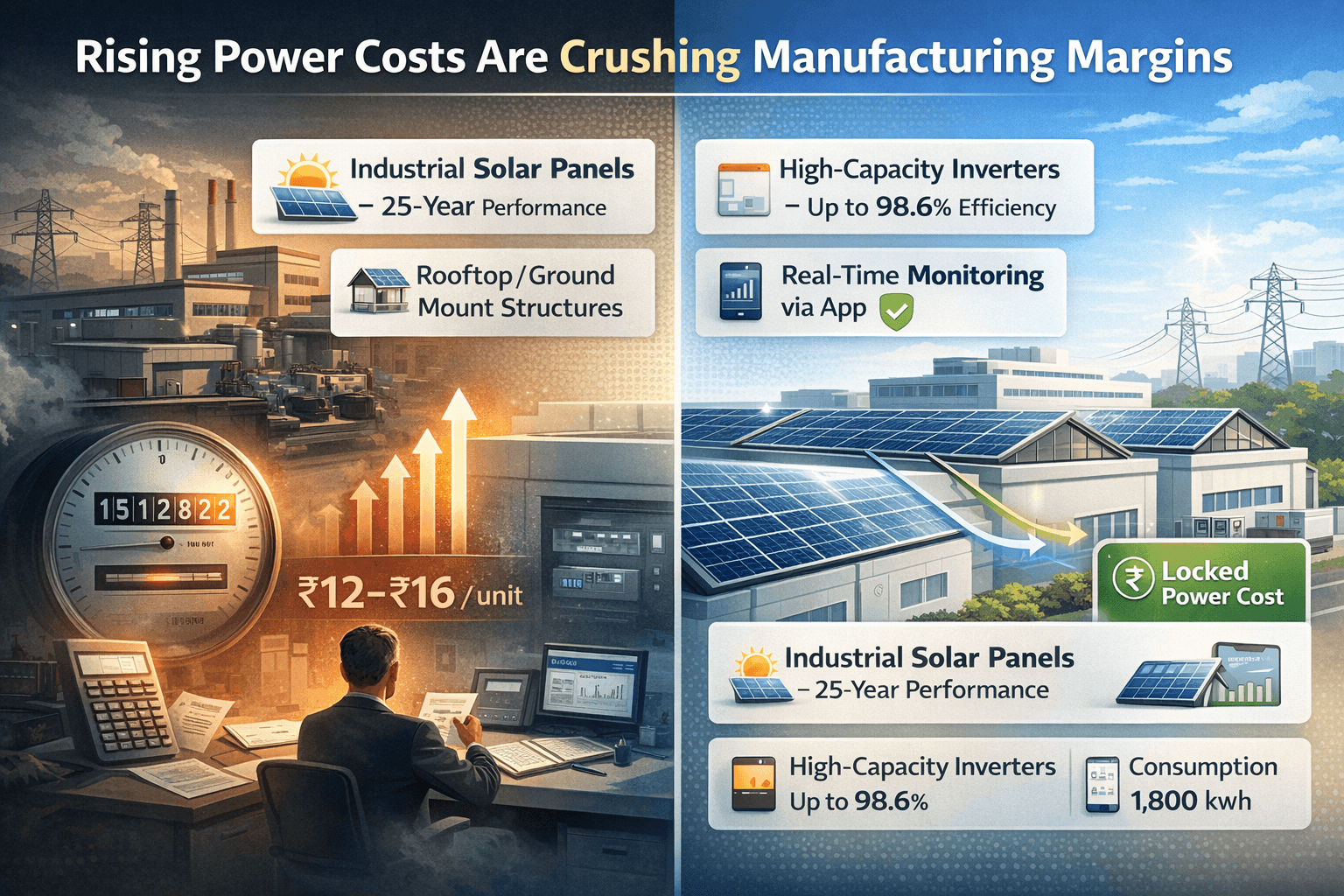
Commercial solar installations are engineered specifically for high-energy demands of factories, warehouses, and industrial facilities.
Solar panels
: Industrial-grade modules with 25-year performance warranties generating consistent output
High-capacity inverters
:
Wave string inverters from 5 kW to 25 kW
with up to 98.6% conversion efficiency
Mounting structures
: Engineered for rooftops or ground mount installations optimized for maximum sun exposure
Monitoring systems
: Real-time dashboards tracking generation, consumption, and savings via smartphone apps
Modern solar systems generate free electricity after installation. A 500 kW system produces 1,750 to 2,000 units daily, meeting substantial portions of factory load requirements.
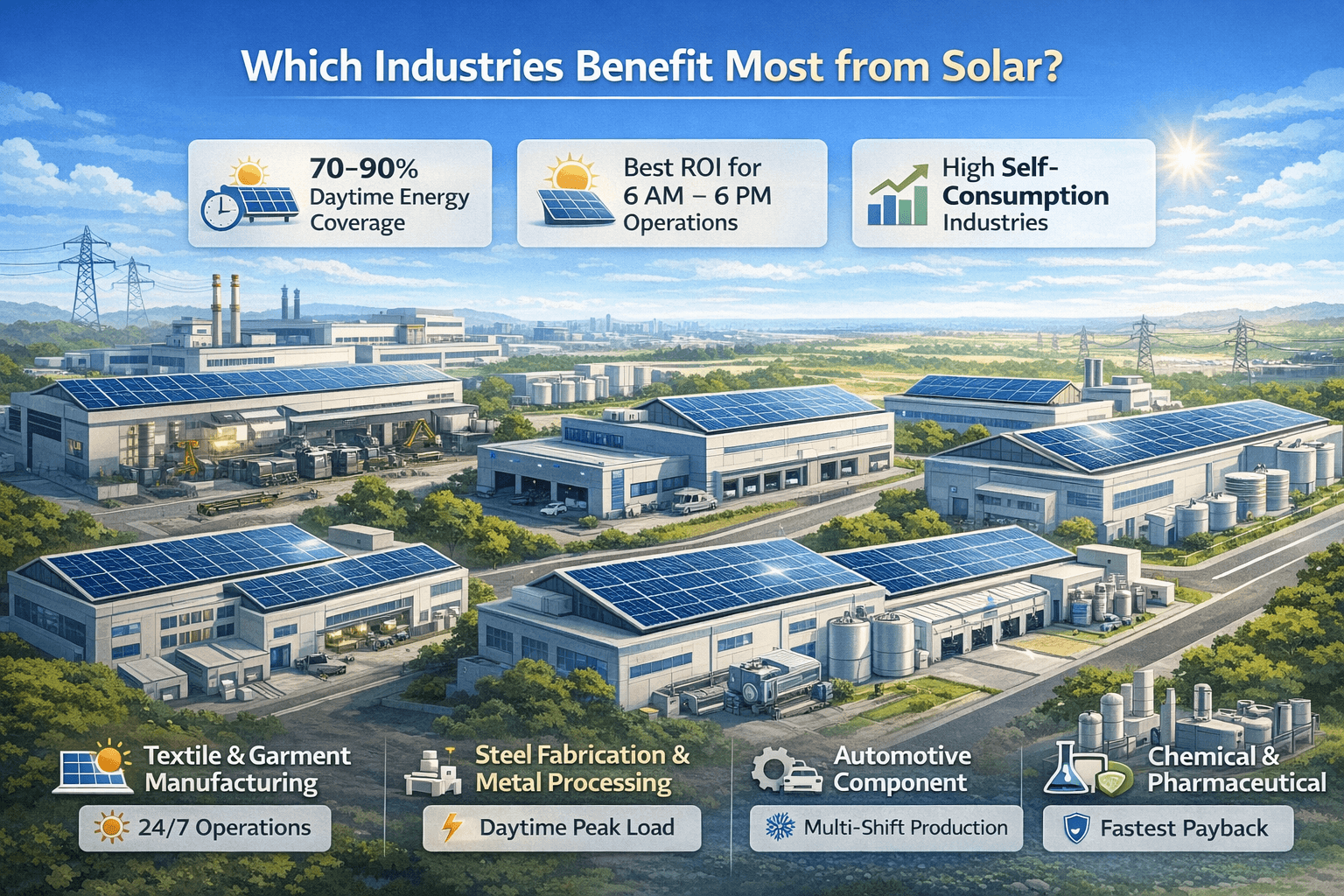
Commercial solar installations deliver maximum value for facilities with consistent daytime operations and high energy consumption.
Textile and garment manufacturing
: 24/7 operations with heavy machinery loads align perfectly with solar generation patterns
Steel fabrication and metal processing
: Peak demand during daylight hours reduces grid dependency by 60% to 70%
Automotive component manufacturing
: Multi-shift operations ensure high solar utilization rates
Food processing and cold storage
: Continuous refrigeration loads match solar output cycles, maximizing self-consumption
Chemical and pharmaceutical
: Process industries with daytime production schedules achieve fastest payback periods
Factories operating 6 AM to 6 PM see the highest returns, with solar meeting 70% to 90% of daytime energy needs
Real-world installations demonstrate measurable financial impact.
A 500 kW installation generates annual savings of ₹45 lakhs to ₹90 lakhs depending on tariff rates
Facilities spending ₹2 crore annually save ₹60 lakhs to ₹1.4 crore per year
Across a 25-year lifespan, a 1 MW solar plant can generate cumulative savings of more than ₹25 crore.
Monthly savings of ₹7.2 lakhs for units currently spending ₹12 lakhs on electricity
A textile manufacturing unit with a 170 kW system reduces power expenses by 30% to 40%, improving EBITDA without operational changes.
Commercial solar often generates returns that surpass many traditional capital deployments.
System cost ranges from ₹35,000 to ₹50,000 per kW depending on configuration and location. For a 500 kW installation, total investment is approximately ₹1.75 crore to ₹2.5 crore.
Payback calculation example:
Monthly electricity bill: ₹12 lakhs
Monthly savings with solar: ₹7.2 lakhs (60% reduction)
Annual savings: ₹86.4 lakhs
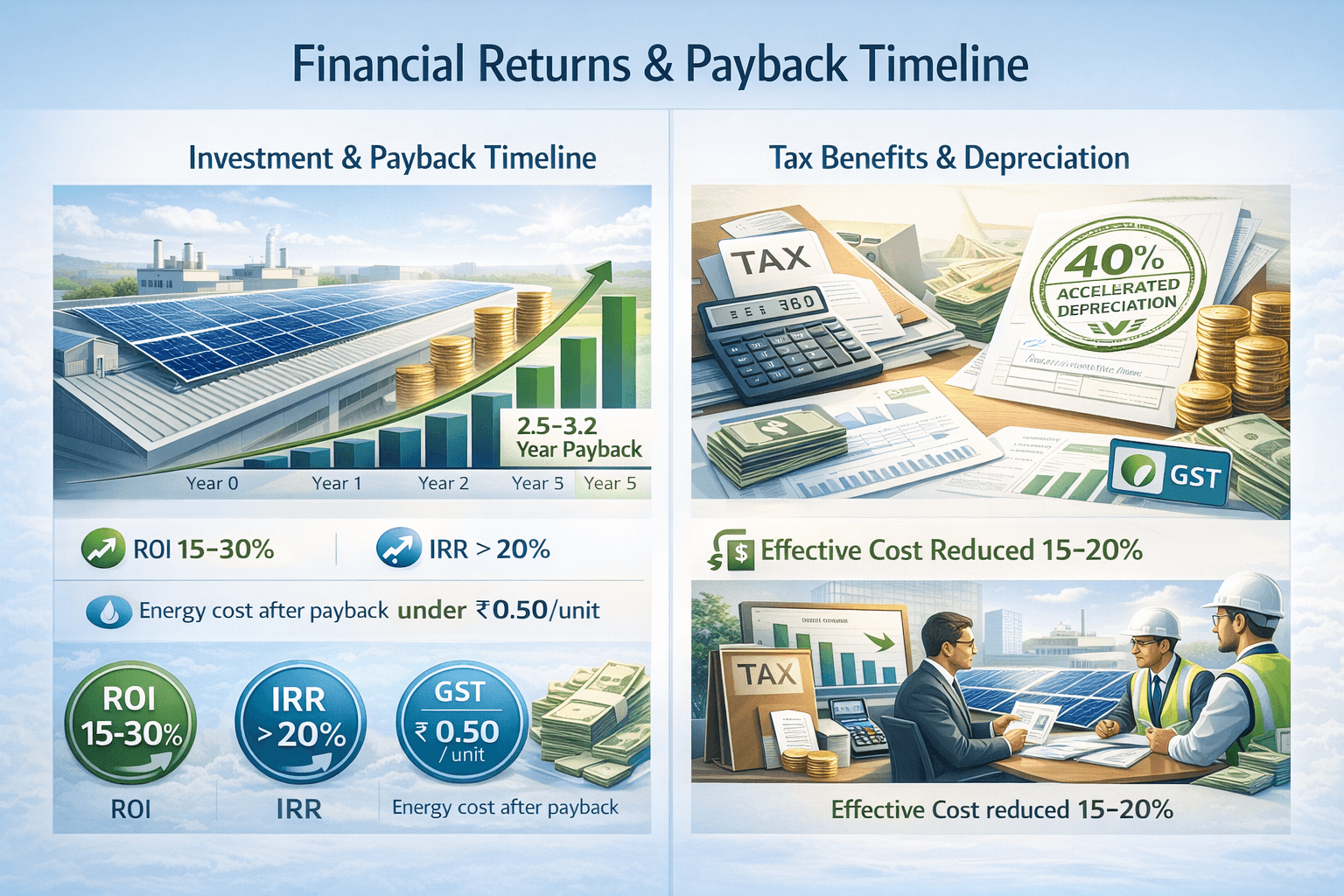
Payback period: 2.5 to 3.2 years
Annual ROI ranges from 15% to 30%
Internal rate of return (IRR) frequently exceeds 20%
Post-payback energy costs drop to maintenance levels (under ₹0.50 per unit)
20+ years of virtually free electricity after investment recovery
Discover how to calculate and maximize your solar energy savings with detailed ROI frameworks.
Commercial installations qualify for significant tax incentives not available to residential consumers.
Industries can claim 40% accelerated depreciation in the first year, substantially reducing taxable income. This benefit alone reduces the effective system cost by 15% to 20%.
Example: A ₹2 crore solar installation allows ₹80 lakh depreciation in year one, saving approximately ₹20 to ₹25 lakh in taxes at standard corporate rates.
GST input credits on solar equipment further improve project economics, making the all-in cost significantly lower than the sticker price.
Solar systems adapt to various industrial configurations.
Rooftop solar systems are ideal for manufacturing facilities with 5,000+ square feet of available roof space.
Utilize otherwise unused space
Require no additional land acquisition
Complete installation without production disruption
Generate power closest to consumption points
Ground-mounted solar systems are perfect for facilities with available land or limited roof structural capacity:
Easier maintenance access
Scalability up to multi-megawatt capacity
Optimal panel orientation regardless of building design
Flexibility for future expansion
Earthwave Solar has successfully deployed both configurations, including an 80 MW ground mount project and multiple rooftop installations ranging from 120 kW to 2 MW.
Professional EPC partners address potential obstacles before they impact your project timeline.
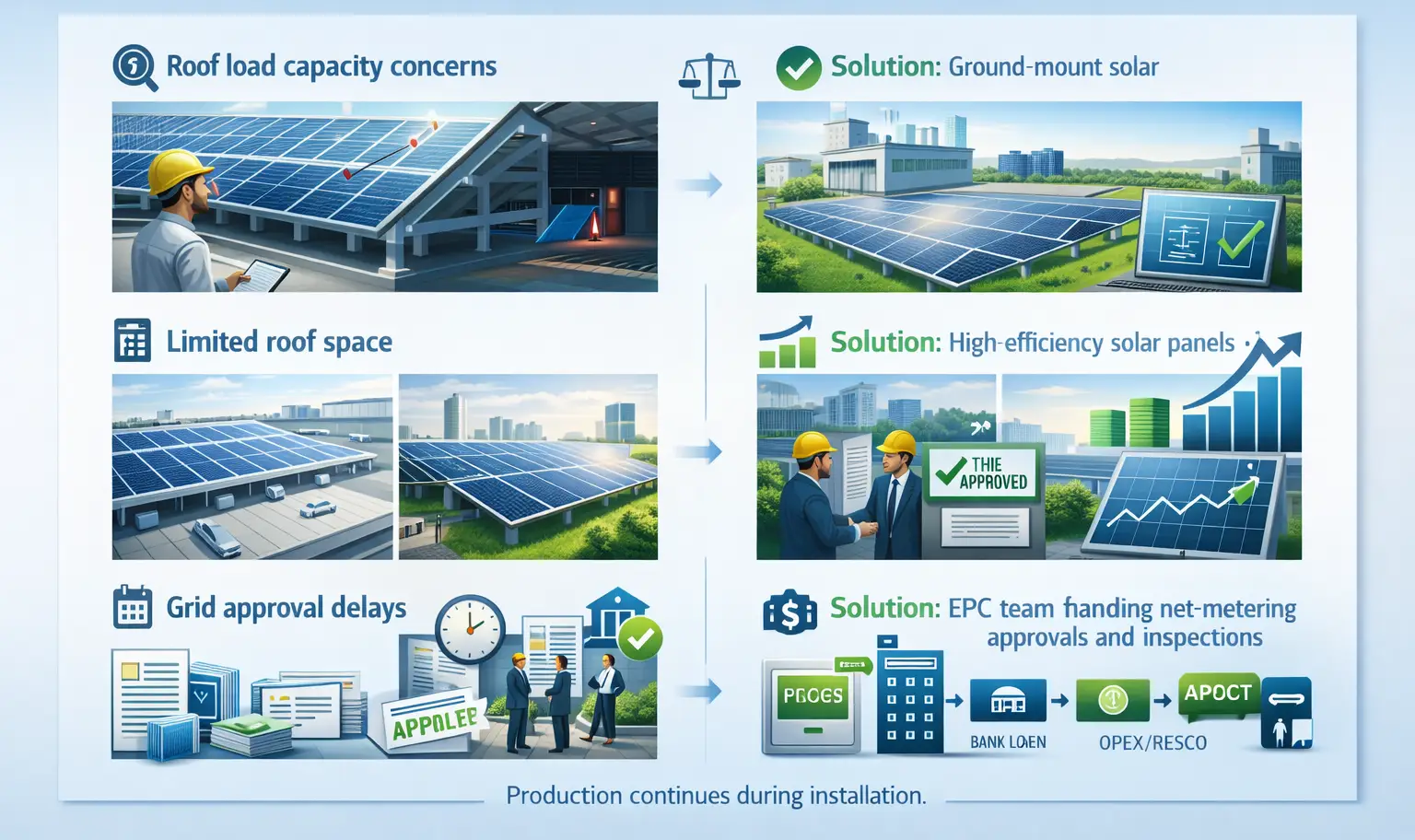
Industrial buildings built before 2010 may require structural assessment. Ground-mount systems provide full alternative without roof modifications.
High-efficiency panels and vertical mounting solutions maximize output from constrained areas. A 250 kW system fits in approximately 25,000 square feet.
Experienced EPC providers handle utility coordination, net metering applications, and inspections. Complete approvals typically require 6 to 12 weeks.
Not sure if your facility has adequate space?
Read our complete guide to understanding solar installation requirements."
Grid dependency creates operational vulnerability that solar addresses directly.
Solar systems with battery storage maintain critical operations during power disruptions. Manufacturing lines remain operational while competitors face downtime.
Smart inverters with MPPT technology manage load intelligently, provide remote monitoring, and detect faults automatically, ensuring consistent power quality.
Commercial systems include comprehensive monitoring platforms accessible via smartphone or desktop.
Live energy production data across all arrays
Consumption tracking by production line or zone
Cost savings calculations updated in real-time
System health alerts with predictive maintenance notifications
Historical performance analytics for reporting and optimization
Wave On Grid inverters feature built-in monitoring with RS485, WiFi, LAN, and optional 4G connectivity for seamless data access.
Real installations demonstrate system performance and reliability.
True Colors, Palsana
: 2 MW digital printing facility
Pari Textile, Diamond Nagar
: 170 kW textile manufacturing
Sahaj Textile, Sachin
: 120 kW industrial installation
View our complete portfolio of commercial solar projects across manufacturing, textile, and industrial sectors.
Solar adoption delivers quantifiable sustainability metrics for corporate reporting.
A 250 kW solar installation can produce more than 230,000 units of electricity per year while cutting nearly 55 tonnes of annual carbon emissions.
Over 25 years, a single 1 MW installation prevents 33,750 tonnes of emissions.
Manufacturing units increasingly require verified sustainability credentials for supply chain participation, regulatory compliance, and stakeholder confidence.
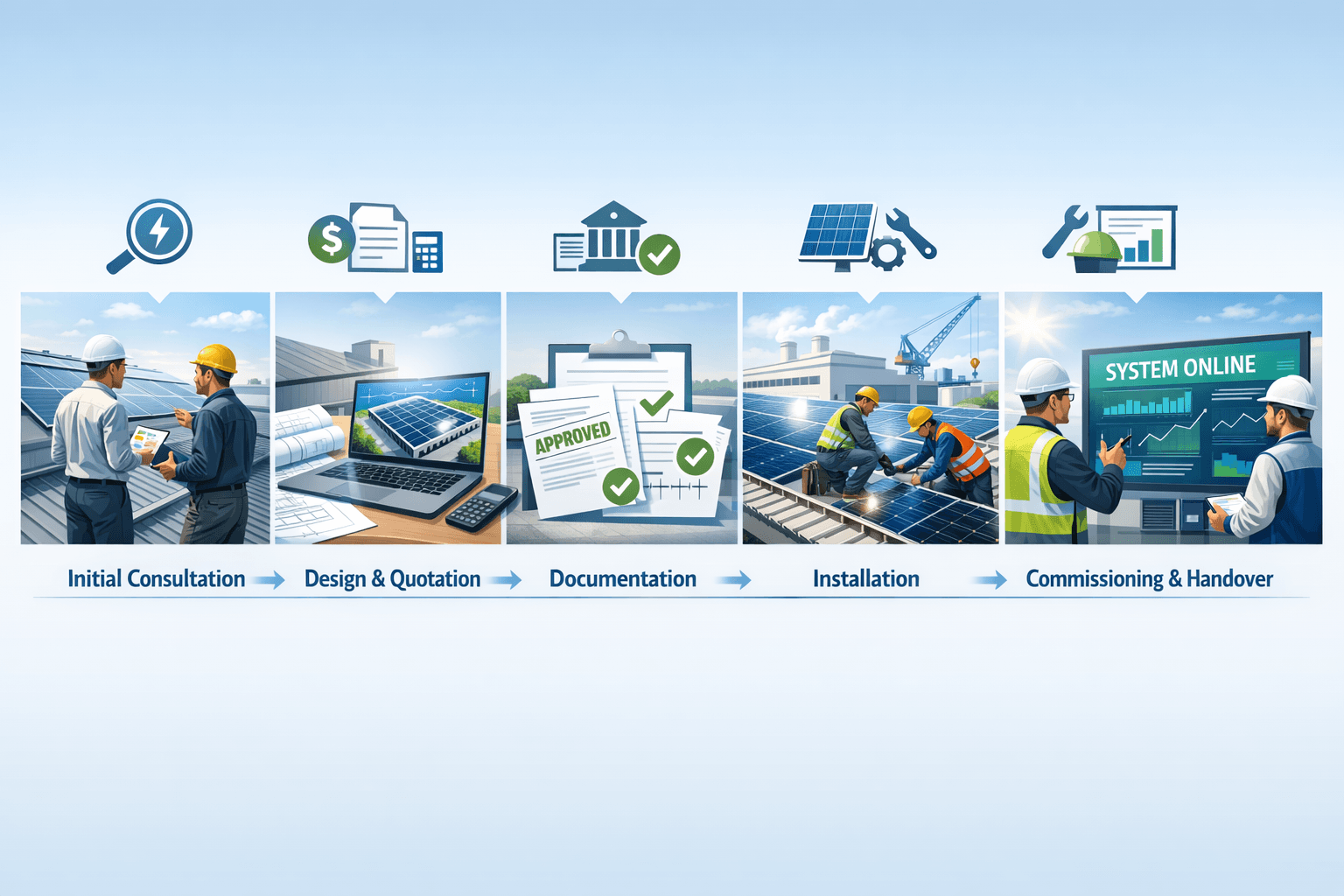
Professional installation ensures zero production disruption.
Site energy assessment and consumption analysis determine optimal system size and configuration. Learn more about our EPC approach and project methodology.
Detailed system design with transparent pricing covering every component from panels to commissioning. No hidden costs.
Complete handling of utility approvals, grid connection paperwork, and subsidy applications where applicable.
Certified technicians complete installation while production continues uninterrupted. Most factory installations finish within 4 to 6 weeks.
Technical engineers conduct thorough system checks, provide operational training, and ensure monitoring platforms are active.
Solar represents strategic capital allocation with verified returns.
Capital requirement
: ₹35,000 to ₹50,000 per kW
Payback period
: 3 to 5 years
Annual ROI
: 15% to 30%
Operational life
: 25+ years with minimal maintenance
Post-payback energy cost
: Under ₹0.50 per unit
These returns exceed traditional investments while simultaneously reducing operational expense, improving margins, and meeting sustainability requirements.
Commercial solar has evolved from environmental initiative to essential cost-reduction strategy delivering verified financial results.
With 3 to 5 year payback periods, 15% to 30% annual returns, and 25-year operational life, solar represents one of the strongest capital investments available to manufacturing units today.
Get a customized solar assessment for your facility.
Contact our commercial solar team at +91 90336 07212 or schedule a facility assessment to receive a customized financial analysis.
System size depends on monthly electricity consumption. A facility using 50,000 units monthly typically requires 300 to 500 kW capacity. Professional site assessment determines optimal sizing based on roof space, consumption patterns, and budget.
Yes, solar panels generate electricity even on cloudy days, though output reduces by 20% to 40% compared to sunny conditions. Annual generation calculations account for seasonal variation, ensuring ROI projections remain accurate.
No, professional EPC companies complete rooftop installations without halting operations. Most factory systems install within 4 to 6 weeks with work scheduled around production schedules.
Minimal maintenance includes panel cleaning every 2 to 3 months and annual inverter inspections. Total maintenance costs remain under ₹0.50 per unit generated over the system's lifetime.
Yes, net metering allows facilities to earn credits for surplus generation fed to the grid. This creates additional value beyond direct consumption and improves overall system economics.
FAQS
Can't find the answer you're looking for? Our team is here to help.
SUBSCRIBE NEWSLETTER
Switching to solar is easier than you think. Let us guide you to cleaner, more affordable energy.
