Corporate Solar ESG
Solar for IT Parks & Corporate Offices | ESG Explained
2026-04-02T00:00:00.000Z•8
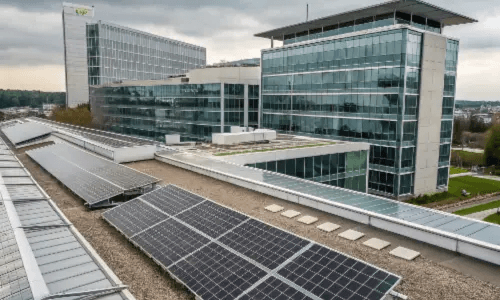
Installing solar on your corporate office or IT campus directly reduces Scope 2 emissions, strengthens your ESG report, and cuts electricity costs by 30–40%.
It is one of the few investments that delivers measurable sustainability outcomes and hard financial returns at the same time.
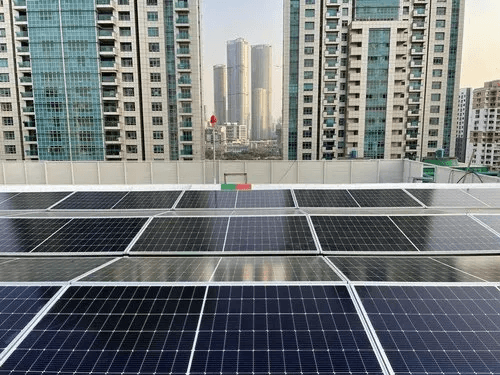
Scope 2 emissions come from purchased grid electricity; solar replaces grid power with clean energy, directly reducing that number
Corporate offices and IT parks can cut electricity bills by 30–40% and achieve full ROI in 5–7 years with a commercial rooftop solar system
Solar generation data integrates directly into ESG sustainability reports under frameworks like GRI, BRSR, and net-zero targets
IT parks with 200 to 2000 employees face the highest ESG compliance pressure from investors, global clients, and regulatory bodies
Earthwave Solar provides end-to-end commercial solar EPC services designed for office complexes and corporate campuses
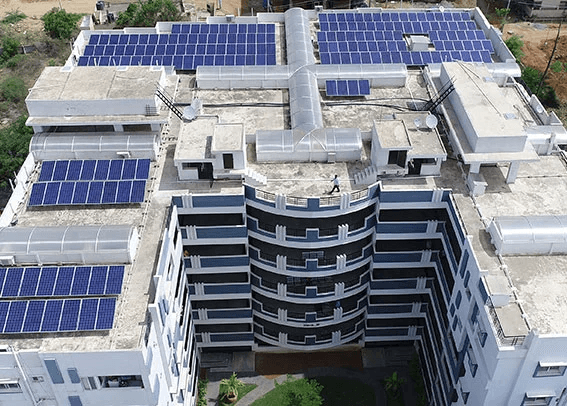
Scope 2 emissions are the indirect greenhouse gas emissions a company produces by consuming purchased electricity, and they are the single largest emission category for most office-based businesses.
The GHG Protocol, the globally accepted standard for corporate carbon accounting, classifies emissions into three scopes:
Scope 1: Direct emissions from owned sources like diesel generators or company vehicles
Scope 2: Indirect emissions from purchased grid electricity, heat, or steam
Scope 3: All other indirect emissions across the value chain
For IT parks and corporate offices, Scope 2 is the dominant category. Your servers, air conditioning, lighting, and office equipment all run on grid electricity.
Every unit you draw from the grid carries a carbon emission factor assigned by your national or regional electricity grid.
Solar eliminates the need to purchase that electricity. No purchased units, no Scope 2 emissions for the energy your solar system covers.
Every unit of solar energy your building consumes is one unit you did not buy from the grid, which directly reduces your Scope 2 emissions figure.
Here is the calculation logic:
A 200 kW rooftop solar system in Gujarat generates approximately 2,60,000 to 2,80,000 kWh annually
At a grid emission factor of 0.716 kg CO2 per kWh, that equals approximately 186 to 200 tonnes of CO2 avoided per year
Over a 10-year reporting period, the same system prevents approximately 1,860 to 2,000 tonnes of Scope 2 emissions
Your purchased electricity figure drops in absolute terms
Your Scope 2 emissions decline proportionally
You can report both market-based and location-based Scope 2 figures with solar as a clear reduction driver
If you hold Renewable Energy Certificates (RECs) or use Power Purchase Agreements (PPAs), you can claim zero Scope 2 for the corresponding units under the market-based method
This is not just a reporting exercise. Global clients, foreign investors, and sustainability rating agencies such as MSCI ESG, CDP, and Sustainalytics actively evaluate Scope 2 reduction trajectories when assessing corporate sustainability performance.
Solar generates quantifiable, verifiable data that feeds directly into the most widely used ESG and sustainability reporting frameworks.
GRI Standard 302 covers Energy. Solar installations allow you to report:
Total renewable energy consumed (GRI 302-1)
Reduction of energy consumption due to conservation initiatives (GRI 302-4)
Energy intensity per employee or per square meter of office space (GRI 302-3)

SEBI mandates BRSR filings for the top 1000 listed companies in India. Solar directly supports:
Principle 6 disclosures on environmental responsibility
Energy consumption intensity metrics
Renewable energy percentage of total consumption
Companies committing to net-zero targets or SBTi-aligned pathways must show year-on-year Scope 2 reductions.
Solar is the most accessible and measurable action for office-based companies to demonstrate credible progress.
IT parks and corporate office complexes are among the highest electricity consumers per square meter in the commercial real estate sector, which is exactly why solar ROI is so strong for them.
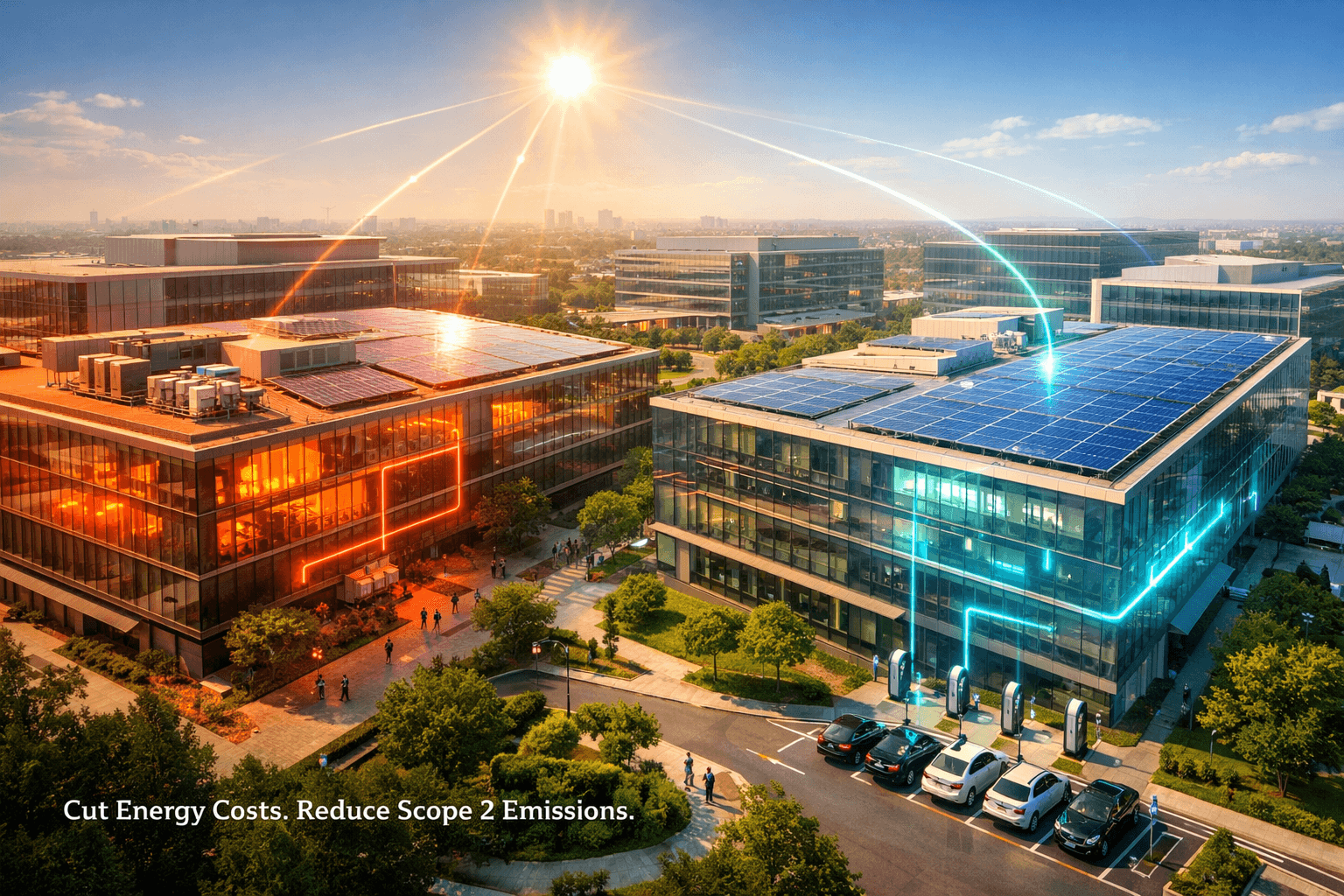
Consider what runs 24/7 in a typical IT campus:
Server rooms and data infrastructure
Centralized HVAC for large floor plates
24-hour lighting in common areas and security systems
EV charging points and building management systems
Cafeterias, gym facilities, and amenity spaces
Monthly electricity bills for IT parks and large office complexes range from Rs. 20 Lakhs to Rs. 200 Lakhs or more, depending on size and occupancy.
This scale of consumption is exactly where solar delivers the strongest cost savings. You are offsetting expensive grid units during peak daytime hours when your office is fully operational.
A well-designed commercial rooftop solar system for a corporate campus delivers full ROI in 5–7 years and generates free clean energy for 18–20 years after payback.
Building type:
4-floor corporate office, 500 employees
Monthly electricity consumption:
80,000 units
Grid tariff:
Rs. 9 per unit
Monthly electricity bill:
Rs. 7,20,000
Recommended solar system size:
250 kW to 300 kW rooftop
Year | Annual Saving (Approx.) | Cumulative Savings |
Year 1 | Rs. 25–30 Lakhs | Rs. 25–30 Lakhs |
Year 2 | Rs. 26–32 Lakhs | Rs. 51–62 Lakhs |
Year 3 | Rs. 28–34 Lakhs | Rs. 79–96 Lakhs |
Year 5 | Rs. 30–37 Lakhs | Rs. 1.3–1.6 Crore |
Assumptions: 30–40% bill reduction, 5% annual tariff escalation, net metering active.
40% accelerated depreciation
in Year 1 under Indian income tax rules reduces your net investment cost significantly
Net metering credits
offset grid bills during low-generation periods
Predictable energy cost
for 25 years removes electricity tariff risk from your financial planning
Green building certification
support, LEED or IGBC ratings are enhanced by on-site renewable energy
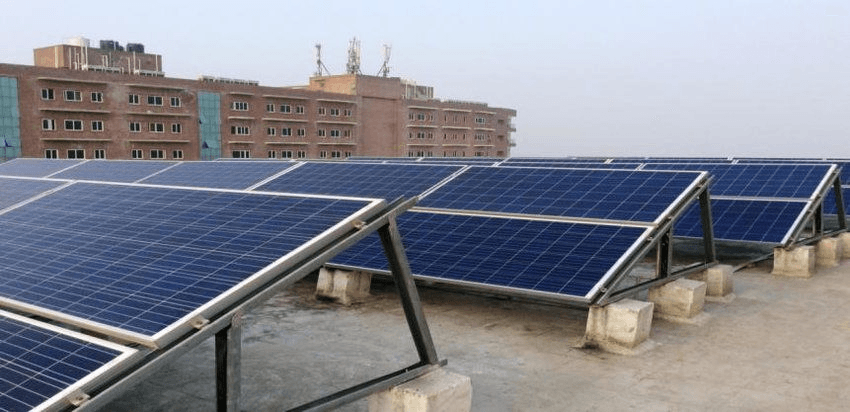
The right system design for a corporate office depends on rooftop area, load profile, shading conditions, and ESG documentation requirements, all of which a qualified EPC company evaluates during the site assessment.
Rooftop solar:
Most IT parks and office buildings have large, flat rooftops with significant shadow-free area, making rooftop systems the most practical choice
System monitoring:
Real-time monitoring dashboards give your Facilities Manager and Sustainability Head live generation data, which feeds directly into monthly ESG reporting
Inverter quality:
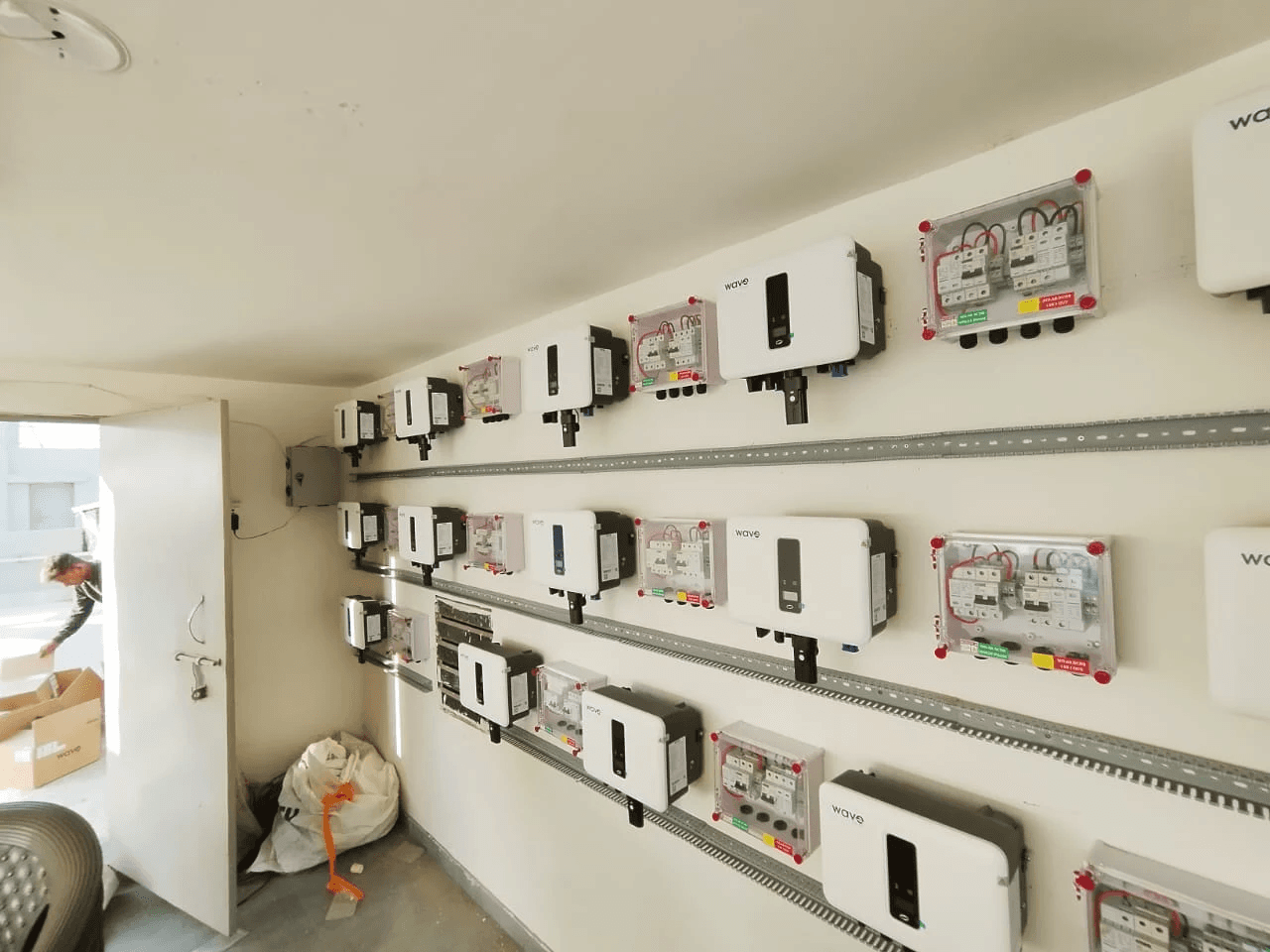
High-efficiency inverters ensure clean power conversion without voltage irregularities that could affect server rooms or sensitive office equipment
Scalability:
Systems can be designed in phases to match building expansion or tenant growth
For campuses where rooftop space is limited relative to consumption, a combination of rooftop and ground-mounted systems can be considered based on available land.
Earthwave Solar is a Gujarat-based full-spectrum EPC company with demonstrated expertise in commercial and industrial solar installations across India.
Founded in 2018, Earthwave has executed projects from small 30 kW rooftop systems to 80 MW ground mounts for clients including Mahindra Sustain, Goldi Solar, DGVCL, and Torrent Power.
Their team brings 9+ years of renewable energy experience to each project, ensuring system performance, documentation compliance, and long-term reliability.
Commercial and Industrial Solar
: High-demand systems that cut power expenses by 30–40% with real-time monitoring for ESG reporting
For campuses with available land beyond rooftop capacity
: In-house manufactured inverters with up to 97% efficiency, 2.5 kW to 125 kW range, 10-year warranty, and smart monitoring via smartphone
Initial Consultation: Energy needs assessment, no sales pressure
Site Visit and Consulting:Rooftop mapping, shadow analysis, electrical audit
Design and Quotation: Detailed system layout with itemized, transparent pricing
Documentation: All DISCOM, net metering, and subsidy paperwork handled
Installation: Certified technicians execute with precision
Final Handover: Full system briefing with monitoring setup and ongoing support
Clients including Goldi Solar, Torrent Power, and Cleantech Solutions consistently describe Earthwave as a reliable, ethical long-term partner.
If your monthly electricity bill exceeds Rs. 5 Lakhs and you have ESG reporting obligations, solar is both a financial and strategic priority.
Three questions to evaluate your readiness:
Does your organization report on ESG metrics to investors, clients, or regulators?
Is electricity one of your top three operational cost items?
Do you have rooftop space or land area that remains underused at your campus?
If you answered yes to all three, solar is the most direct action you can take to reduce Scope 2 emissions and cut energy costs in the same move.
Solar generation reduces your purchased electricity figure, which directly lowers your Scope 2 emissions under the GHG Protocol. Your real-time monitoring system provides verified generation data you can report under GRI 302, BRSR Principle 6, or any sustainability framework your company uses.
Yes. A properly designed on-grid solar system with high-quality inverters provides stable, clean power. Server rooms and sensitive equipment stay connected to the grid at all times, with solar reducing the grid draw rather than replacing it entirely.
Solar generation reduces on cloudy days but does not stop. Your system automatically draws more from the grid when solar output is lower. Annually, Gujarat's 300+ clear sunny days ensure your system meets projected generation targets.
Two main options exist: CAPEX (you own the system outright and claim accelerated depreciation) and RESCO or PPA models (a third party owns and operates the system, and you pay a fixed per-unit rate lower than grid tariff). Your EPC company can model both options based on your cash flow preferences.
A system of this size typically takes 3 to 6 weeks from documentation approval to final commissioning. Earthwave's process is designed for active commercial buildings, with zero disruption to office operations during installation.
If your organization is evaluating solar as part of your ESG or net-zero strategy, Earthwave Solar's team can assess your campus, calculate your Scope 2 reduction potential, model your ROI, and give you a complete, transparent proposal.
No pressure. Just data that helps your sustainability and finance teams make an informed decision.
Contact Earthwave Solar today:
Website:
Phone: +91 90336 07212
Email:
Office: Surat, Gujarat
Or explore Earthwave's full range of commercial solar services to understand how office complexes and corporate campuses across Gujarat are already reducing their Scope 2 footprint with solar.
FAQS
Can't find the answer you're looking for? Our team is here to help.
SUBSCRIBE NEWSLETTER
Switching to solar is easier than you think. Let us guide you to cleaner, more affordable energy.
