small roof solar solutions
How to Plan Rooftop Solar with Limited Roof Space
2026-04-01T00:00:00.000Z•8
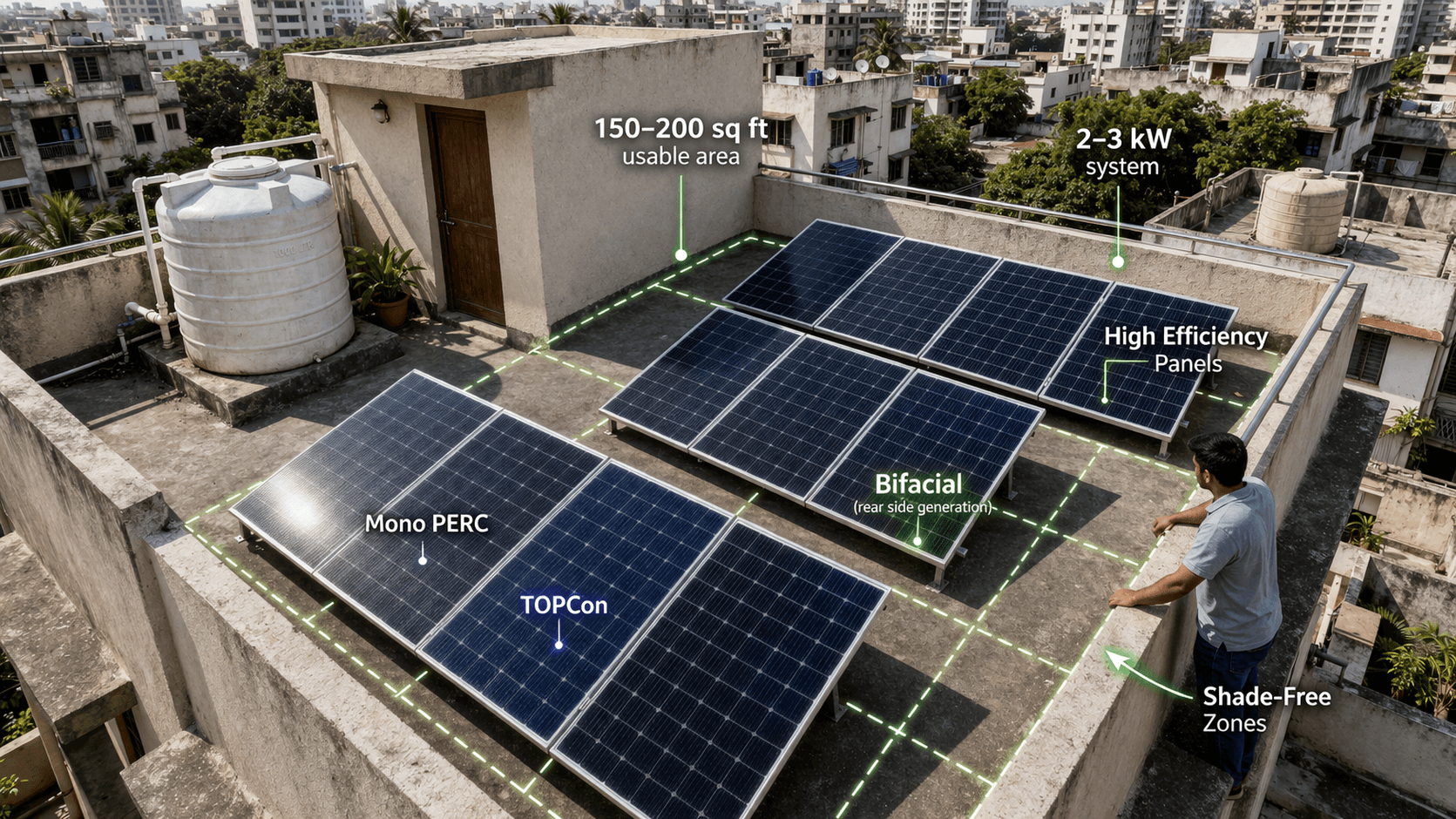
You can absolutely install rooftop solar on a limited roof. With the right high-efficiency panels and a smart layout strategy, even 150 to 200 square feet of usable roof space can power a significant portion of your home's electricity needs.
You need roughly 10 sq meters (107 sq ft) of shadow-free roof area per 1kW of solar capacity
High-efficiency panels like
Mono PERC, TOPCon, and Bifacial
generate more power from the same space
Roof orientation, tilt angle, and shade-free zones matter more than total roof size
A 2kW to 3kW system covers most urban homes with limited rooftops
Smart micro-inverter or MLPE (module-level power electronics) setups reduce shading losses on compact roofs
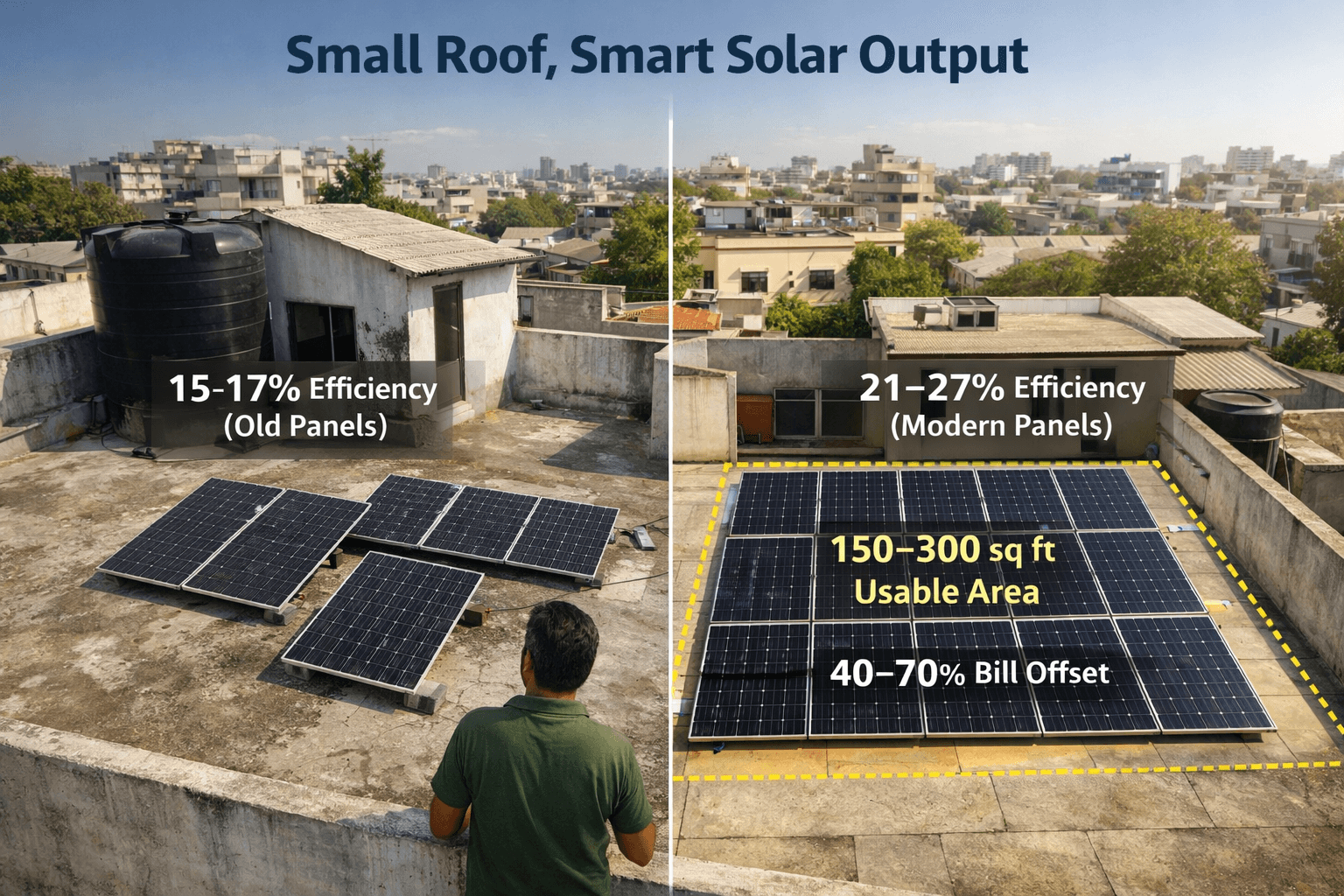
Limited roof space is a planning challenge, not a barrier.
The real question is not how big your roof is. It is how efficiently that available space generates electricity.
Most urban homes in India have 150 to 300 sq ft of usable shadow-free roof area. That is enough for a 1.5kW to 3kW system, which can offset
40% to 70% of a typical household's monthly electricity bill
.
The shift in solar technology over the last five years has made this possible. Panel efficiencies that were 15% to 17% a decade ago are now routinely 21% to 27% with modern panel types.
The standard benchmark is 10 sq meters (107 sq ft) of shadow-free roof per 1kW of solar capacity.
Here is a quick reference for residential systems in India:
System Size | Roof Space Needed | Avg. Daily Generation | Best Suited For |
1kW | ~10 sq m (107 sq ft) | 4 to 5 units | Small 1-2 BHK apartments |
2kW | ~20 sq m (215 sq ft) | 8 to 10 units | 2 BHK homes |
3kW | ~30 sq m (323 sq ft) | 12 to 15 units | 3 BHK homes |
5kW | ~50 sq m (538 sq ft) | 20 to 25 units | Villas and large homes |
A typical 5kW rooftop system uses 9 to 10 panels of 550W each and requires around 20 sq meters of clear roof area.
If you only have that much space, a 5kW system is fully achievable with the right panel selection.
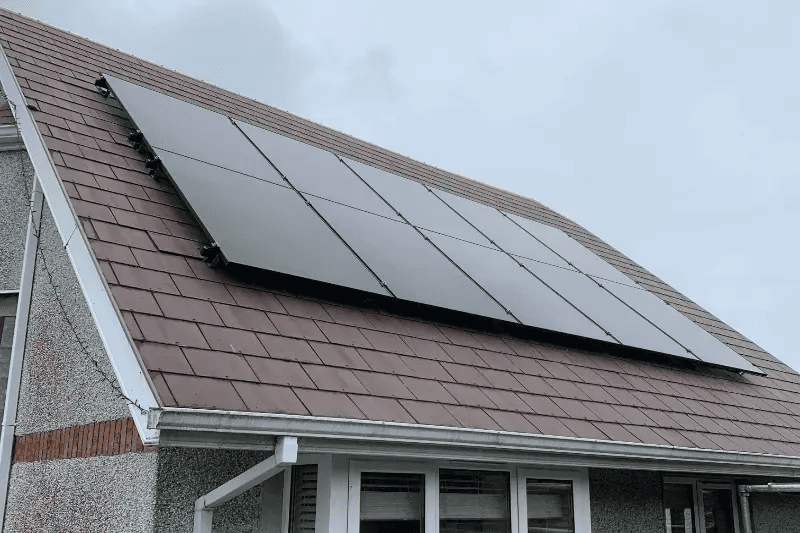
For limited roof space, choose high-efficiency Monocrystalline PERC, TOPCon, or Bifacial panels. They generate more watts per square foot compared to standard polycrystalline panels.
Here is a practical comparison:
Panel Type | Efficiency Range | Best Use Case | |
Polycrystalline | 15% to 17% | Rs 18 to Rs 24 | Large open rooftops |
Monocrystalline PERC | 20%+ | Rs 22 to Rs 28 | Limited roof space |
Bifacial | 25% to 27% | Rs 32 to Rs 40 | Elevated mounts, light-colored roofs |
TOPCon / HJT | 22% to 24% | Premium tier | Small roofs needing max output |
For most urban homeowners with a compact roof, Mono PERC panels give the best balance of efficiency, cost, and long-term performance.
Bifacial panels capture reflected light from the roof surface below the panel.
On a white or light-colored rooftop, they can boost output by 5% to 15% without needing extra roof area.
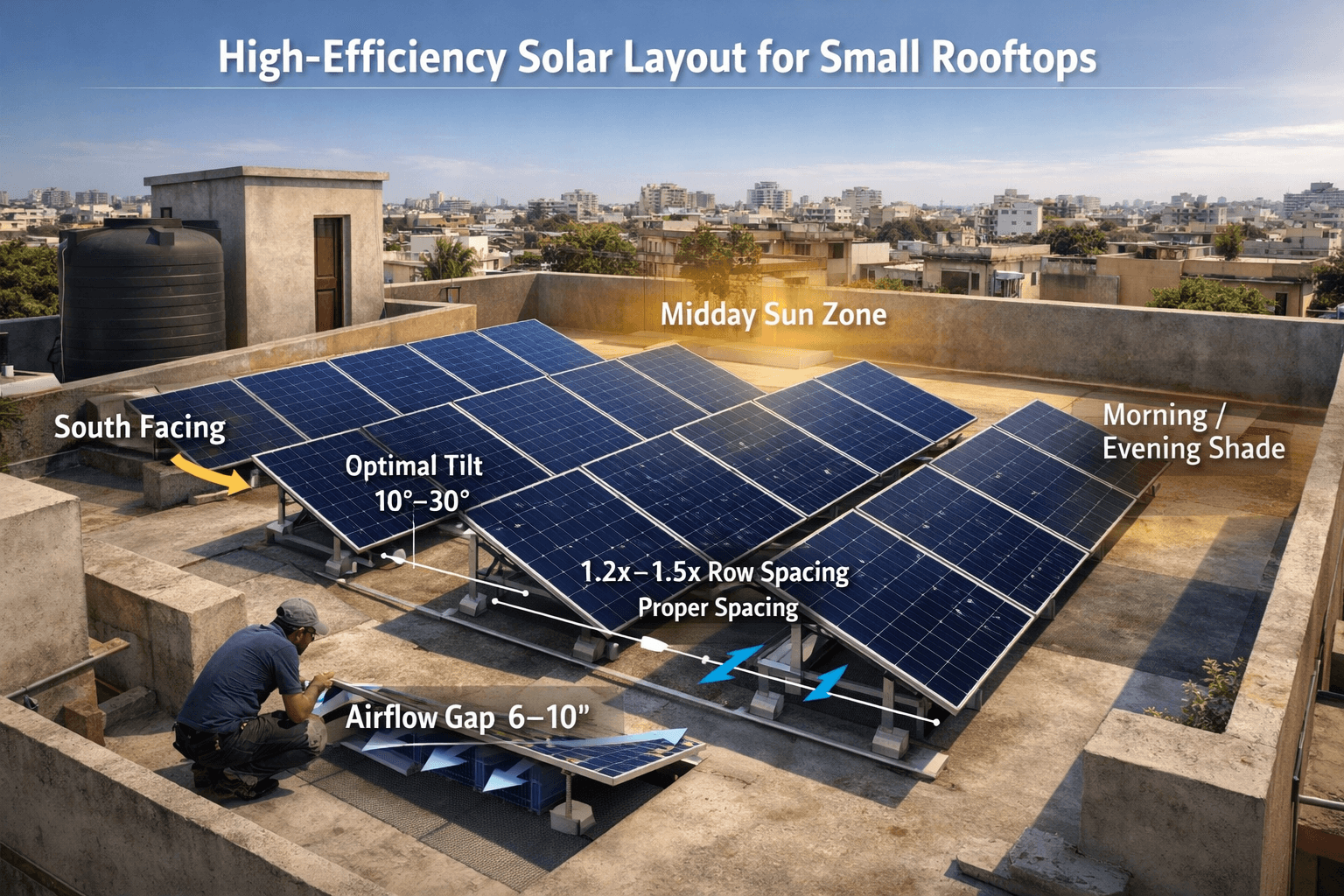
The layout of your panels directly determines how much power you extract from a limited roof. A poorly designed layout loses 15% to 30% of potential output even with premium panels.
South-facing roof surfaces in India receive the maximum annual solar irradiation.
If your roof has a south-facing slope or flat terrace, prioritize placing all panels there before using other directions.
Panels tilted between 10 and 30 degrees in most Indian cities (latitude-dependent) deliver optimal annual output.
use adjustable mounting structures to achieve this angle. Proper tilt also helps rain clean the panels naturally, reducing maintenance needs.
Portrait (vertical) layout fits more panels on narrow rooftops
Landscape (horizontal) layout works better on wide, shallow rooftops
Always align the long side of the panel parallel to the roof ridge to minimize wasted edge space
Panels placed too close in rows shade each other in early morning and late evening hours.
For flat rooftop installations, maintain a row-to-row spacing of at least 1.2x to 1.5x the panel height to avoid inter-row shading during low sun angles.
Keep 6 to 10 inches of airflow space between the panel underside and the roof surface.
Panels that trap heat lose efficiency. Good airflow keeps panel temperature down and output steady.
Shading is the biggest performance killer on small roofs, and it needs a dedicated technical solution. Even one shaded panel in a traditional string setup can reduce the output of your entire array.
Two solutions work well here:
Each panel operates independently. A shaded or underperforming panel does not drag down the rest of the array. Ideal for roofs with partial shade from water tanks, parapets, or nearby structures.
Module-level power electronics attach to each panel and allow individual maximum power point tracking (MPPT).
They offer a middle ground between
and micro-inverters in terms of cost and performance recovery.
For most Indian rooftops with a single shade source (water tank or parapet wall), a string inverter with at least 2 MPPTs handles partial shading reasonably well without the premium cost of micro-inverters.
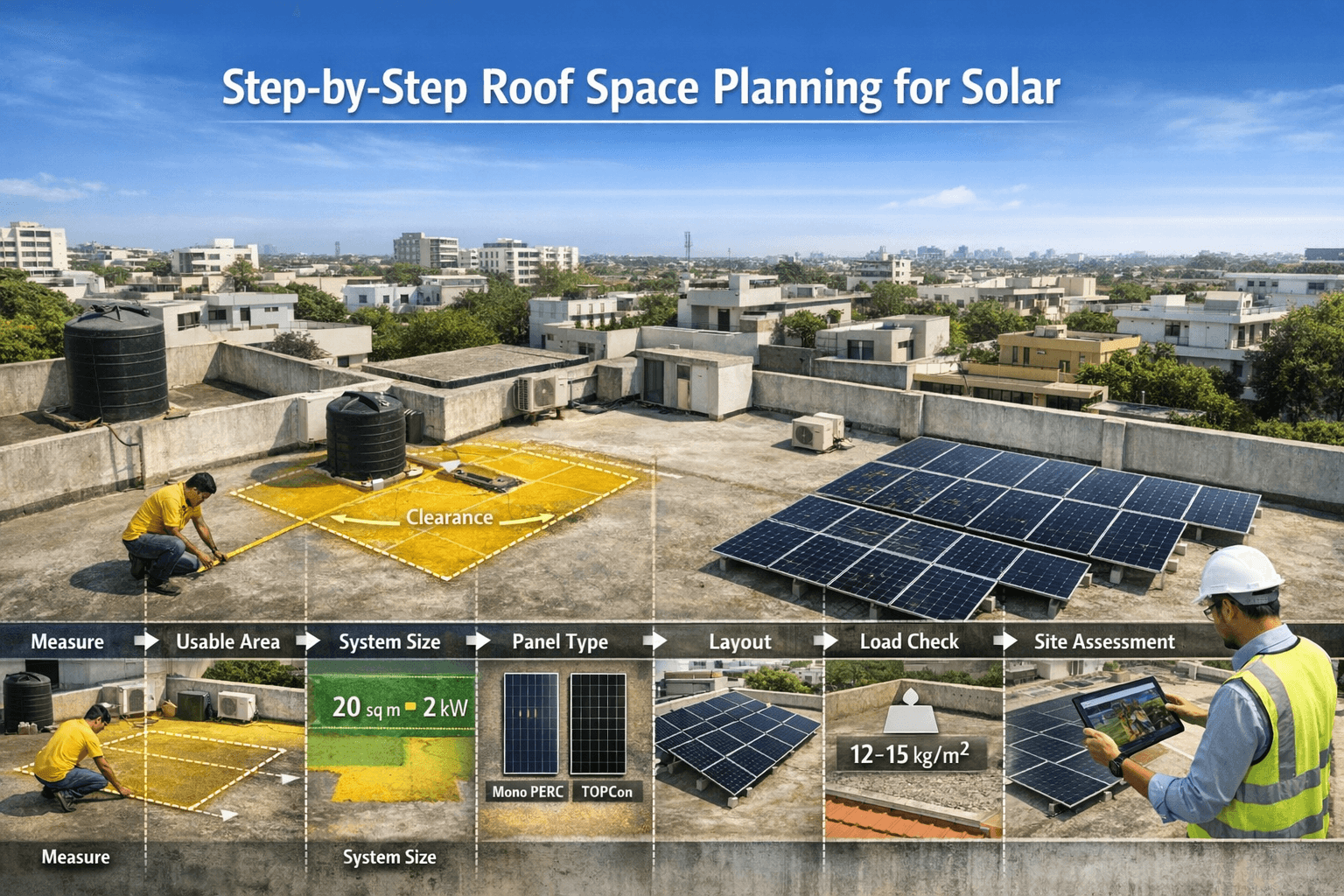
Follow this process before finalizing your solar layout. Skipping any step often leads to undersized or inefficient systems.
Measure your shadow-free roof area.
Walk your rooftop at noon and identify sections with no shade. Measure width and length in feet.
Calculate usable area.
Subtract space occupied by water tanks, AC units, parapet walls, and access pathways. Allow 2 to 3 feet clearance from edges.
Determine system size.
Divide usable area (in sq meters) by 10 to get maximum system capacity in kW.
Choose panel type.
For space under 25 sq meters, go Mono PERC or TOPCon. For larger spaces, standard Mono works.
Design the layout.
Use portrait or landscape orientation based on roof shape. Confirm row spacing against your tilt angle.
Check structural load.
Solar panels add 12 to 15 kg per sq meter. Confirm your roof slab or structure supports this load before finalizing.
Get a site assessment.
A
will use shadow analysis tools to finalize layout and confirm generation projections.
A 200 sq ft (about 18.5 sq meters) shadow-free roof can comfortably support a 1.8kW to 2kW system.
Using six 370W Mono PERC panels (each roughly 20.86 sq ft), the total panel area comes to about 125 sq ft.
Add row spacing and edge clearances, and the full array fits within 200 sq ft comfortably.
This 2kW system generates 8 to 10 units per day in a city like Surat or Ahmedabad, covering up to 240 to 300 units per month.
For a household with a monthly bill of Rs 2,500 to Rs 3,500, that translates to 60% to 80% offset with a payback period of 3 to 4 years after the PM Surya Ghar subsidy.
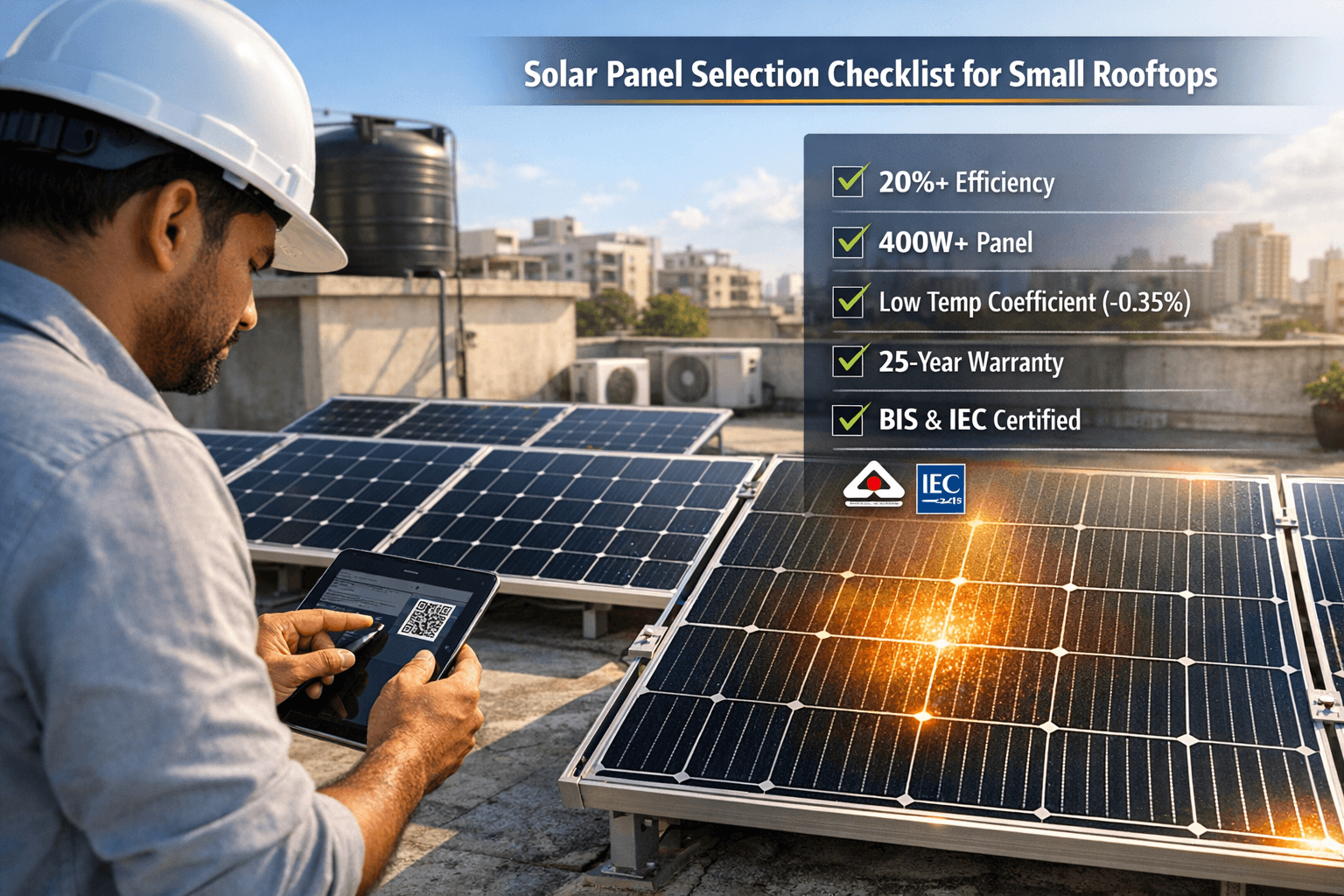
Before finalizing your panel order, verify these points:
Panel efficiency is 20% or above
Wattage per panel is 400W or higher to keep panel count low
Temperature coefficient is below -0.35% per degree Celsius (lower is better for hot Indian summers)
Panel comes with a 25-year linear performance warranty
Certification includes BIS mark and IEC 61215 compliance
If you are an urban homeowner in Gujarat or surrounding regions, Earthwave Solar offers a free rooftop feasibility assessment.
Their team uses shadow analysis, roof load evaluation, and layout planning tools to tell you exactly what is possible on your specific roof, before you spend a rupee.
Get your free rooftop solar assessment from Earthwave Solar and find out your exact system size and savings potential.
You need a minimum of 100 sq ft (about 10 sq meters) of shadow-free roof area to install a 1kW system. For a meaningful energy offset, 200 to 300 sq ft is the practical minimum for most urban homes.
Yes. Use micro-inverters or power optimizers (MLPE) to limit shading losses. These technologies allow each panel to perform independently, so a shaded panel does not affect the rest of the array.
Monocrystalline PERC panels with 20%+ efficiency are the best choice for limited roof space. They generate more output per square foot and are priced between Rs 22 and Rs 28 per watt, making them cost-effective for residential use.
A tilt angle of 10 to 30 degrees works best for most Indian cities. Flat rooftop installations use adjustable mounting structures to achieve this. The exact angle depends on your city's latitude for optimal annual energy generation.
No. The PM Surya Ghar subsidy applies based on system capacity, not roof size. You can claim up to Rs 78,000 subsidy for systems of 3kW and above, even if you install a compact high-efficiency system on a small roof.
FAQS
Can't find the answer you're looking for? Our team is here to help.
SUBSCRIBE NEWSLETTER
Switching to solar is easier than you think. Let us guide you to cleaner, more affordable energy.
