Commercial Solar Savings
Reduce Peak Demand Charges with Solar Panels
2026-04-07T00:00:00.000Z•9

Yes, solar directly reduces peak demand charges for commercial buildings.
By generating on-site power during peak consumption hours, solar cuts the load your facility draws from the grid during MD-billed intervals, which is exactly where your biggest electricity cost hides.

Solar panels generate maximum power between 9 AM and 4 PM, which overlaps with peak business hours when demand charges apply
Lower grid draw during peak hours means a lower Maximum Demand (MD) reading on your electricity bill
Commercial buildings in India typically see 30–50% reduction in total electricity costs after solar installation
On-grid solar systems work without batteries and still reduce demand charges significantly
Adding battery storage amplifies savings by covering early morning and evening peak windows too
For a full breakdown of how solar cuts operating costs, see our guide on commercial solar energy cost savings.
Peak demand charges are often the single largest line item on a commercial electricity bill, yet most facility teams focus only on the per-unit cost.
In India, commercial buildings pay electricity bills under two components:
Energy charges:
Cost per kWh of electricity consumed
Maximum Demand (MD) charges:
A fixed charge based on the highest 15-minute or 30-minute power draw recorded during the billing cycle
The MD reading is unforgiving. One spike, such as heavy HVAC load plus a production surge, can set your MD for the entire month. You pay for that peak even if it happened only once.
For a building with a sanctioned MD of 500 kVA, MD charges can represent 25–40% of the total monthly bill. That is a significant cost, and most operators are not actively managing it.

Solar reduces demand charges by generating electricity on-site during the exact hours when your grid demand peaks.
Here is the mechanism:
Your solar panels generate power between 8 AM and 5 PM
This on-site generation offsets what your building would otherwise pull from the grid
Your net grid draw during those hours drops
The peak MD reading recorded by the meter is lower
Your MD charge for that billing cycle decreases
This is not theoretical. This is how on-grid solar works in practice across commercial rooftop installations in India.

The numbers change significantly once you separate energy savings from demand charge savings.
Most solar proposals focus only on per-unit cost savings.
But for commercial buildings under MD-based tariffs, demand charge reduction can contribute an equal or greater portion of total savings.
Here is a simplified breakdown for a 200 kWp commercial rooftop system:
Savings Category | Monthly Estimate |
Energy cost reduction (per unit) | Rs. 1.2L – 1.8L |
MD charge reduction | Rs. 0.8L – 1.4L |
Total monthly savings | Rs. 2L – 3.2L |
System cost:
Rs. 90L – 1.1 Cr (approximate range for 200 kWp)
Simple
: 3.5 to 5 years
System life:
25 years
Pro tip: Ask your solar EPC provider to model your MD charge savings separately from energy savings. Many proposals underreport this figure.
On-grid solar reduces daytime peak demand charges. Battery storage extends that reduction into evening and morning peaks.
Not sure which system type fits your building? Read our detailed comparison of on-grid, off-grid, and hybrid solar options before you decide.

Works best when your peak loads fall between 9 AM and 4 PM
No additional cost of battery bank
Ideal for offices, IT parks, and retail that operate standard business hours
ROI is faster due to lower capital cost

Covers evening peak windows (6 PM to 10 PM) when grid rates are high
Better suited for hospitals, hotels, and manufacturing units with 24-hour loads
Higher upfront investment, but stronger MD charge reduction across more billing hours
Makes sense when your Time-of-Use (ToU) tariff penalizes evening consumption heavily
For most commercial buildings in India, an on-grid system delivers strong ROI without batteries. Add storage only when your load profile genuinely demands it.
Also review CAPEX vs financing options to understand the best ownership model for your business.
Buildings with high daytime operational loads and MD-based tariffs see the fastest payback from commercial rooftop solar.
The strongest candidates are:
IT parks and tech campuses:
Consistent 9-to-6 load, large rooftop area, high MD sanctioned capacity
Hospitals and healthcare facilities:
24-hour load, high MD, critical power needs, battery storage is a bonus
Hotels and hospitality:
Daytime kitchen, laundry, HVAC load aligns with solar generation hours
Retail chains and malls:
High lighting and HVAC load during business hours
Manufacturing and industrial units:
Heavy equipment runs during the day, often with ToU tariffs
If your monthly electricity bill exceeds Rs. 5 Lakhs, a detailed solar feasibility study almost always reveals a strong financial case.
See how solar for factories and warehouses delivers results for high-load industrial operations.
No, solar does not reduce your sanctioned Maximum Demand limit. It reduces your recorded MD reading.
This is a common question, and the distinction matters.
Your sanctioned MD is a fixed limit set in your contract with the DISCOM. Solar does not change that contract.
What solar changes is the actual load your building draws from the grid during the billing period.
Because solar covers a portion of that load on-site, the meter records a lower net demand.
Your MD charge is calculated on that recorded figure, not the sanctioned limit.
So your bill goes down. Your contract stays the same. Both outcomes work in your favor.
Earthwave Solar is a Gujarat-based full-service solar EPC company with over 7 years of experience delivering commercial and industrial solar projects across India.
Commercial and Industrial Solar EPC : Systems designed for factories, warehouses, and commercial complexes, typically delivering 30–40% reduction in power expenses
Rooftop Solar : Grid-tied installations with real-time monitoring to track generation and savings
Ground Mount Solar : For properties with limited roof area or higher capacity requirements
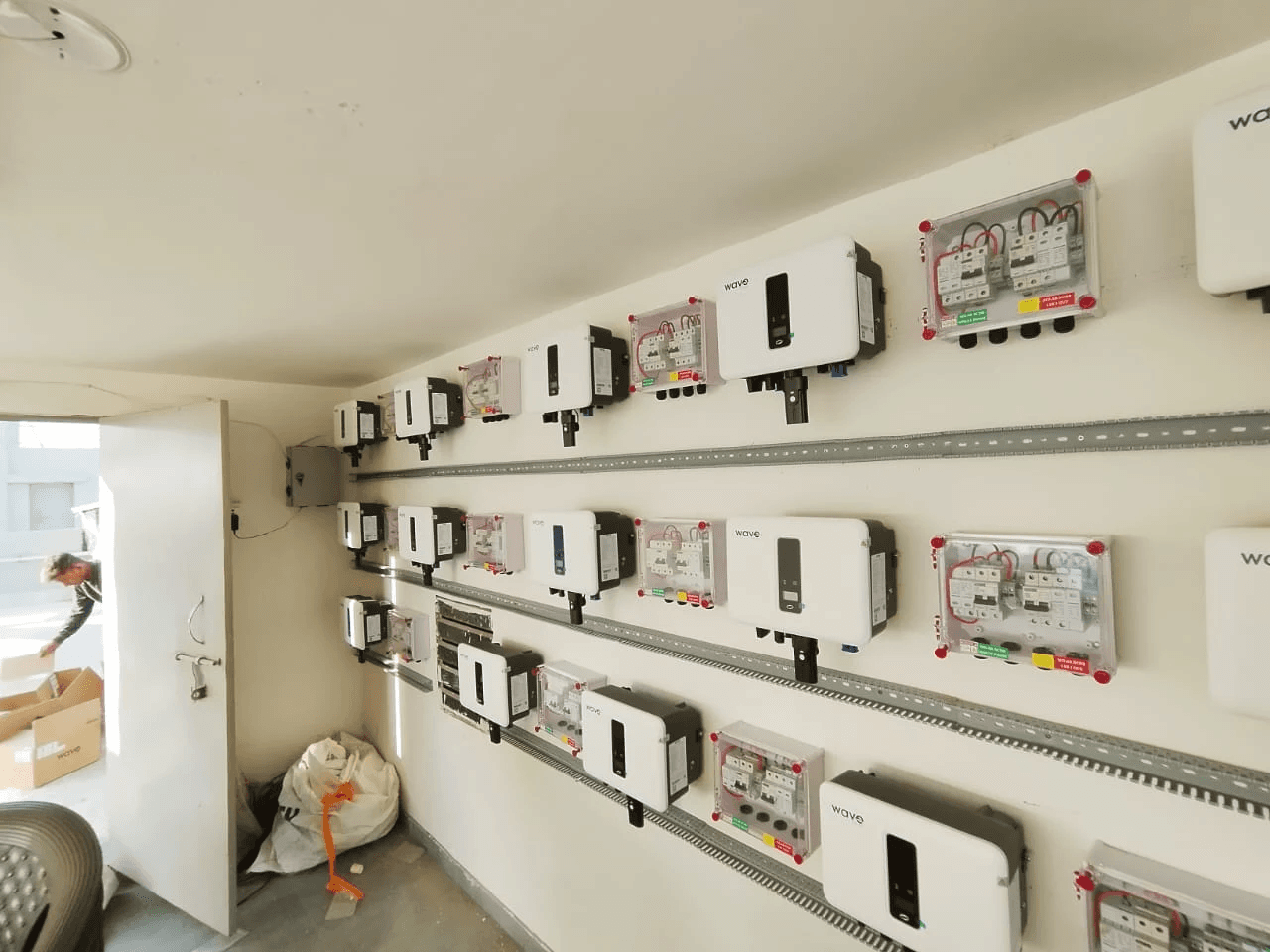
Wave Inverters: In-house manufactured inverters with up to 97% efficiency, available from 2.5 kW to 125 kW, backed by a 10-year warranty and smartphone-based smart monitoring

Initial consultation to understand your energy needs (no sales pressure)
Site visit and technical assessment of roof condition, sun exposure, and electrical setup
Detailed system design with transparent quotation, no hidden costs
Full documentation handling including DISCOM approvals, net metering, and subsidy paperwork
Installation by certified technicians followed by a thorough technical handover
Browse our completed projects to see the scale and variety of commercial installations Earthwave has delivered.
Most finance managers hesitate on solar for one of three reasons. Each one has a practical answer.
You do not need the entire rooftop. Even a partial installation that covers 30–40% of your peak load can meaningfully reduce your MD reading. The system is modular.
Solar generation drops 15–30% during monsoon months in India. Your MD savings reduce proportionally. But the annual average still delivers a strong ROI because peak savings during 9–10 clear months outweigh two reduced months.
Solar savings stack on top of tariff changes. If your DISCOM revises rates upward, your solar system insulates you from that increase. It is a hedge, not just a cost cut.
Yes, on-grid solar reduces MD charges when your peak demand window overlaps with solar generation hours (9 AM to 5 PM). If your highest consumption spikes occur during daylight hours, a well-sized on-grid system directly lowers the kVA recorded by your MD meter.
A properly sized on-grid commercial solar system can reduce peak kVA drawn from the grid by 20–40%, depending on how well solar generation hours align with your building's peak demand intervals. Adding BESS can push this further by covering evening peak loads as well.
As a general rule, size your system to cover at least 40–60% of your peak daytime demand. A site-specific load profile analysis will give you a more precise figure, which is why any reputable EPC provider starts with a detailed energy assessment before recommending a system size.
In most Indian states, grid-connected on-grid solar systems operate under net metering regulations without changing your base tariff category. Your DISCOM approvals are handled as part of the installation process. Always confirm the applicable net metering policy with your EPC provider for your specific state.
When MD charge reduction is factored in alongside energy savings, commercial solar payback periods in India typically range from 3 to 5 years. Buildings with higher MD charges as a share of their total bill often see payback at the lower end of that range, since the savings per rupee invested are larger.
If your commercial building's monthly electricity bill is above Rs. 5 lakhs and MD charges are a significant portion of it, solar is worth a detailed analysis.
Earthwave Solar reviews your existing bills, maps your peak demand window, and shows you what a commercial solar system can realistically do for your MD charges and total power costs.
**Talk to our team and get a no-obligation consultation.**
Phone: +91 90336 07212
Email:
Website:
Office: Surat, Gujarat and Bhopal, Madhya Pradesh
FAQS
Can't find the answer you're looking for? Our team is here to help.
SUBSCRIBE NEWSLETTER
Switching to solar is easier than you think. Let us guide you to cleaner, more affordable energy.
