Solar inverter load calculation
Best Solar Inverter for Home India: Load & Backup
2026-04-10T00:00:00.000Z•8
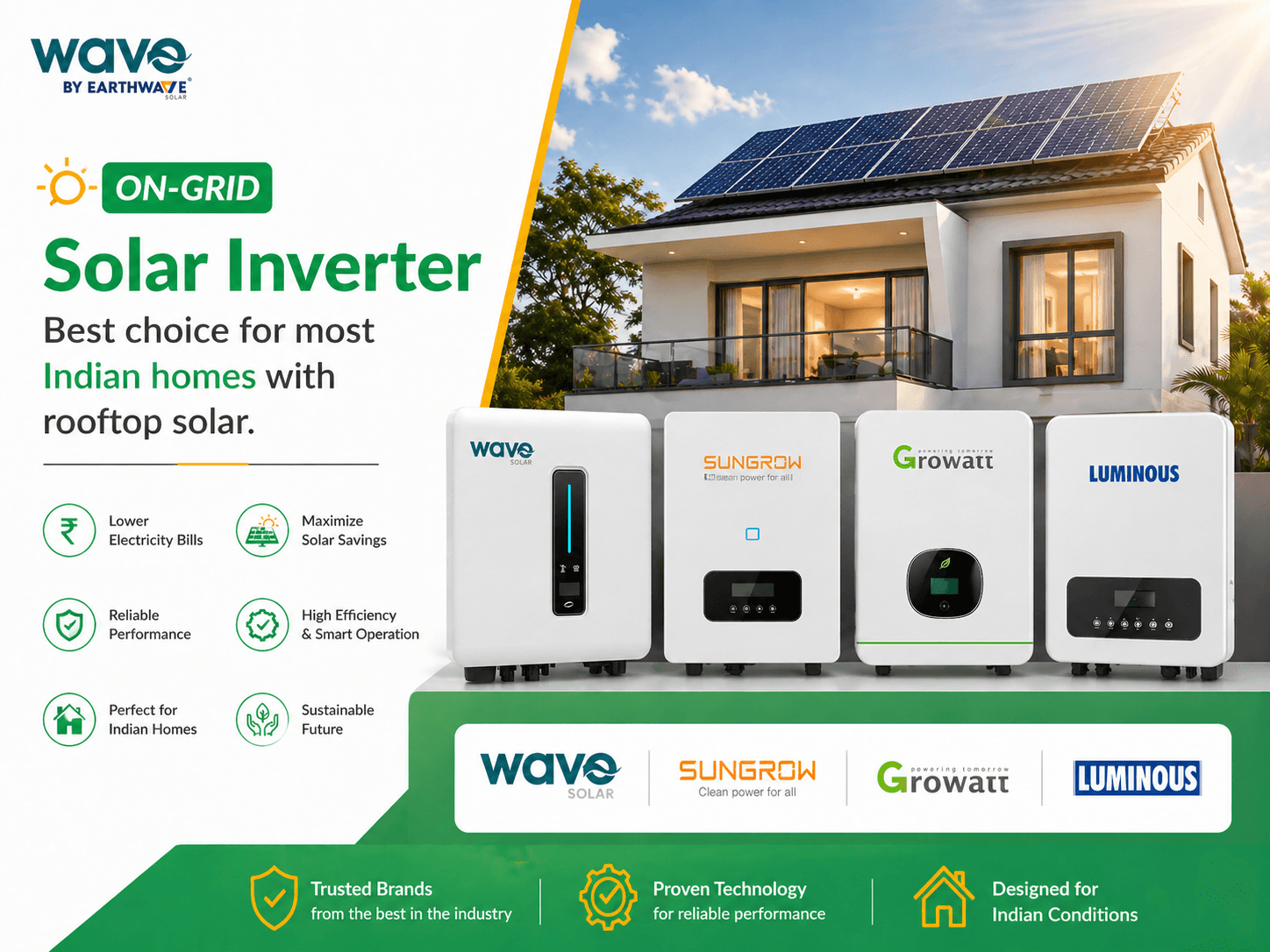
A On grid solar inverter like Wave Inveter, Sungrow, Growatt, Luminous is the best choice for most Indian homes with rooftop solar.
It combines solar generation, battery backup, and grid power in one unit, so you never lose electricity even during power cuts.
A hybrid inverter works best for homes that have both solar panels and face power cuts.
Your inverter size depends on your total home load, not your solar panel size alone.
A standard 3 BHK home typically needs a 3kW to 5kW inverter.
Battery backup hours depend on your battery capacity (Ah) and the load you run during cuts.
One 150Ah battery at 12V gives roughly 1.5 to 2 hours of backup for a 800W load.
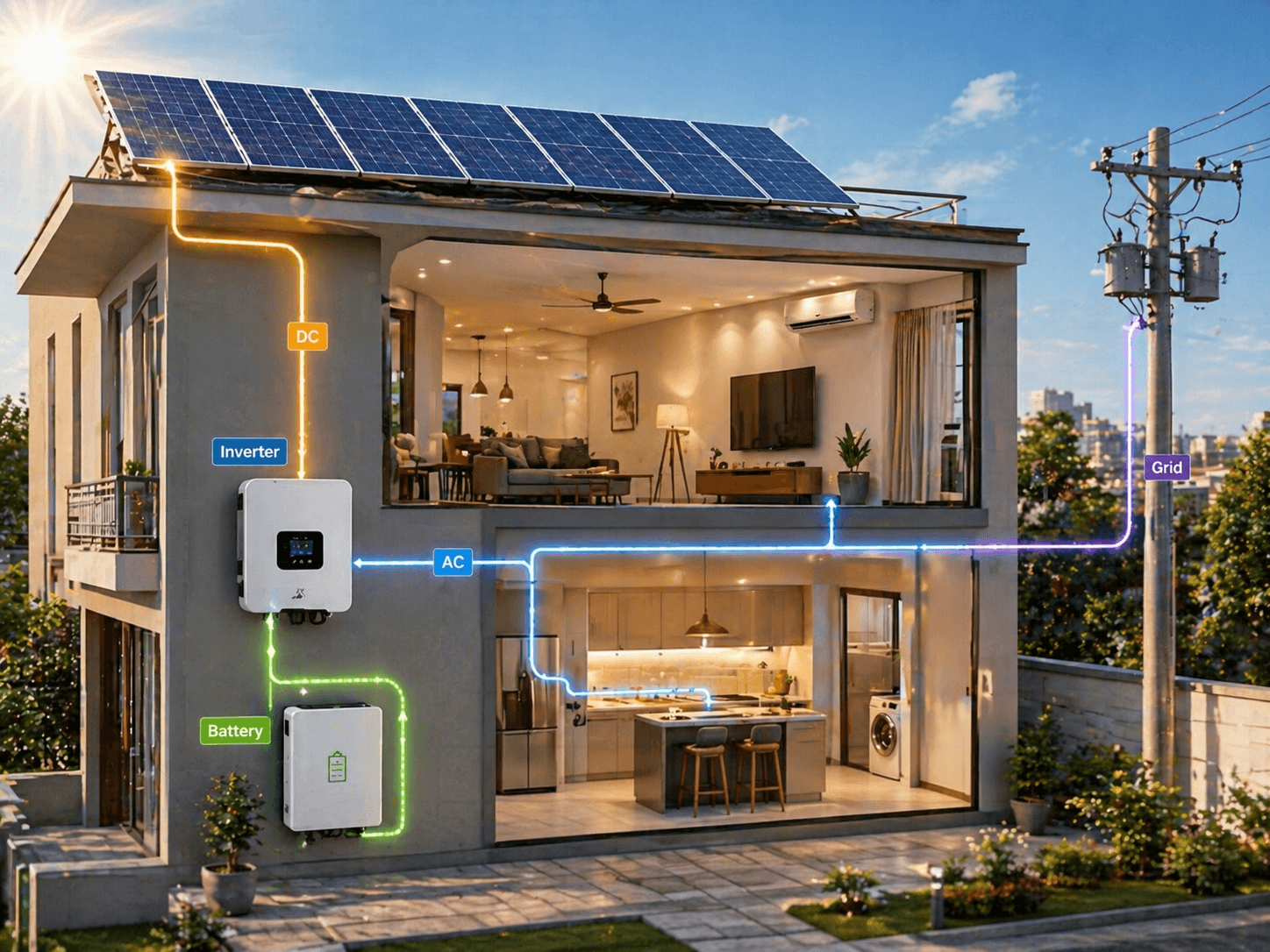
A solar inverter converts DC power from your solar panels into AC power your home appliances use. Without an inverter, your solar panels produce power you simply cannot use.
For Indian homes, the inverter also manages three power sources: solar panels, batteries, and the grid.
If you are still planning your rooftop setup, read our guide on how to plan rooftop solar for homes before choosing your inverter.
The quality of this management directly affects your electricity savings and backup reliability.
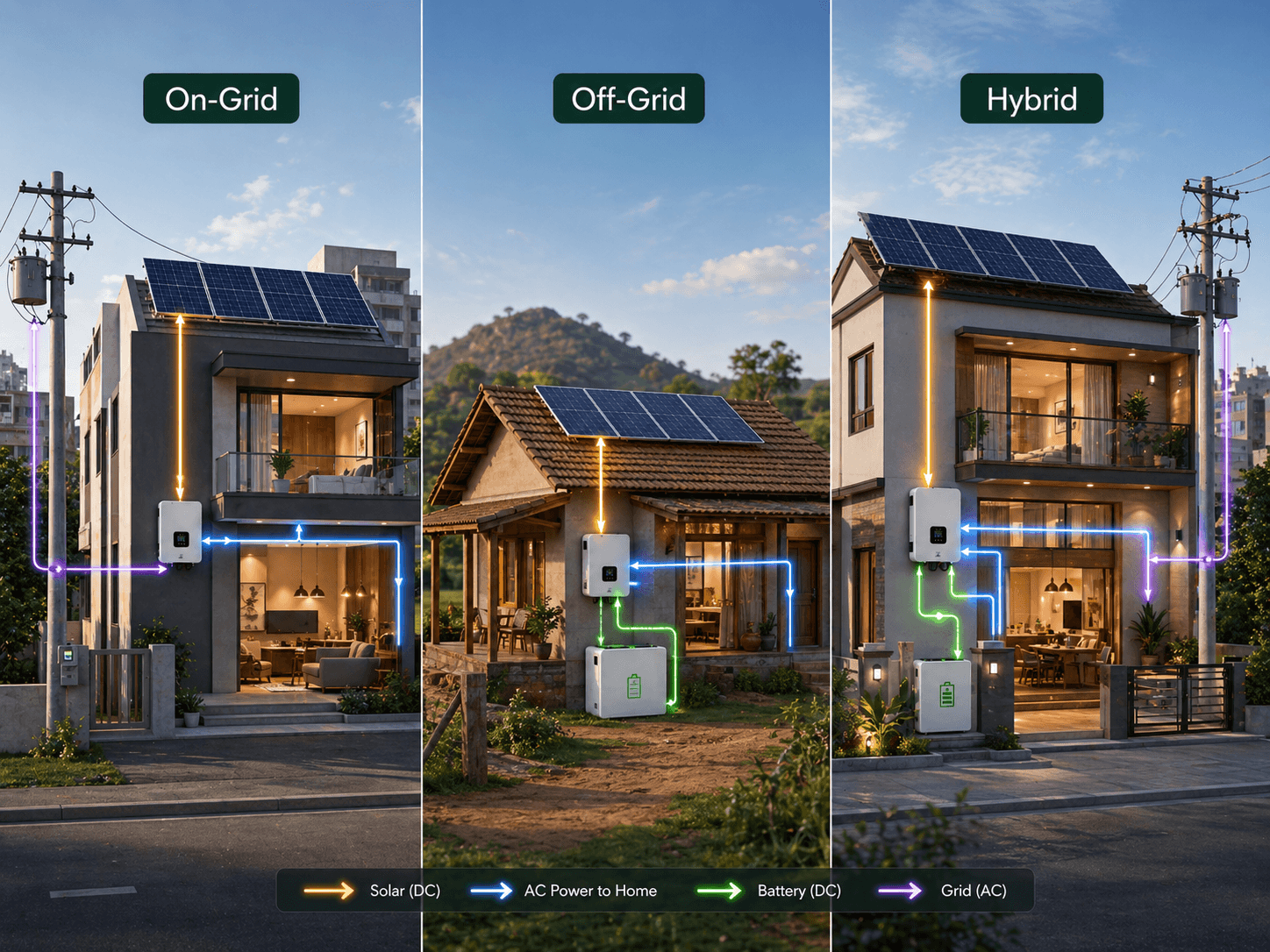
A hybrid solar inverter is the right choice for 90% of Indian homeowners.
Here is why:
Type | Battery Backup | Grid Connection | Best For |
On-Grid | No | Yes | Areas with stable power, zero cuts |
Off-Grid | Yes | No | Remote areas, no grid access |
Hybrid | Yes | Yes | Urban/semi-urban homes with power cuts |
: Exports surplus solar power to the grid and earns credits. If the grid goes down, it shuts off automatically for safety. No backup during power cuts.
Off-Grid Inverter:
Runs entirely on solar and battery. No grid dependency, but you need larger battery banks and oversized panels. Higher upfront cost.
Hybrid Inverter:
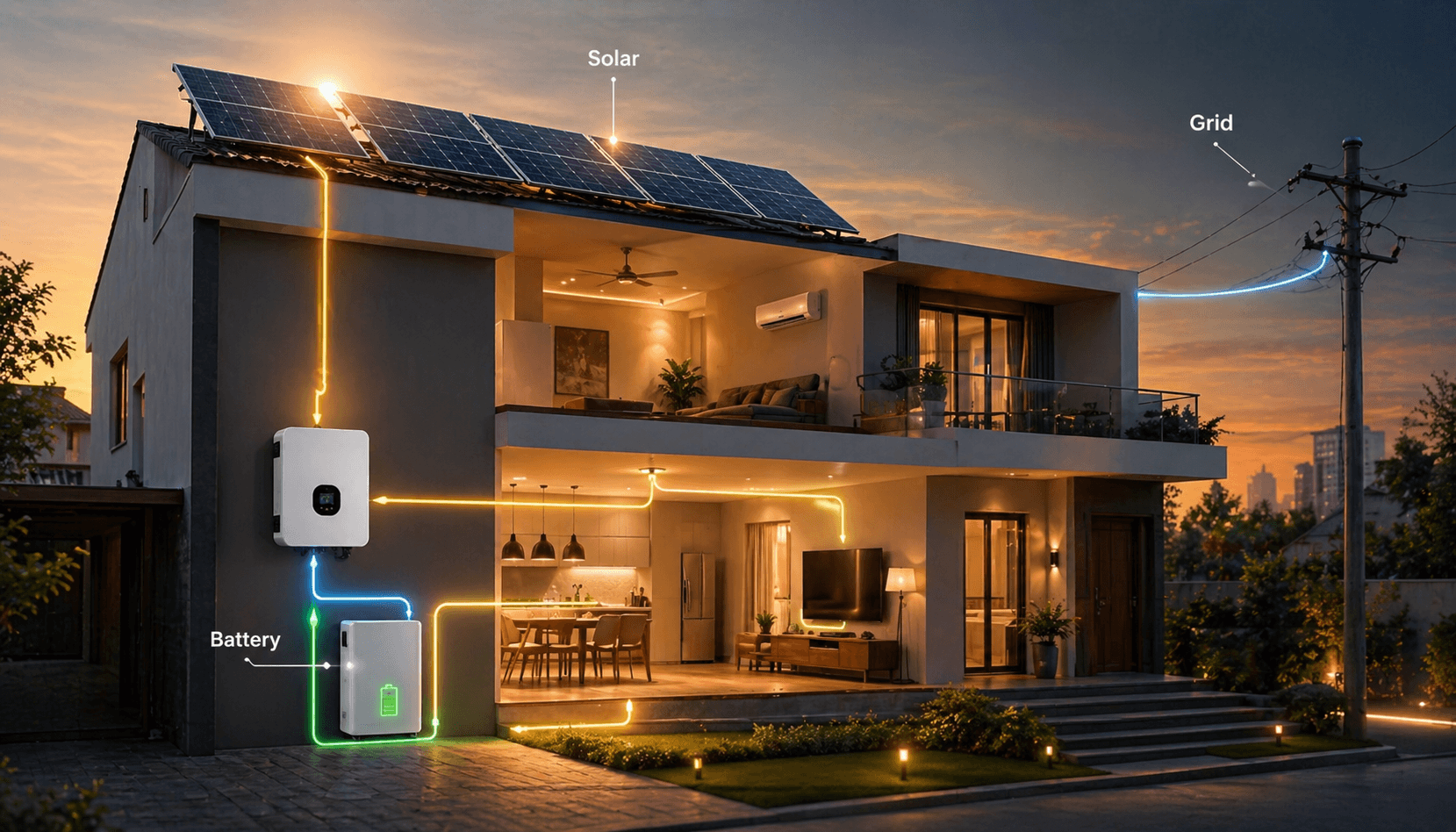
Uses solar first, charges the battery, and draws from the grid only when needed. During a power cut, it switches to battery instantly. This is the practical choice for Indian cities.
A homeowner in Surat with a 3kW solar system and frequent 2 to 4 hour power cuts chose a hybrid inverter with 2 batteries (150Ah each).
During the day, solar powers the home and charges the battery. At night or during cuts, the battery kicks in. His electricity bill dropped by over 80%.
The right brand matters as much as the right capacity. A good inverter from a reliable brand will run without issues for 10 to 15 years. A cheap one will fail in year 3.
Here are the most trusted solar inverter brands available in India for residential use.
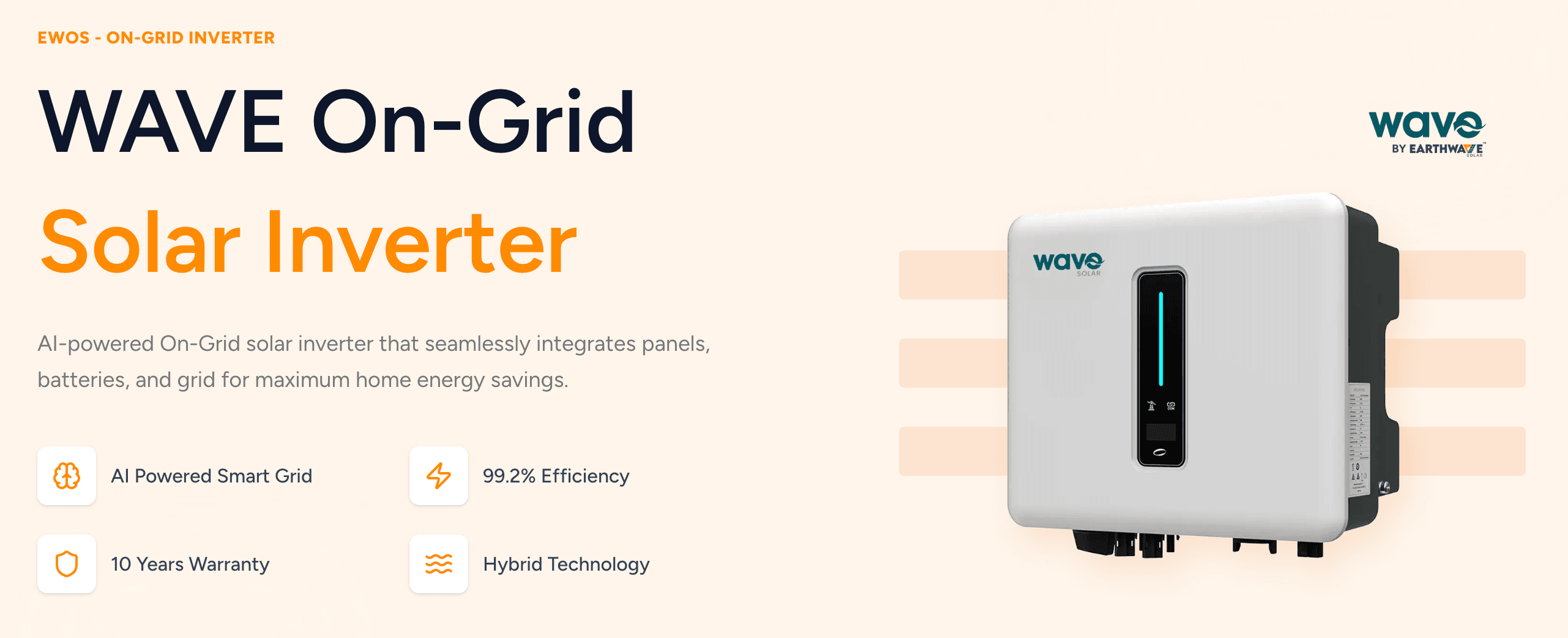
For a deeper comparison, read our full guide on best solar inverter brands in India.
Brand | Best For | Key Strength | Warranty |
Homes, apartments, commercial | 97% efficiency, 2.5kW to 125kW range, smart monitoring | 10 years | |
Sungrow | Large residential, commercial | Wide global service network, high efficiency | 5 to 10 years |
Growatt | Budget-friendly home setups | Low cost, decent performance, wide availability | 5 years |
Luminous | Small homes, first-time buyers | Strong after-sales network in Tier 2 cities | 2 to 5 years |
Fronius | Premium residential | Industry-leading reliability, smart grid features | 5 to 10 years |
Goodwe | Mid-range hybrid setups | Good hybrid capability, affordable battery support | 5 years |
What separates Wave inverters from the rest:
Manufactured in India, which means faster service and spare part availability
Available from 2.5kW to 125kW, covering homes to large commercial buildings
Comes with smartphone-based smart monitoring for real-time generation tracking
Backed by Earthwave Solar's full EPC support, so you get installation, warranty, and servicing from one team
See how Wave inverters stack up in detail: Wave Inverters vs Leading Brands
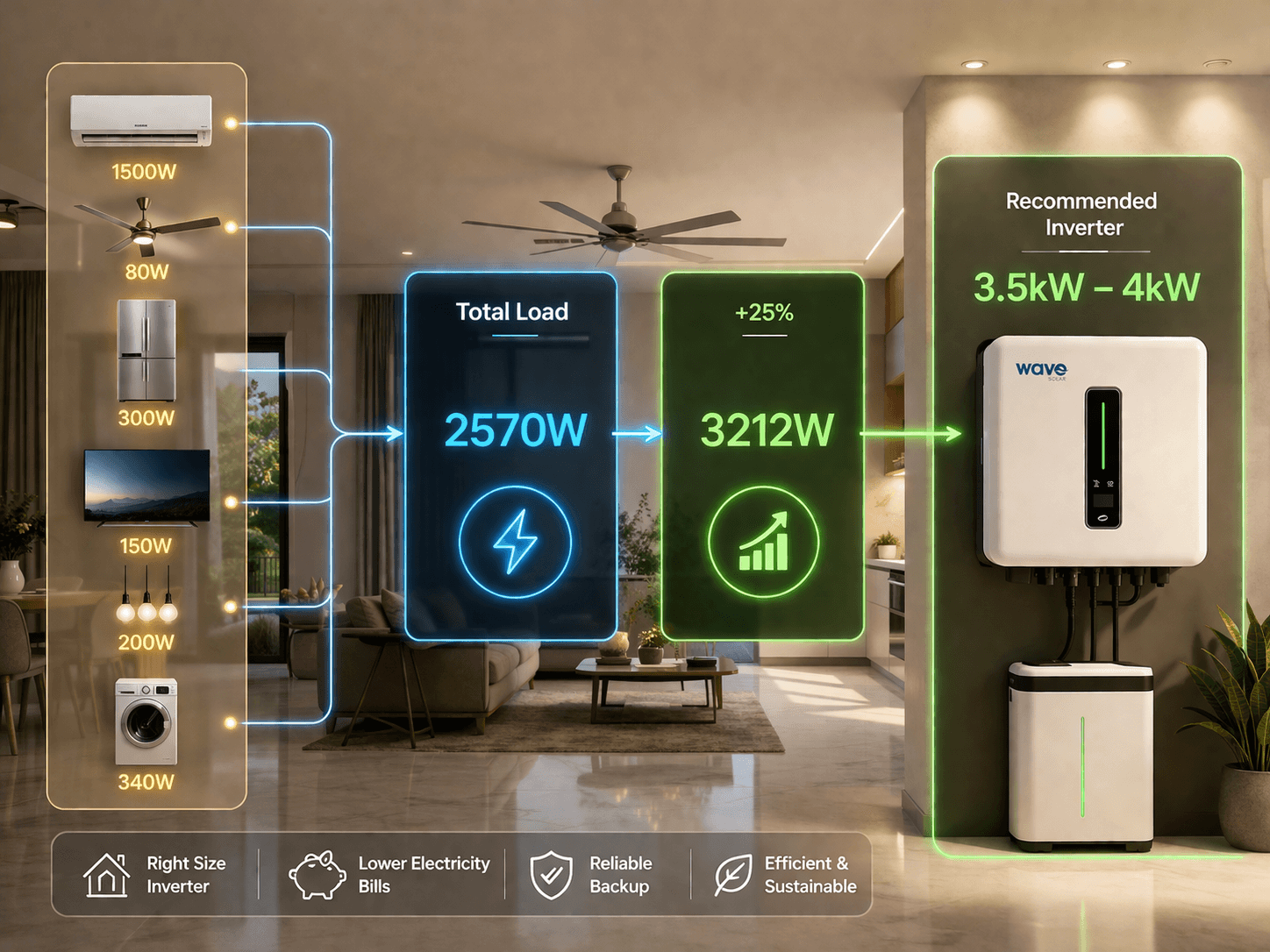
Your inverter capacity must be at least 25% more than your total running load. This buffer prevents overloading and protects your appliances.
Appliance | Wattage | Hours Used/Day | Daily Units (kWh) |
1.5 Ton AC | 1500W | 8 hrs | 12 kWh |
Refrigerator | 150W | 24 hrs | 3.6 kWh |
LED Lights (8 nos) | 80W | 6 hrs | 0.48 kWh |
Ceiling Fans (4 nos) | 240W | 10 hrs | 2.4 kWh |
Washing Machine | 500W | 1 hr | 0.5 kWh |
TV | 100W | 4 hrs | 0.4 kWh |
Total | 2570W | ~19.4 kWh/day |
Add up the wattage of all appliances running at the same time. For the example above, the running load is approximately 2,570W.
2,570W x 1.25 = 3,212W
So, a 3.5kW to 4kW hybrid inverter is the right fit for this home.
1 BHK (no AC):
1kW to 1.5kW inverter
2 BHK (1 AC):
2kW to 3kW inverter
3 BHK (2 ACs):
4kW to 5kW inverter
Bungalow/Villa (3+ ACs):
7.5kW to 10kW inverter
If you live in an apartment, also check our dedicated guide: Apartment Solar Installation Guide
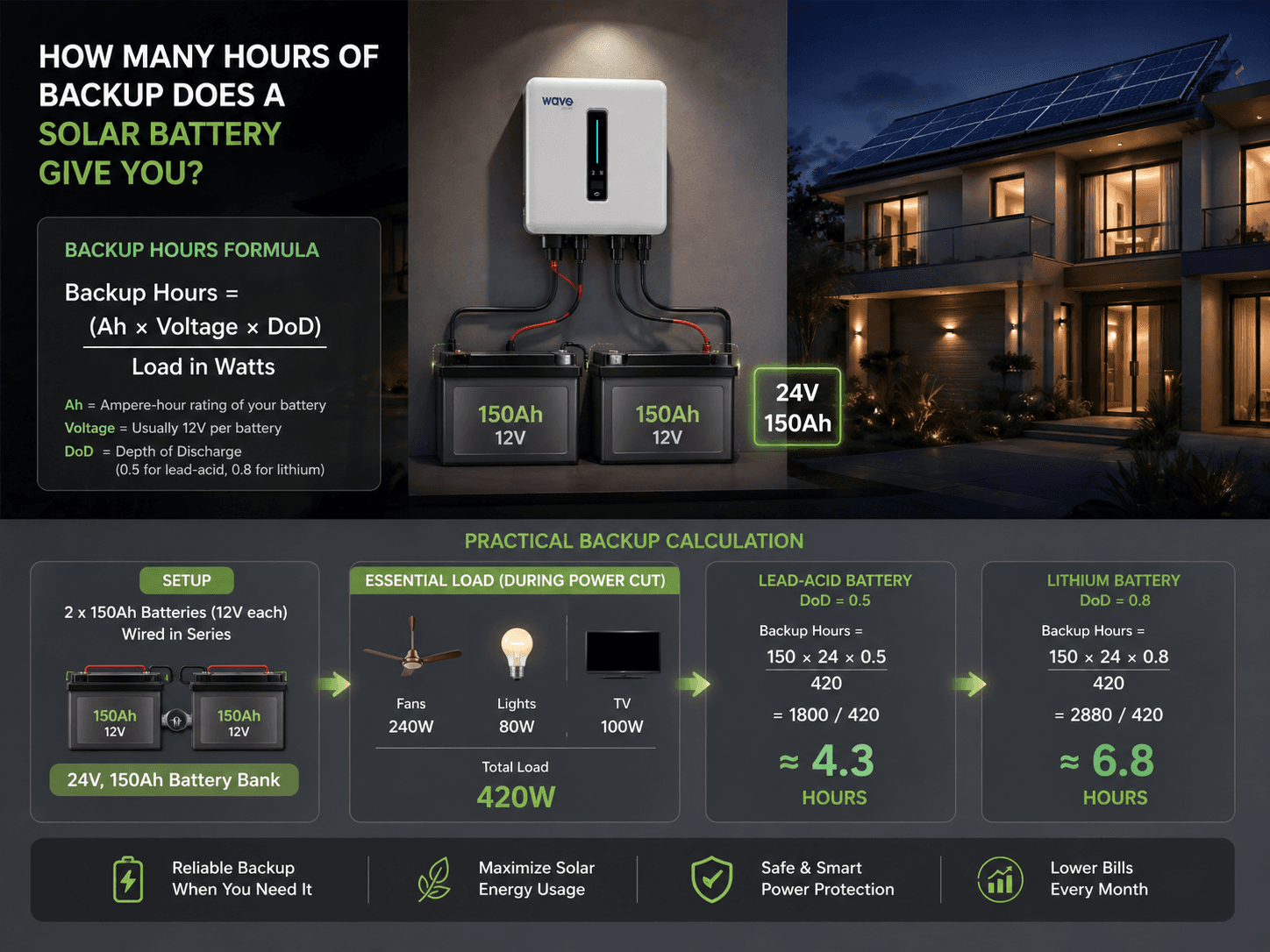
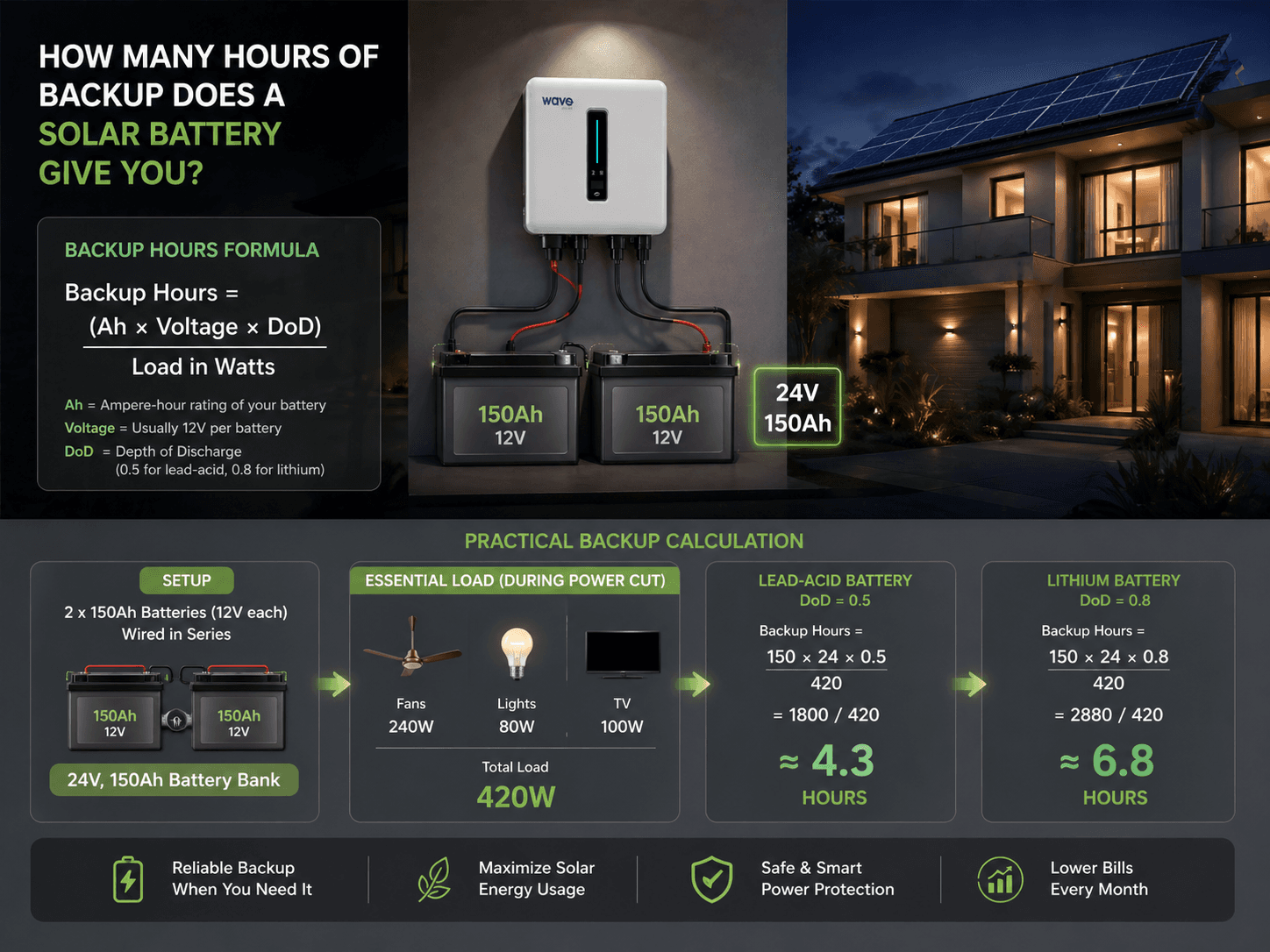
Backup hours depend on your battery capacity and the load you run during a power cut. The formula is simple:
Backup Hours = (Battery Ah x Battery Voltage x DoD) / Load in Watts
Where:
Ah
= Ampere-hour rating of your battery
Voltage
= Usually 12V per battery (or 48V battery bank)
DoD
= Depth of Discharge (use 0.8 for lithium, 0.5 for lead-acid)
Setup:
2 x 150Ah batteries (12V each), wired in series = 24V, 150Ah battery bank
Essential Load during power cut:
Fans (240W) + Lights (80W) + TV (100W) = 420W
Backup = (150 x 24 x 0.5) / 420 =
1800 / 420 = ~4.3 hours
If you use lithium batteries with 0.8 DoD:
Backup = (150 x 24 x 0.8) / 420 = 2880 / 420 = ~6.8 hours
Battery Setup | Type | Approx Backup |
1 x 150Ah (12V) | Lead-Acid | 1.5 hrs |
2 x 150Ah (12V) | Lead-Acid | 3 hrs |
2 x 150Ah (12V) | Lithium | 5 hrs |
4 x 150Ah (24V) | Lithium | 10+ hrs |
An MPPT (Maximum Power Point Tracking) solar inverter extracts up to 30% more power from your panels than a basic PWM inverter.
If you have more than a 1kW solar system, always choose an MPPT-based inverter.
MPPT continuously adjusts the electrical operating point of your solar panels to extract maximum power even in cloudy or partially shaded conditions.
Read more about how solar panels perform in variable weather:
Your inverter capacity should match your solar panel capacity, not exceed it by a large margin. Oversizing leads to waste; undersizing clips your production.
Follow these guidelines:
For a
3kW solar system
, use a 3kW to 3.6kW inverter
For a
5kW solar system
, use a 5kW to 6kW inverter
Most hybrid inverters allow up to
150% DC oversizing
, meaning a 5kW inverter can handle 7.5kW of panels
Also consider:
Number of MPPTs:
2 MPPTs allow panels to face different directions (east-west rooftop)
Battery compatibility:
Check if the inverter supports lithium or only lead-acid
Monitoring:
Smart monitoring via app lets you track daily generation and savings
You can download the technical datasheets for Wave inverters here:
Solar inverter prices in India vary significantly based on type, capacity, and brand. Budget for the inverter as 15 to 20% of your total solar system cost.
For full system pricing, see our detailed breakdown: Solar Panel Cost in India
Capacity | Price Range |
1kW to 2kW | Rs. 8,000 to 18,000 |
3kW to 5kW | Rs. 20,000 to 40,000 |
6kW to 10kW | Rs. 40,000 to 80,000 |
10kW to 25kW | Rs. 80,000 to 2,00,000 |
Capacity | Price Range |
3kW to 5kW | Rs. 45,000 to 85,000 |
6kW to 10kW | Rs. 90,000 to 1,60,000 |
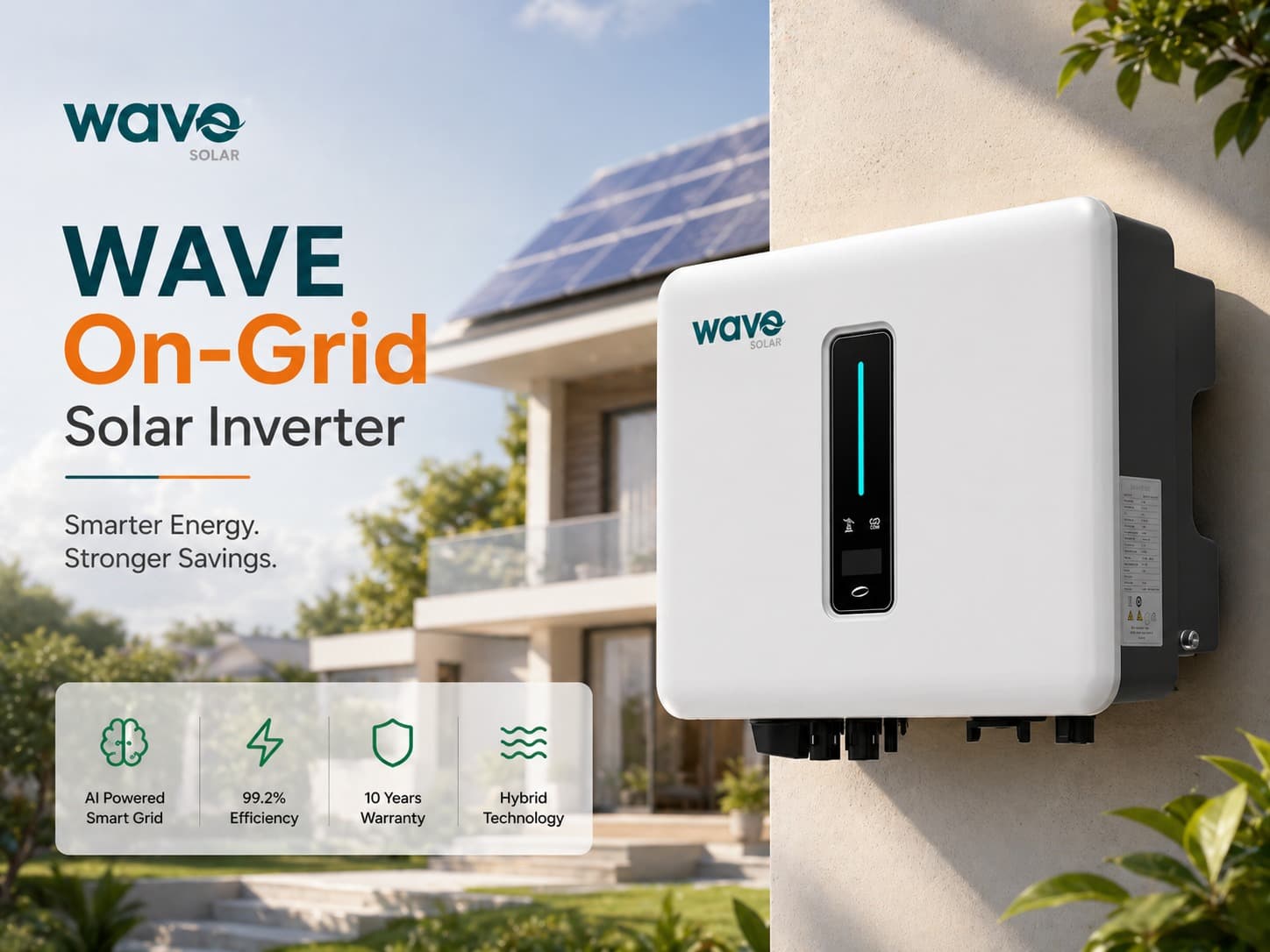
If your area has less than 2 hours of power cuts per month, an on-grid inverter gives you the fastest ROI. No battery cost means lower upfront investment and simpler maintenance.
On-grid inverters like the Ewave Solar EWOS series (1.5kW to 25kW) offer up to 98.6% efficiency, a single-phase and three-phase option, IP65 weatherproofing, and real-time monitoring. They feed surplus power back to your DISCOM and earn net metering credits.
Key specs to check for on-grid inverters:
Max efficiency (target 97% or above)
MPPT voltage range (wide range handles panel mismatch better)
Grid protection features (anti-islanding, overvoltage)
Warranty (minimum 5 years, ideally 10 years)
A hybrid inverter costs more upfront but saves more if your area has daily power cuts. An on-grid inverter wins only if your grid is nearly uninterrupted.
Here is a realistic 5-year financial comparison for a typical 3kW solar system on a 3 BHK home in a Tier 1 city.
For a full payback period analysis, read: Solar Payback Period India 2026
Factor | On-Grid System | Hybrid System |
Inverter cost | Rs. 25,000 to 35,000 | Rs. 45,000 to 65,000 |
Battery cost | None | Rs. 40,000 to 80,000 (2x150Ah lithium) |
Total setup cost (approx.) | Rs. 1.8 to 2.2 lakh | Rs. 2.5 to 3.2 lakh |
Monthly bill savings | Rs. 2,000 to 3,000 | Rs. 2,500 to 3,500 |
Power cut coverage | None | 4 to 8 hours/day |
Generator/inverter replacement saved | Rs. 0 | Rs. 15,000 to 25,000 |
Approx. payback period | 3 to 4 years | 4 to 5 years |
Value after payback (20-year life) | Free electricity | Free electricity + zero power cut loss |

Earthwave Solar is a complete EPC (Engineering, Procurement, and Construction) solar company trusted by homeowners, businesses, and utility-scale clients across India.
Learn more about the team and their journey: About Earthwave Solar
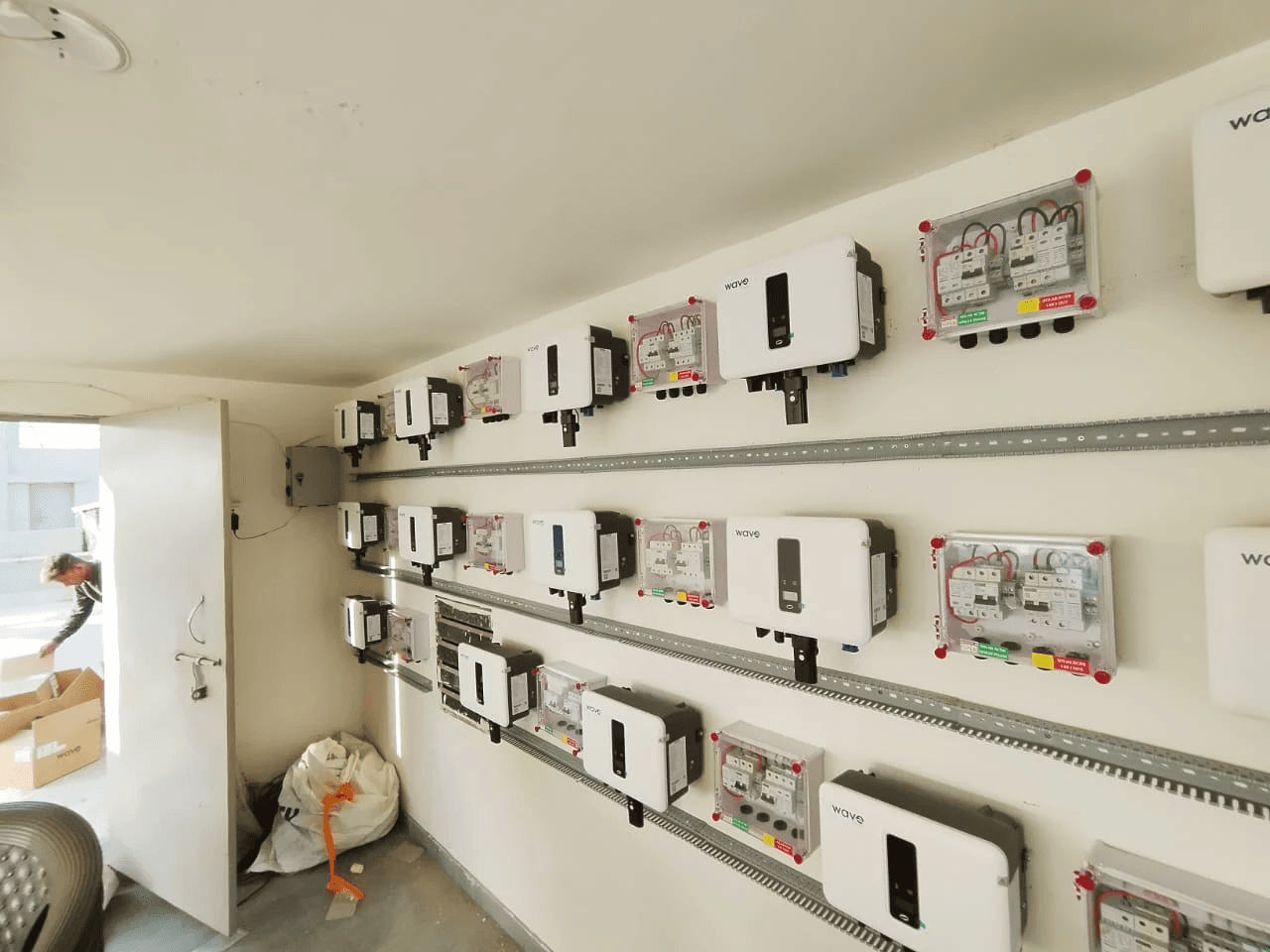
Founded in 2018 in Surat, Earthwave has grown from a 100kW installation in 2019 to completing an 80 MW ground mount for Mahindra Sustain in 2021.
In 2024, they launched their own inverter manufacturing unit under the Wave Inverter brand, and by 2025, they expanded into solar module manufacturing and multiple states.
Residential/Rooftop Solar:
Systems that reduce electricity bills by up to 100%, with installation done in a few days and ROI within 3 to 4 years.
Commercial and Industrial Solar:
Reduces power costs by 30 to 40% for factories, warehouses, and commercial buildings.
Ground Mount Solar:
For properties with limited roof space, built on durable steel structures.
Wave Hybrid Inverters:
Up to 97% efficiency, 2.5kW to 125kW, 10-year warranty, smart monitoring.
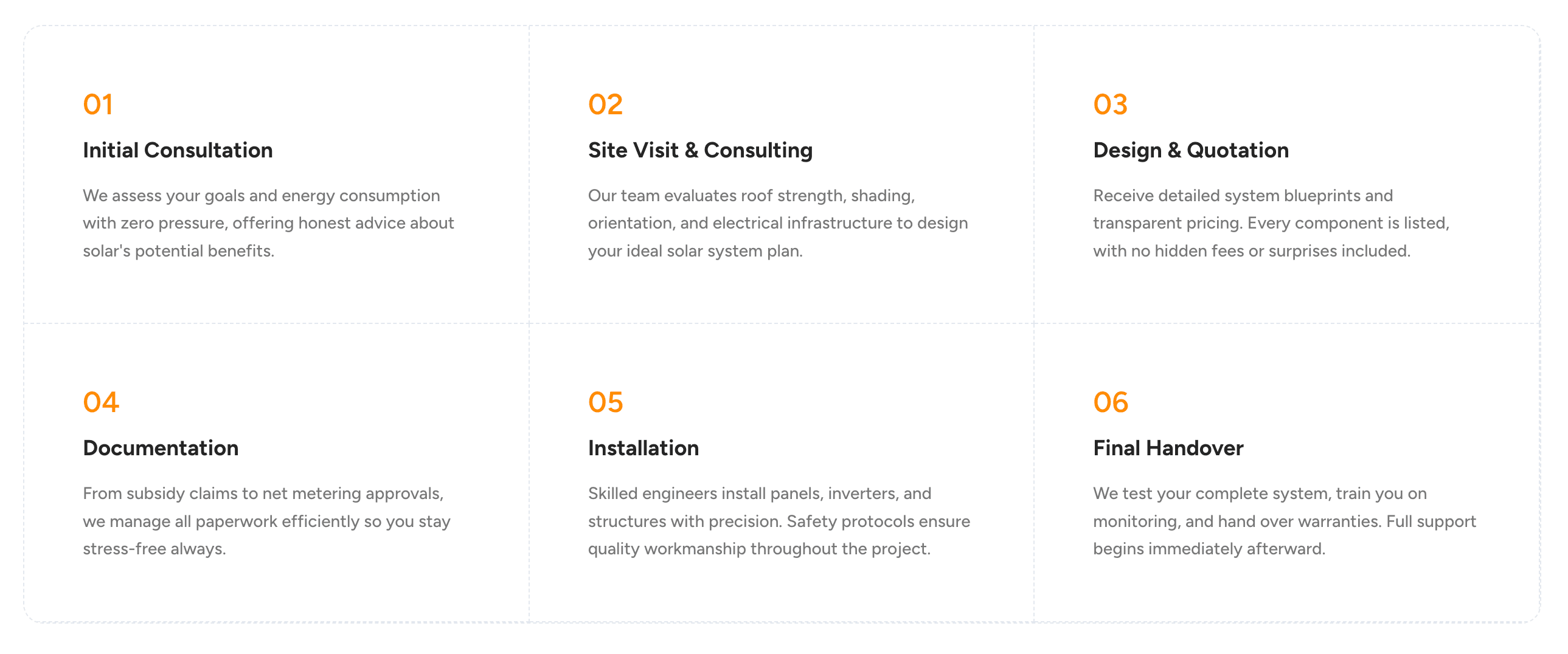
Free initial consultation to understand your energy needs
Site visit and technical assessment
Detailed system design with transparent pricing
Full documentation: subsidy claims, DISCOM approvals, paperwork
Installation by certified technicians with final handover and training
Clients like Goldi Solar, Torrent Power, Mahindra Sustain, and DGVCL trust Earthwave for quality and reliability.
Choosing the wrong inverter size or battery bank is the single most common mistake Indian homeowners make.
An undersized inverter trips under load. An oversized one wastes money upfront and underperforms daily.
A professionally designed system by Earthwave Solar accounts for your actual load, roof orientation, shadow analysis, battery chemistry, and grid tariff to give you the most cost-effective setup.
If you live in a Tier 1 or Tier 2 city, face 2 to 6 hours of daily power cuts, and pay electricity bills above Rs. 3,000 per month, a hybrid solar system with battery backup will pay for itself in 3 to 5 years and give you free electricity for 20+ years after.
A hybrid inverter of 3kW to 3.6kW capacity is best for a 3kW solar system. It manages solar generation, battery charging, and grid power together, giving you both savings and backup during power cuts.
For an 8-hour backup with a 500W essential load, you need 4 to 6 batteries of 150Ah (12V) using lithium chemistry. The exact count depends on your actual backup load and depth of discharge. Always consult a solar professional for accurate sizing.
A normal inverter only works on battery and grid power. A hybrid solar inverter also connects to your solar panels, charges the battery from solar first, and uses the grid only when needed. This reduces your electricity bill significantly compared to a normal inverter.
No. Standard on-grid inverters do not support battery backup. You need to replace it with a hybrid inverter or add a separate battery inverter in parallel. Plan for battery compatibility before you buy your initial inverter.
A 3 BHK flat with 2 ACs typically needs a 4kW to 5kW hybrid inverter. Calculate your total running load, add 25% buffer, and match that to available inverter sizes. A site assessment by an expert like Earthwave Solar gives you the most accurate recommendation.
Stop guessing your inverter size and backup hours. Get a free site assessment from Earthwave Solar.
Where their certified engineers calculate your exact load, recommend the right inverter, and handle everything from design to installation with zero hidden costs.
Visit earthwavetech.in or call +91 90336 07212 (Surat) to book your consultation today.
FAQS
Can't find the answer you're looking for? Our team is here to help.
SUBSCRIBE NEWSLETTER
Switching to solar is easier than you think. Let us guide you to cleaner, more affordable energy.
