Solar inverter selection India
How to Choose the Right Solar Inverter for Your Home
2026-04-09T00:00:00.000Z•8
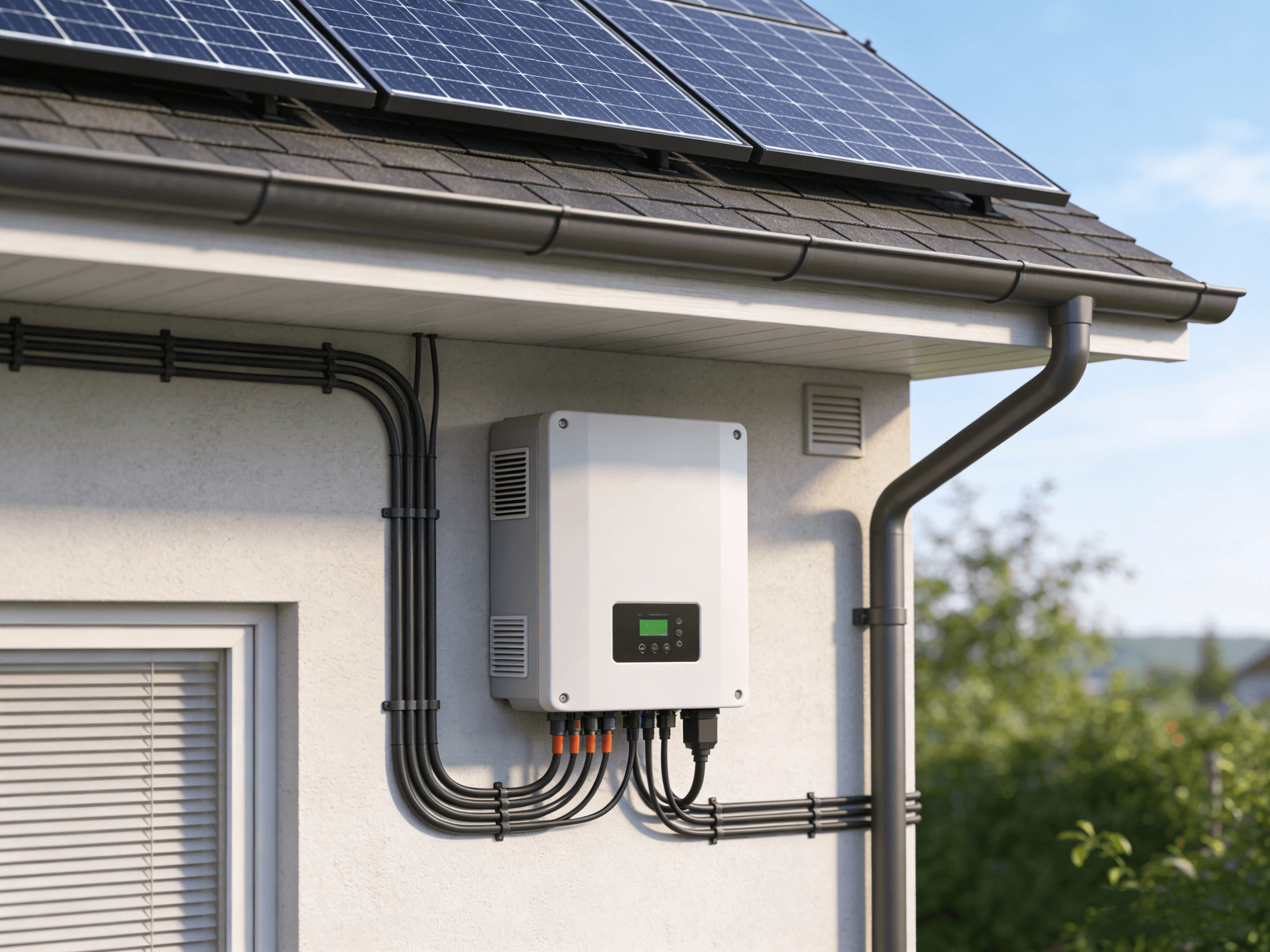
The right solar inverter for your home depends on two things: how stable your grid is and what your monthly electricity bill looks like.
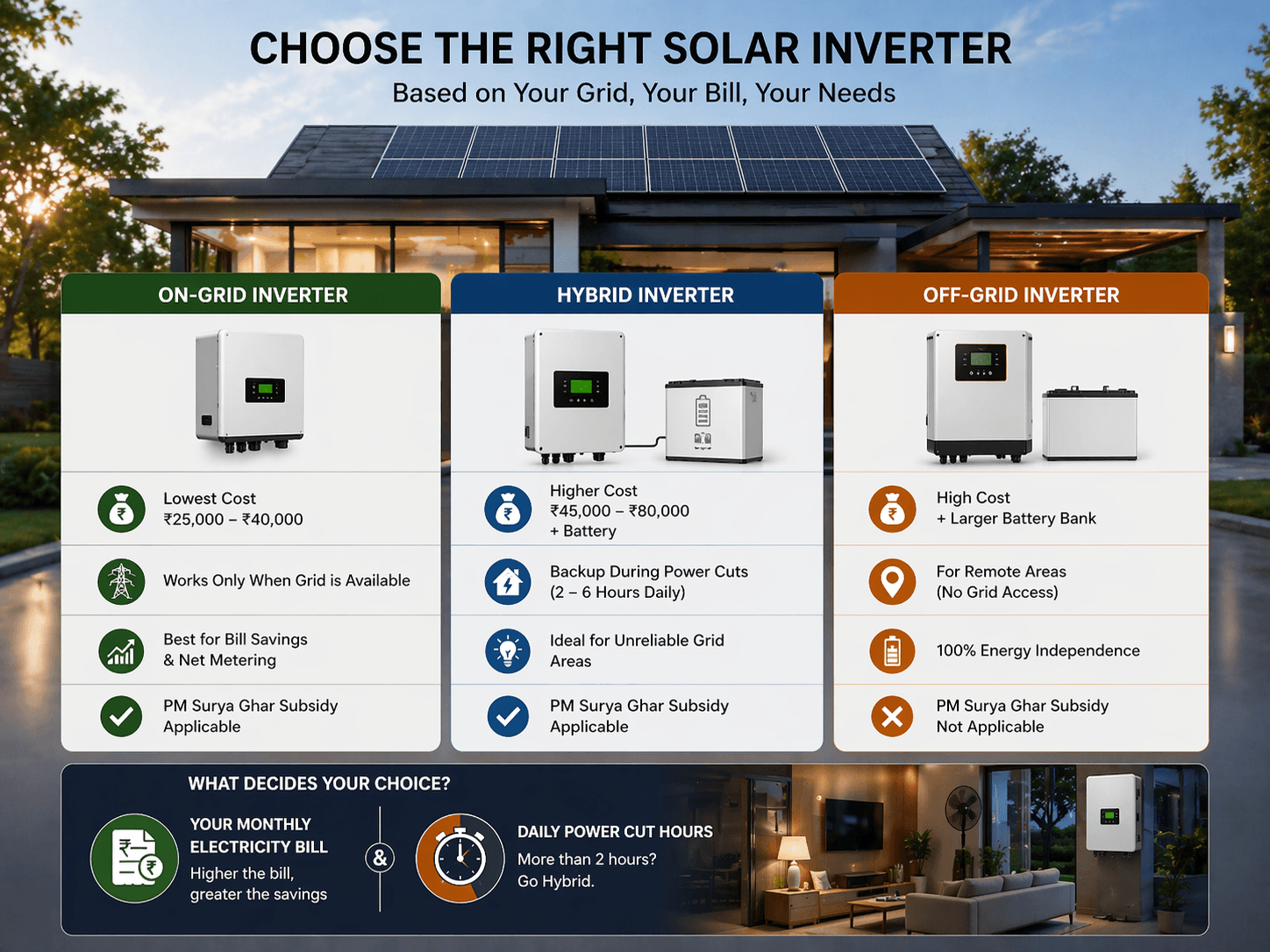
If your area has a reliable grid and your goal is bill reduction, on-grid is the most cost-effective choice. If you face 2 to 6 hours of daily power cuts, hybrid is worth the extra investment.
On-grid inverters
are cheapest (₹25,000 to ₹40,000) but go dark during power cuts
Hybrid inverters
cost more (₹45,000 to ₹80,000 plus battery) but keep your home running during outages
Off-grid inverters
suit remote locations with no grid access; not ideal for urban or semi-urban homes
Your monthly bill and daily cut hours
are the two numbers that determine your correct inverter type
PM Surya Ghar subsidy applies only to on-grid and hybrid systems
connected to the DISCOM grid
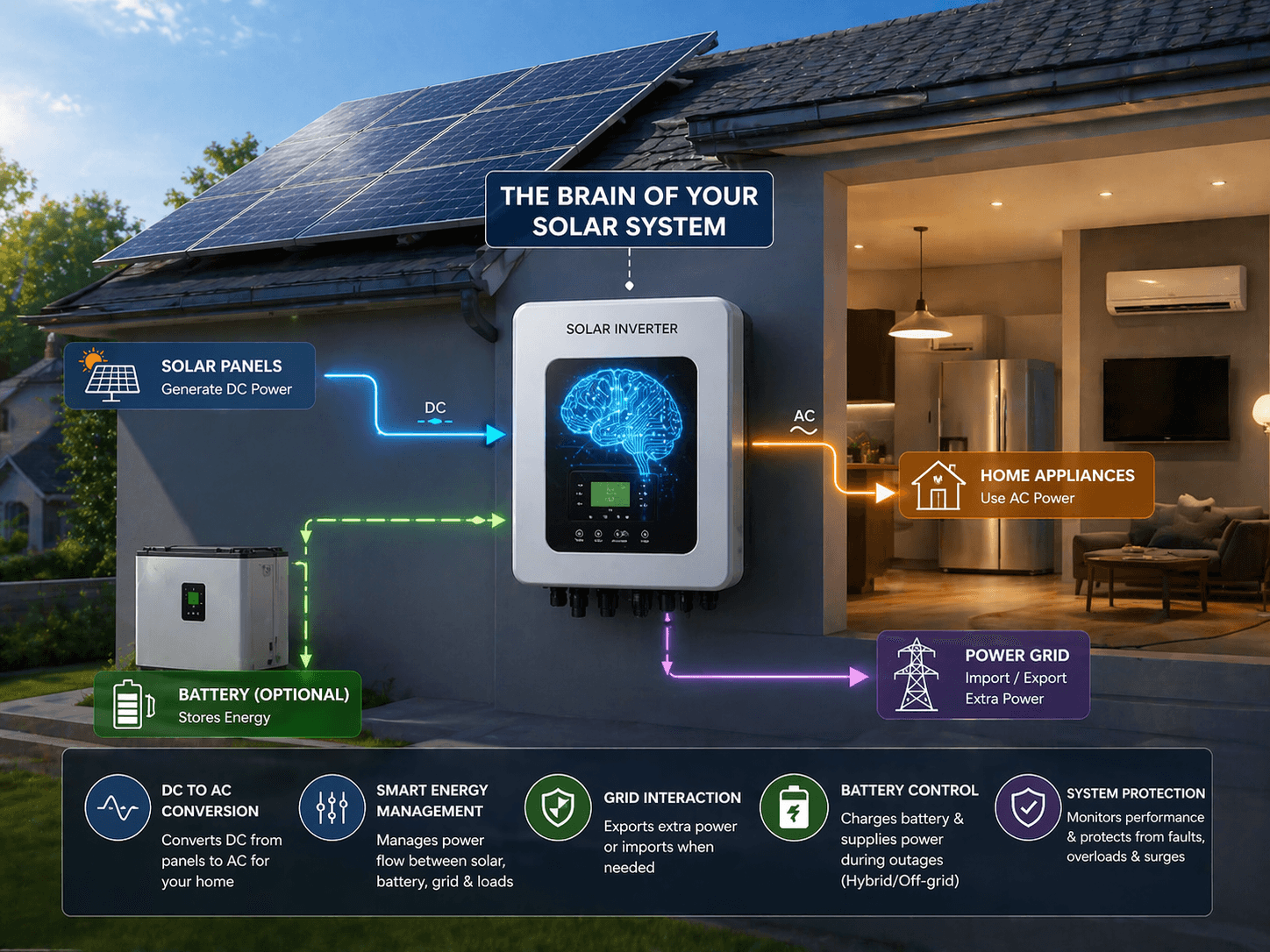
A solar inverter converts DC electricity from your solar panels into AC electricity that your home appliances use.
Without it, your panels generate unusable power. Every solar system needs one.
The inverter also controls how your system interacts with the grid, your battery (if any), and your home load.
That interaction logic is what separates on-grid, hybrid, and off-grid types from each other.
Think of the inverter as the brain of your solar system. Choosing the wrong brain for your situation means your system either cannot handle power cuts, costs more than it needs to, or both.
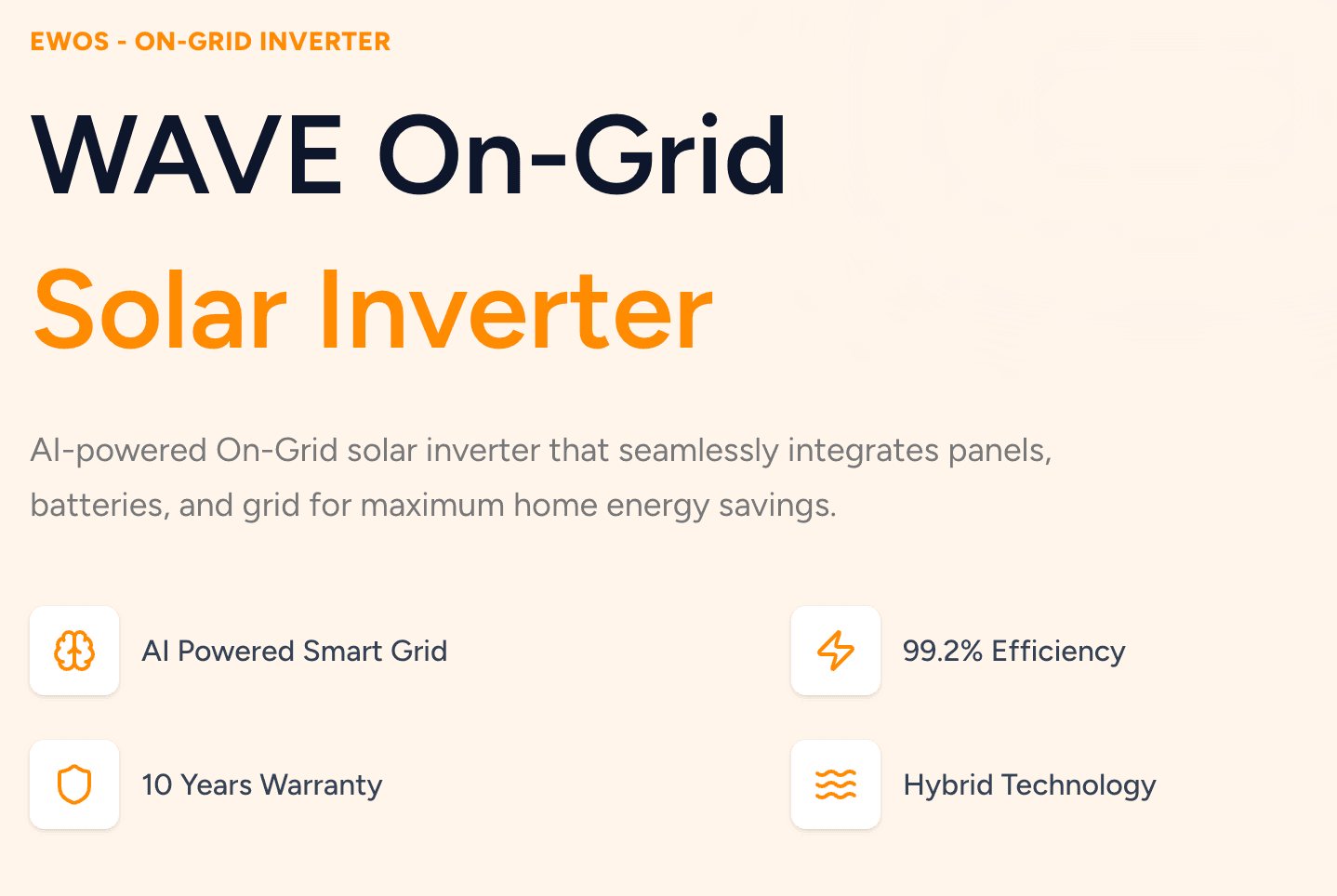
An on-grid inverter connects your solar panels directly to the DISCOM grid and reduces your electricity bill through net metering.
How it works:
Solar panels generate power during daylight
Your home uses that power first
Surplus power exports to the grid and earns net metering credits
No battery storage involved
Key limitations:
Shuts off completely during power cuts (mandatory anti-islanding safety requirement under Indian grid codes)
Entirely dependent on grid availability to function
Zero backup during outages, even on a sunny day
Best for: Homes with a stable grid, monthly bills above ₹3,000, and fewer than 30 minutes of daily cuts.
Typical cost: ₹80,000 to ₹1.4 lakh for a 3 kW system fully installed.
A hybrid inverter manages solar panels, a battery bank, and the grid simultaneously, giving you both bill savings and backup power during cuts.
How it works:
Solar powers your home during the day
Surplus energy charges your battery
During a power cut, the inverter switches to battery in milliseconds
If solar and a power cut both happen at the same time, panels charge battery and run your load together
Best for: Homes with 2 to 8 hours of daily cuts, work-from-home setups, and anyone with critical loads that cannot tolerate outages.
Typical cost: ₹2.3 to ₹3.2 lakh for a 3 kW system with a 10 kWh lithium battery fully installed.
Read the full breakdown: Hybrid vs On-Grid Solar Inverter: Backup Hours, Battery Size and Cost.
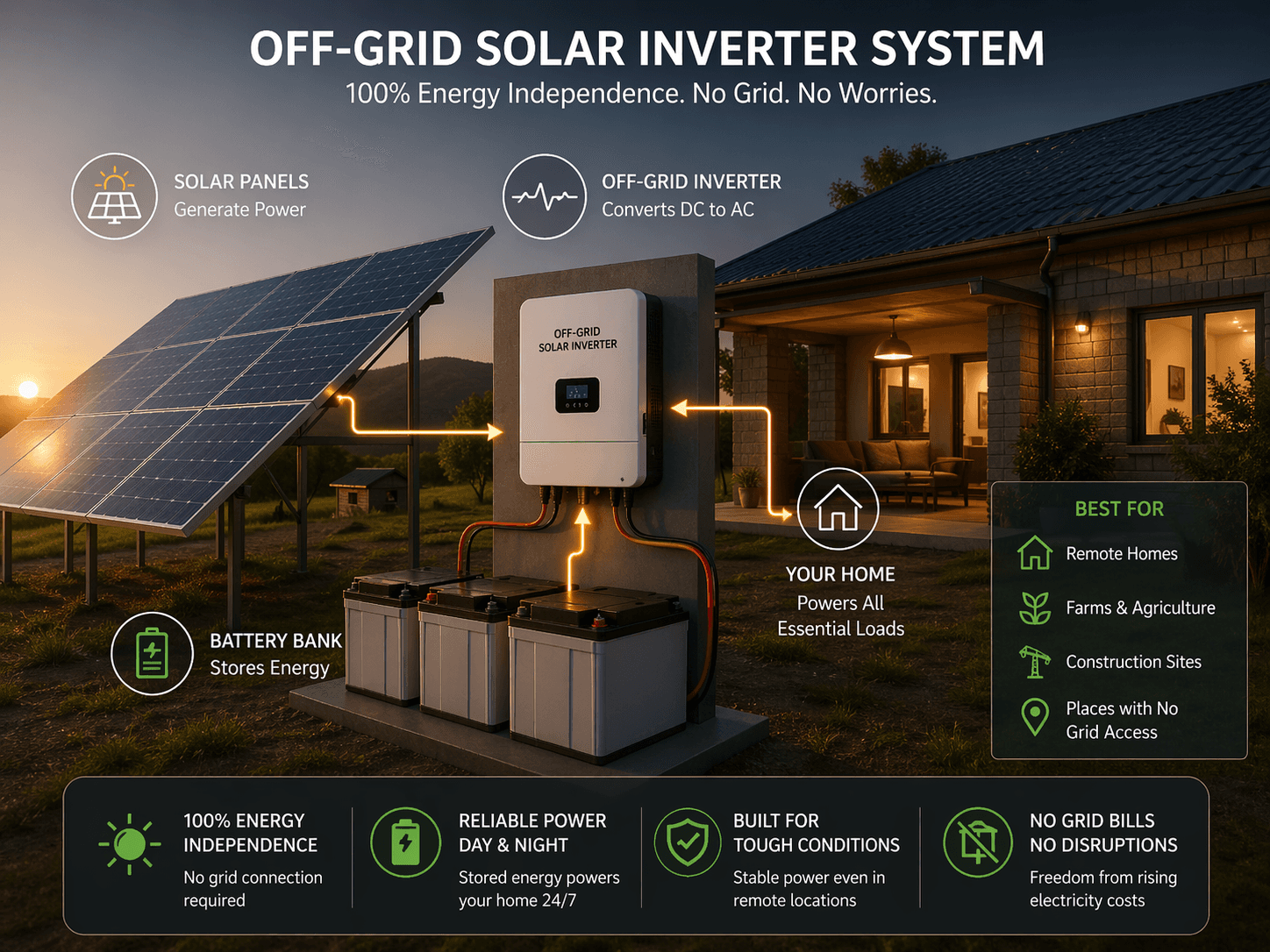
An off-grid inverter runs your home entirely on solar and battery, with zero grid connection.
How it works:
Panels charge a large battery bank throughout the day
Your home draws power from batteries at all times
No grid export, no net metering, no grid backup
Limitations for urban Indian homes:
Requires a much larger battery bank to cover nights and cloudy days
No grid backup means a cloudy week can drain your batteries completely
Cannot claim PM Surya Ghar subsidy (no DISCOM connection)
Higher total cost with lower ROI compared to hybrid
Best for: Farms, remote properties, construction sites, or locations with no grid access at all.
Not recommended for homes in Surat, Ahmedabad, Bhopal, Indore, Pune, or any city with grid access.
Factor | On-Grid | Hybrid | Off-Grid |
Works during power cut | No | Yes | Yes |
Battery required | No | Yes | Yes (large bank) |
System cost (3 kW) | ₹80,000 to ₹1.4L | ₹2.3L to ₹3.2L | ₹2.5L to ₹4L+ |
Net metering eligible | Yes | Yes | No |
PM Surya Ghar subsidy | Yes | Yes | No |
Payback period | 3 to 4 years | 5 to 7 years | 7 to 10 years |
Best grid condition | Stable grid | Unreliable grid | No grid |
Scalability | Easy | Easy | Complex |
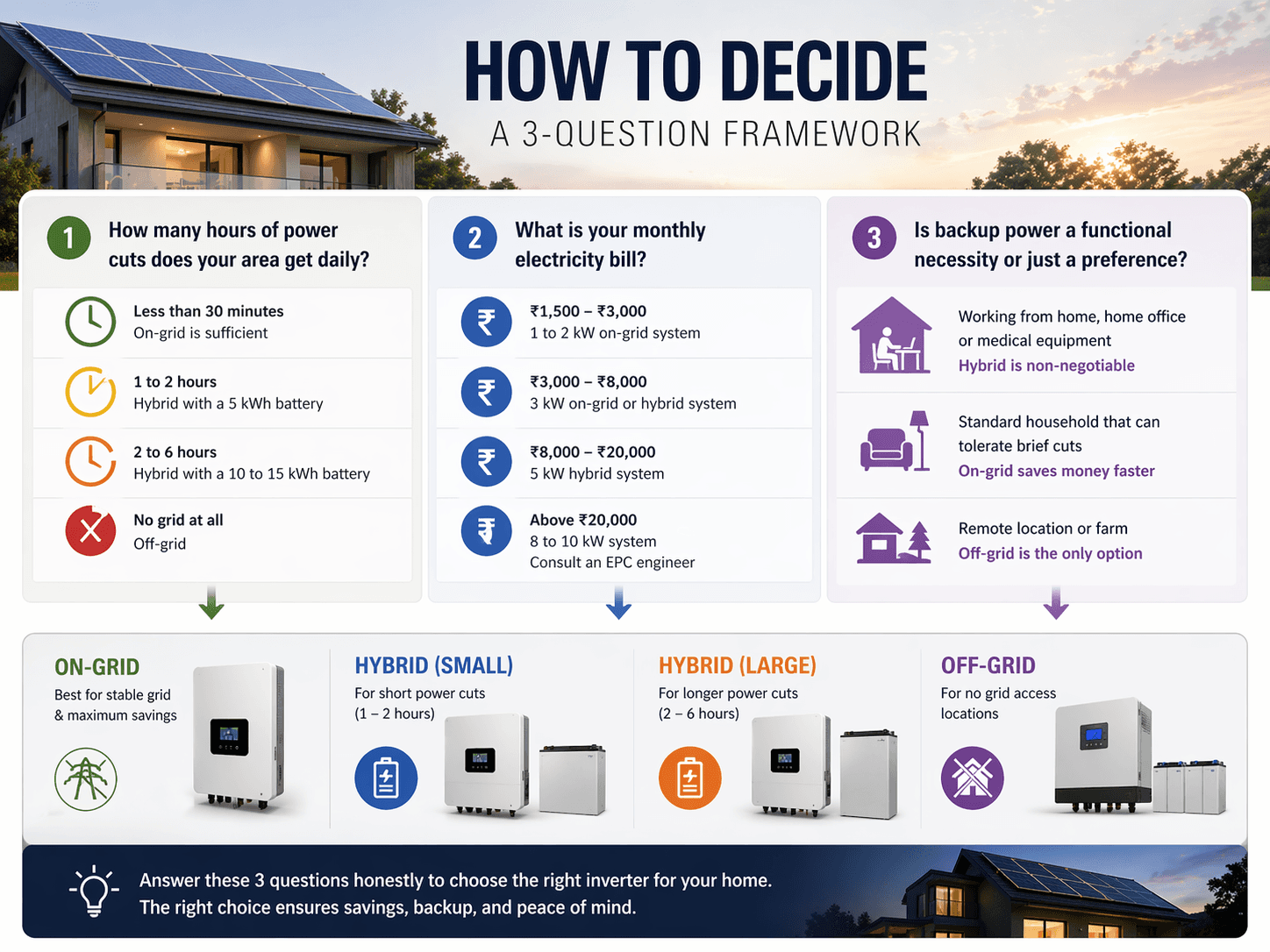
You can identify the right inverter type by answering three questions about your home.
Less than 30 minutes: On-grid is sufficient
1 to 2 hours: Hybrid with a 5 kWh battery
2 to 6 hours: Hybrid with a 10 to 15 kWh battery
No grid at all: Off-grid
₹1,500 to ₹3,000: A 1 to 2 kW on-grid system reduces it to near zero
₹3,000 to ₹8,000: A 3 kW on-grid or hybrid system fits well
₹8,000 to ₹20,000: A 5 kW hybrid system gives both savings and backup
Above ₹20,000: A 8 to 10 kW system; consult an EPC engineer for exact sizing
Working from home, running a home office or medical equipment: Hybrid is non-negotiable
Running a standard household that can tolerate brief cuts: On-grid saves money faster
Living in a remote location or farm: Off-grid is the only option
A 5 kW hybrid solar system in Surat with a 10 kWh lithium battery gives a realistic payback of 5 to 6 years with zero power cuts at home.
Monthly electricity bill before solar:
₹7,500 (at ₹7.5/unit)
System size:
5 kW hybrid with 10 kWh LFP battery
Total system cost:
₹3.8 to ₹4.5 lakh
Monthly savings on bill:
₹5,500 to ₹6,500
Backup coverage:
3 to 4 hours for essential loads (fans, lights, TV, WiFi)
Payback period:
5.5 to 6 years
Net savings over 25 years
: ₹14 to ₹18 lakh (post maintenance)
For a family working from home with 3 to 4 hours of daily cuts in areas like Varachha or Katargam in Surat, the hybrid premium pays for itself through the eliminated productivity loss alone, before you count the bill savings.
Explore how solar reduces electricity bills for Gujarat homeowners: Reduce Electricity Bill with Solar in Gujarat.

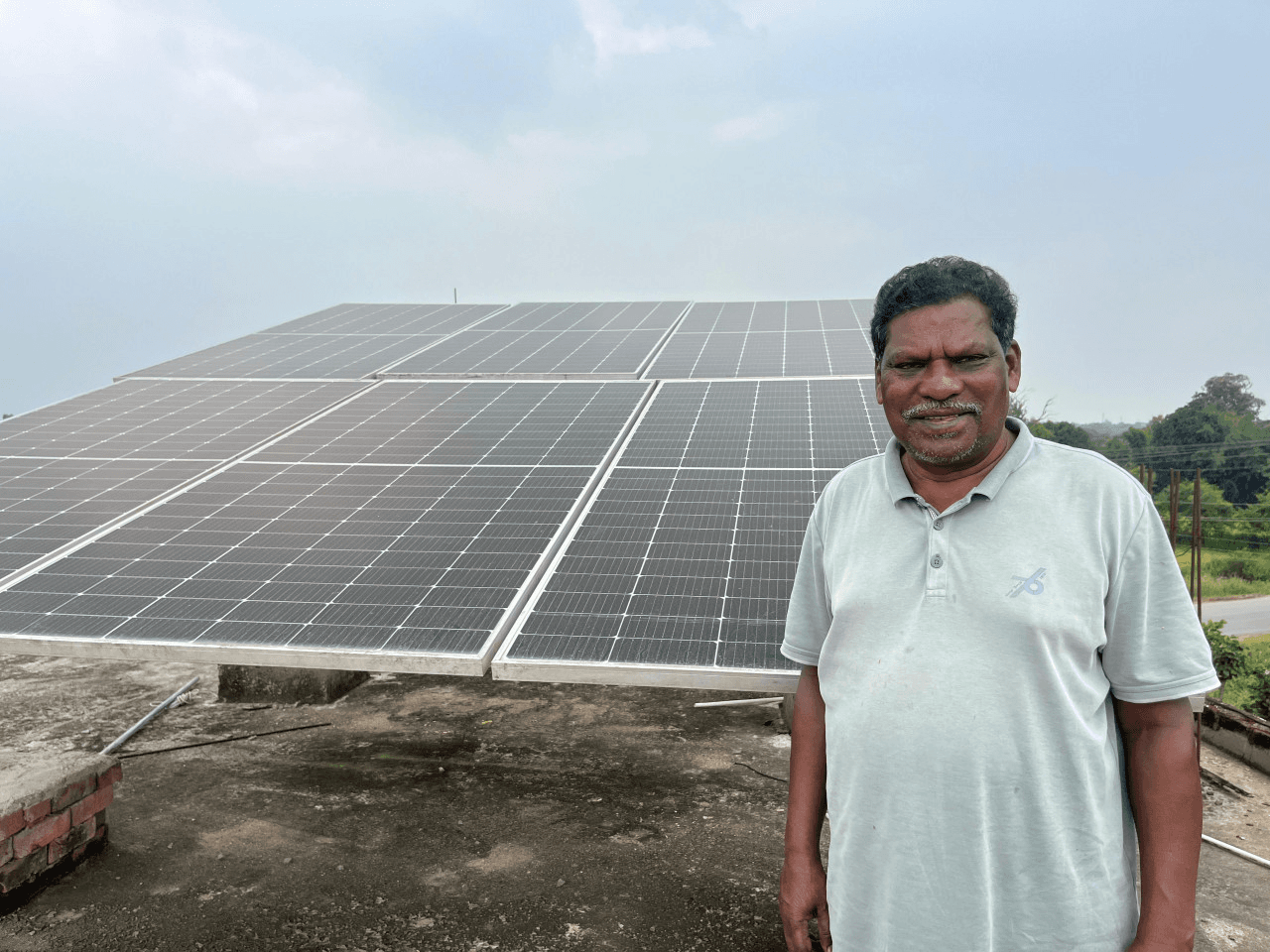
PM Surya Ghar Muft Bijli Yojana provides ₹30,000 to ₹78,000 subsidy for on-grid and hybrid systems connected to the DISCOM grid.
Subsidy structure for residential rooftop solar:
Up to 2 kW: ₹30,000 per kW subsidy
2 to 3 kW: ₹18,000 per kW for the additional capacity
Above 3 kW: Flat ₹78,000 total subsidy cap
Off-grid systems do not qualify because they have no DISCOM grid connection, which is a mandatory requirement for subsidy eligibility.
For Gujarat-specific subsidy details and application steps, read: Solar Subsidy in Gujarat 2026: Full Guide.
Net metering lets you export surplus solar power to the grid and earn credits that offset your future electricity bills.
Both on-grid and hybrid systems are net metering eligible in India. Off-grid systems are not.
Your solar system generates more than your home needs during peak afternoon hours
Surplus units export to the DISCOM grid
DISCOM records the exported units
Your next bill deducts those units from your consumption
Effective result: Your meter runs backwards during sunny days
Read our complete guide: Net Metering Income from Solar in Gujarat.
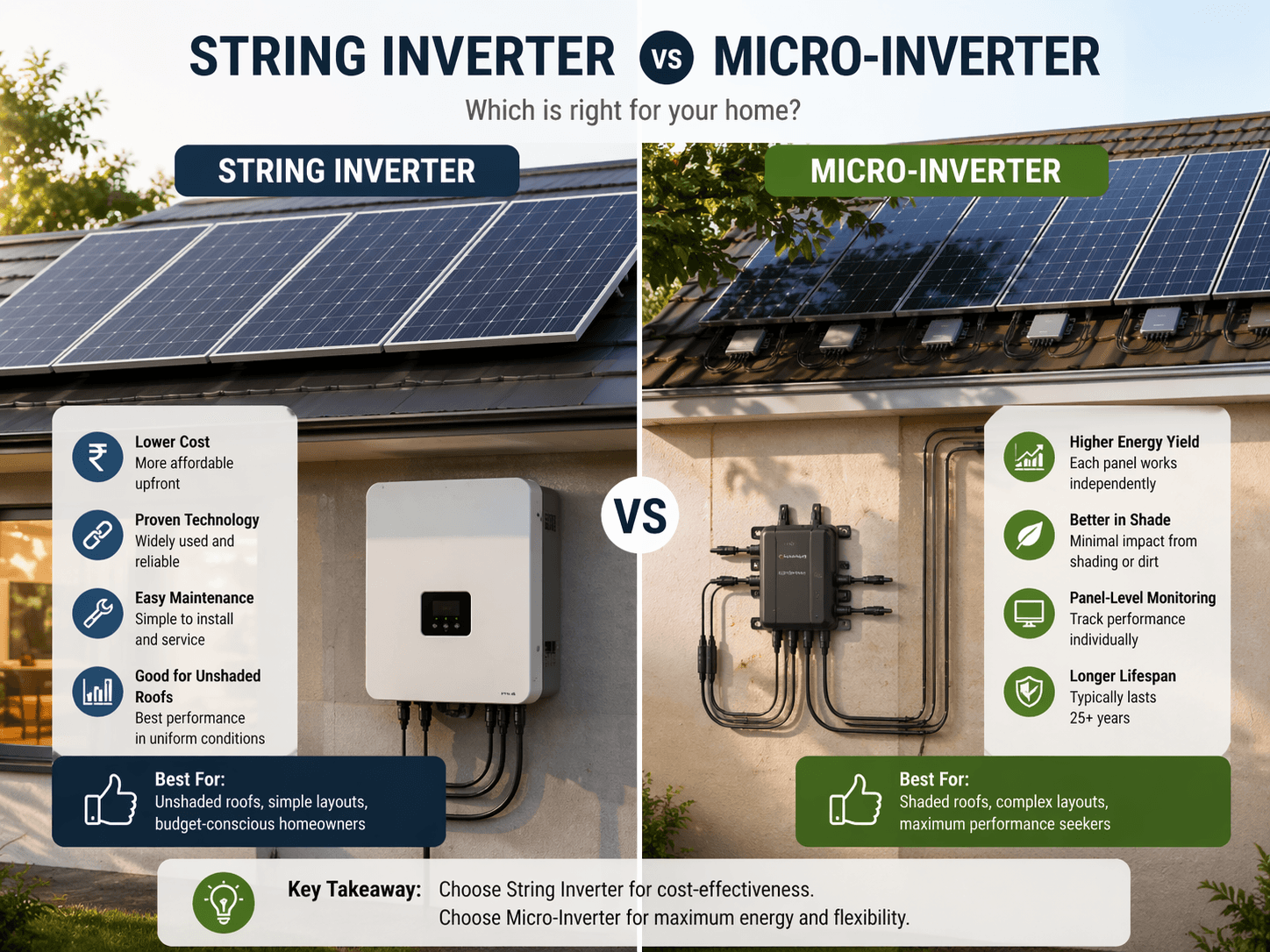
For most Indian homes, a string inverter is the practical and cost-effective choice. Micro-inverters suit complex roof layouts with heavy shading.
Factor | String Inverter | Micro-Inverter |
Cost | ₹25,000 to ₹80,000 | 2 to 3x higher per kW |
Shading impact | One shaded panel reduces whole string output | Each panel works independently |
Monitoring | System-level | Panel-level |
Best for | Simple rooftops, minimal shading | Complex multi-angle roofs |
Maintenance | One unit to service | Multiple units per panel |
For apartment buildings and housing societies, a central string inverter with a well-designed panel layout is cost-efficient and easy to maintain.
Property investors and builders developing multi-unit societies should read our apartment solar installation guide for system sizing and layout best practices.
Your inverter capacity should match your solar panel capacity, not your peak household load.
Quick sizing reference:
Home Size | Monthly Bill | Recommended Inverter Size |
1 BHK | ₹1,500 to ₹3,000 | 1 to 2 kW |
2 BHK | ₹3,000 to ₹6,000 | 3 kW |
3 BHK | ₹6,000 to ₹12,000 | 5 kW |
3 BHK + AC heavy use | ₹12,000 to ₹20,000 | 7 to 8 kW |
Bungalow / Villa | ₹20,000+ | 10 kW+ |
Always size the inverter at 10 to 20% above your panel wattage to allow for DC oversizing.
For example, a 5 kW inverter can typically handle 5.5 to 6.5 kW of panels, which improves morning and evening generation.
For full panel cost and sizing details, read: Solar Panel Cost in India 2026.
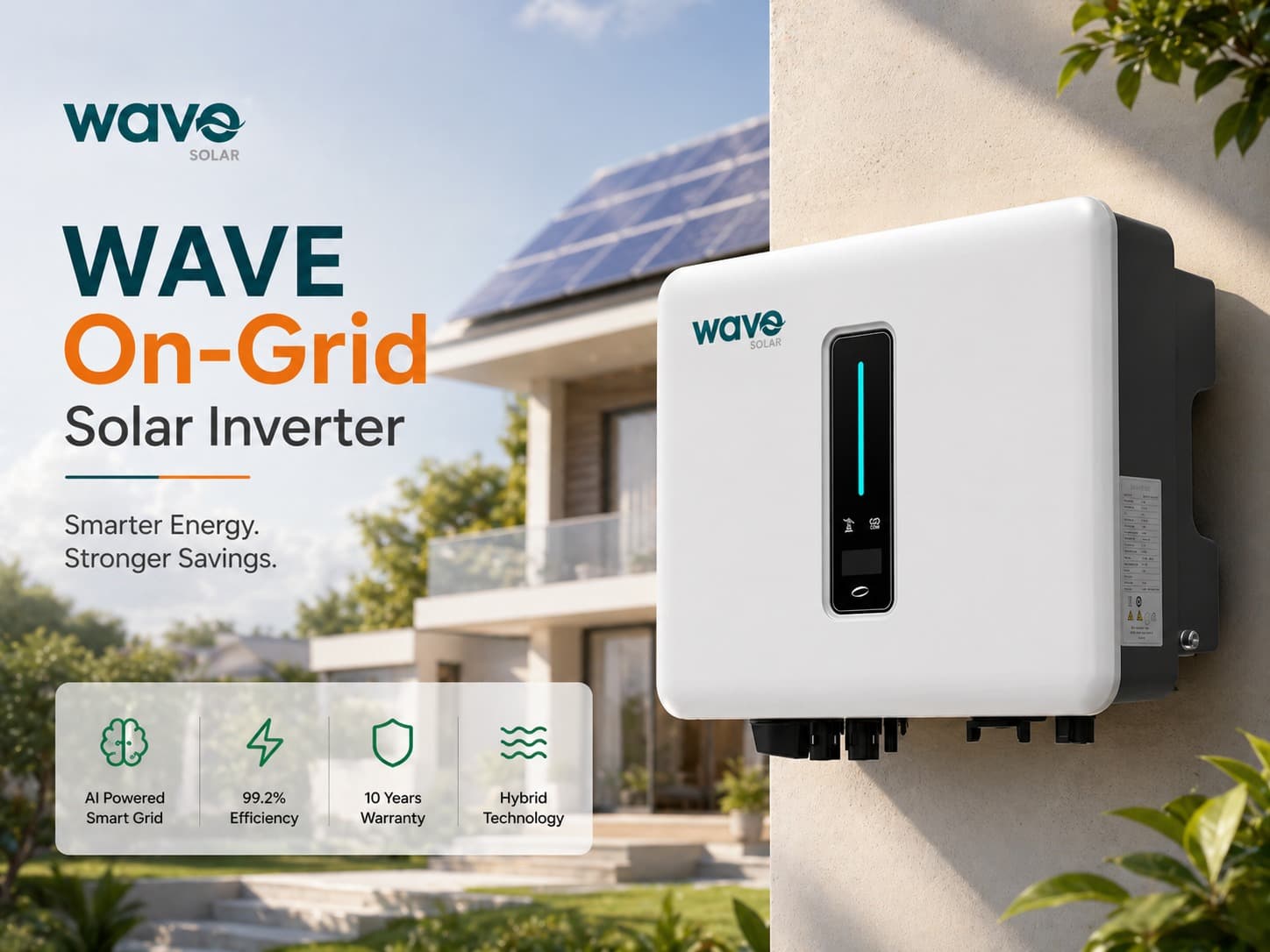
Earthwave Solar manufactures the Wave inverter range (2.5 kW to 125 kW) specifically designed for Indian voltage fluctuations, high temperatures, and mixed grid conditions.
Wave inverter key features for homeowners:
Efficiency:
Up to 97%, one of the highest in its class
Capacity:
2.5 kW to 125 kW; covers 1 BHK apartments to large villas and commercial buildings
Battery compatibility:
Supports both lithium and lead-acid batteries
Grid tolerance:
Handles the wide voltage and frequency fluctuations common in Indian DISCOMs
Monitoring:
Real-time smartphone dashboard showing generation, consumption, and battery state
Warranty:
10 years, backed by Earthwave's in-house service team
Weather rating:
IP65 rated, suitable for rooftop installation in humid coastal cities like Surat
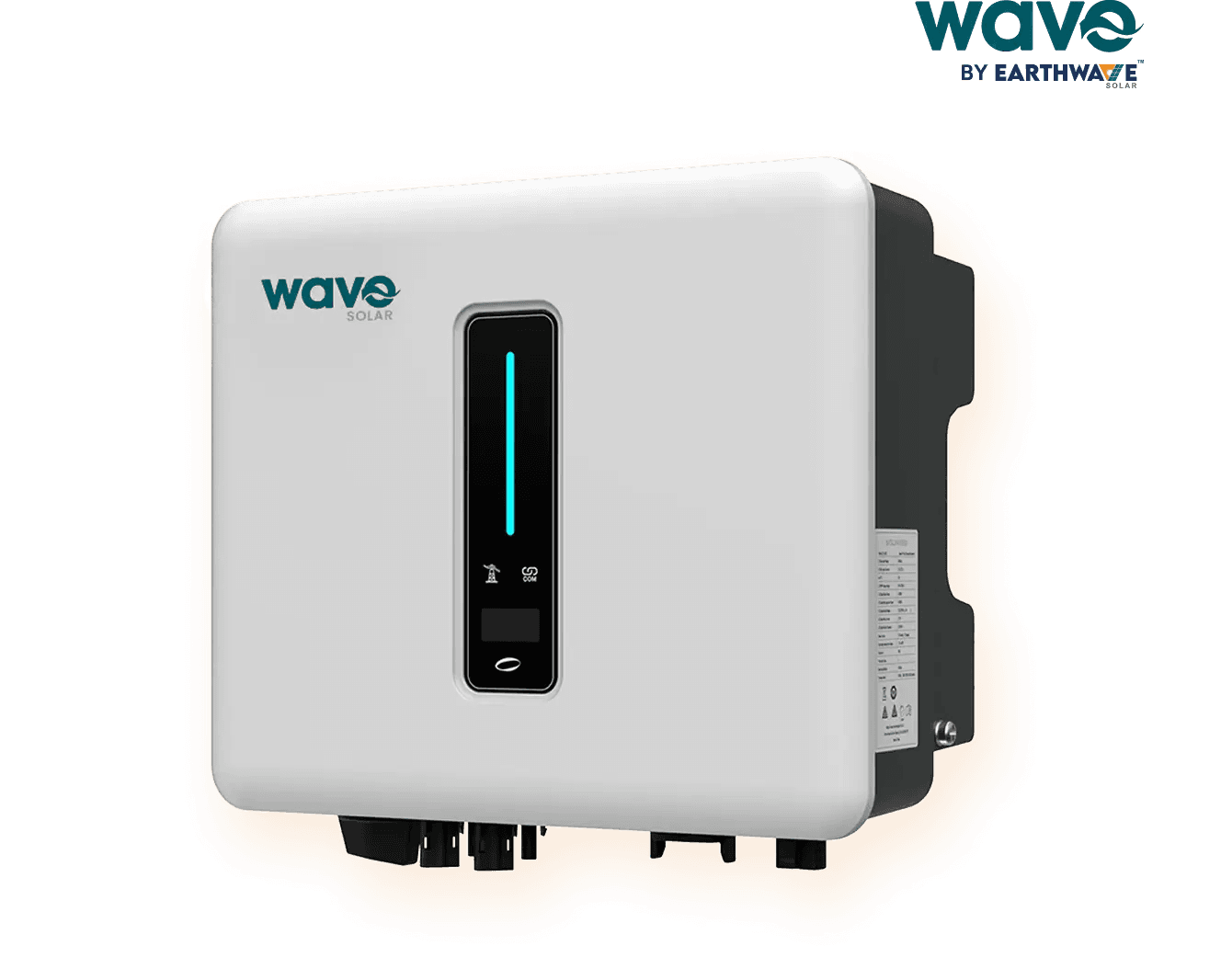
See how Wave compares to other leading brands: Wave Inverters vs Leading Solar Inverter Brands in India.
Download full technical specs: Wave Inverter Datasheets.
Earthwave Solar is a full-spectrum EPC company that engineers, supplies, and commissions your entire solar system, from the first site visit to the final DISCOM approval.
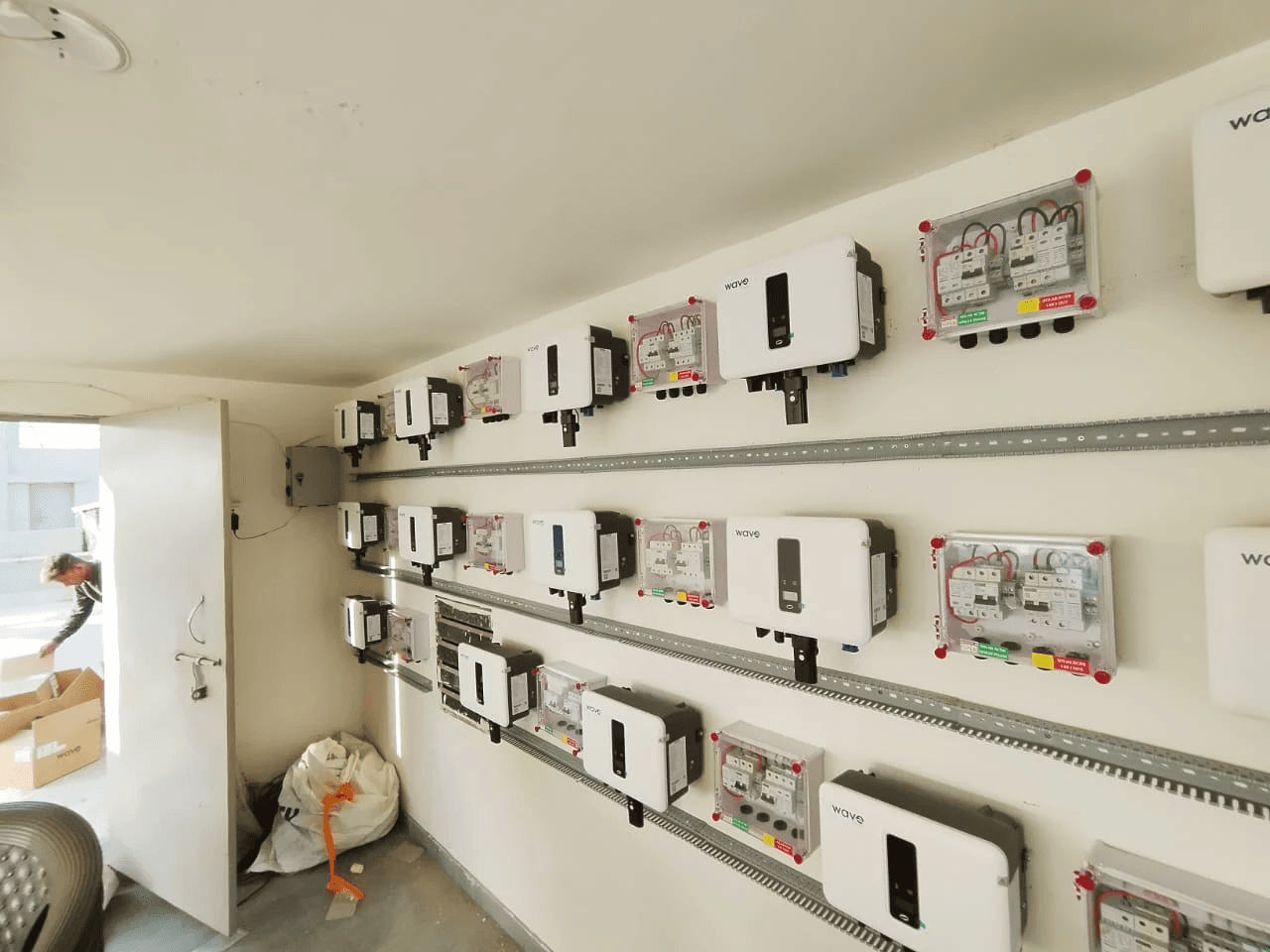
They do not just sell inverters. They design the right system for your specific home, load profile, and local grid conditions.
Their process:
Free Consultation:
Understand your bill, cut hours, and budget
Site Visit:
Assess roof area, shading, wiring condition, and load pattern
System Design:
Custom inverter type, panel count, and battery size recommendation
Transparent Quote:
Component-by-component pricing with no hidden charges
Installation:
Certified technicians handle structure, wiring, inverter setup, and battery integration
Final Handover:
DISCOM net metering filing, subsidy application, and smart monitoring setup
Earthwave has delivered projects from 30 kW residential apartment installations (Casa Amorina, 30 kW; Shivdhara Skylight, 80 kW) to utility-scale 80 MW ground-mount projects for Mahindra Susten.
Explore their services:
Already planning your rooftop system? Read the step-by-step guide: How to Plan Rooftop Solar for Your Home.
A hybrid solar inverter with a lithium battery bank is the best choice for homes with 2 or more hours of daily power cuts. It keeps essential appliances running during outages while still reducing your electricity bill through net metering. On-grid inverters shut off completely during grid outages.
No. An on-grid inverter requires the grid to be active in order to function. When the grid goes down, the inverter shuts off automatically as a safety measure (anti-islanding protection). To get power during cuts, you need a hybrid inverter with battery storage.
Both on-grid and hybrid inverters qualify for PM Surya Ghar subsidy, provided they connect to the DISCOM grid and meet BIS certification requirements. Off-grid inverters do not qualify. The subsidy covers up to ₹78,000 for systems up to 3 kW for residential rooftop installations.
A quality solar inverter lasts 10 to 15 years under normal operating conditions. Most manufacturers offer a 5 to 10-year warranty. Wave inverters by Earthwave Solar carry a 10-year warranty. After warranty, inverter replacement costs ₹30,000 to ₹70,000 depending on capacity.
Yes, but you cannot simply add a battery to an on-grid inverter. You must replace the inverter entirely with a hybrid unit and add a compatible battery bank. The upgrade costs ₹1.5 to ₹1.9 lakh for a 3 to 5 kW system. Your existing panels and DC wiring remain usable and do not need replacement.
If your bill is above ₹4,000 per month or your area gets more than 1 hour of daily power cuts, a solar system will pay for itself within 4 to 6 years.
Earthwave Solar offers a free site visit and a custom system recommendation for your home, with transparent pricing and no sales pressure.
Gujarat:
+91 90336 07212
Madhya Pradesh:
+91 90336 02156
Email:
Website:
FAQS
Can't find the answer you're looking for? Our team is here to help.
SUBSCRIBE NEWSLETTER
Switching to solar is easier than you think. Let us guide you to cleaner, more affordable energy.
