Solar Panel Price India
Solar Panel Price in India 2026: Cost & Savings Guide
2026-05-07T00:00:00.000Z•9
In 2026, solar panel prices in India range from Rs. 30,000 to Rs. 1,10,000 per kW depending on system size, technology, and whether you include battery storage.
A well-sized solar system pays for itself in 3 to 6 years and generates free electricity for 20+ years after that.
For a broader benchmark, you can also review solar panel cost India.
A 1 kW solar system costs Rs. 50,000 to Rs. 75,000 installed in India in 2026.
A 3 kW system (ideal for most homes) costs Rs. 1.5 lakh to Rs. 2.1 lakh.
A 5 kW system (good for larger homes or small offices) costs Rs. 2.2 lakh to Rs. 3.5 lakh.
Commercial and industrial systems above 10 kW cost Rs. 35,000 to Rs. 55,000 per kW.
PM Surya Ghar Yojana subsidy reduces residential system costs by Rs. 30,000 to Rs. 78,000.
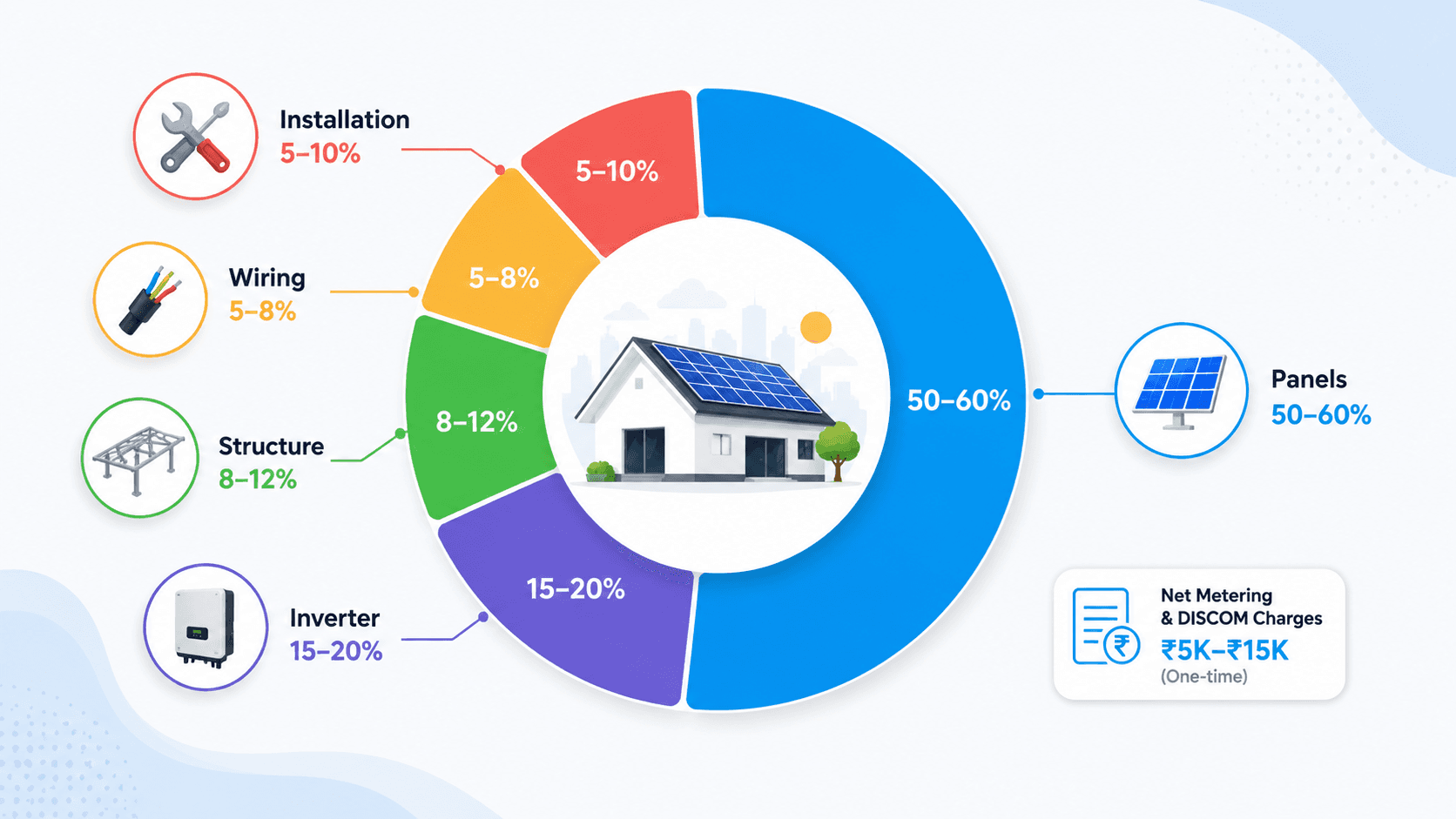
Solar panel price in India is never just the cost of the panels.
The total installed cost includes panels, inverter, mounting structure, wiring, installation labour, and grid connectivity fees.
Here is what goes into the final per-kW cost
Solar panels (modules)
50 to 60 percent of total system cost.
Solar inverter
15 to 20 percent of total cost.
Mounting structure
8 to 12 percent.
Wiring, switchgear, and earthing
5 to 8 percent.
Installation and commissioning
5 to 10 percent.
Net metering and DISCOM charges
Rs. 5,000 to Rs. 15,000 as a one-time cost.
If you are planning a home setup, see rooftop solar systems for homes in India. If you are evaluating a business project, check commercial solar installation for businesses.
The table below reflects real market prices for grid-tied solar systems without battery storage. These are installed costs, not just hardware.
System Type | Capacity | Approx. Installed Cost | Best Suited For |
On-Grid (Grid-Tied) | 1 kW | Rs. 50,000 - Rs. 75,000 | Studio/1BHK flat |
On-Grid (Grid-Tied) | 3 kW | Rs. 1,50,000 - Rs. 2,10,000 | 2BHK/3BHK home |
On-Grid (Grid-Tied) | 5 kW | Rs. 2,20,000 - Rs. 3,50,000 | Large home / small office |
On-Grid (Grid-Tied) | 10 kW | Rs. 3,80,000 - Rs. 5,50,000 | Commercial shop / SME |
Off-Grid (With Battery) | 3 kW | Rs. 2,50,000 - Rs. 3,80,000 | Areas with grid outages |
Off-Grid (With Battery) | 5 kW | Rs. 3,80,000 - Rs. 5,50,000 | Farmhouse / rural site |
Industrial Rooftop | 50 kW - 500 kW | Rs. 35,000 - Rs. 55,000 per kW | Factory / warehouse |
Commercial Campus | 500 kW - 5 MW | Rs. 30,000 - Rs. 45,000 per kW | Industrial park / SEZ |
Prices are indicative for 2026 market conditions. Actual quotes vary by state, brand, and site conditions.
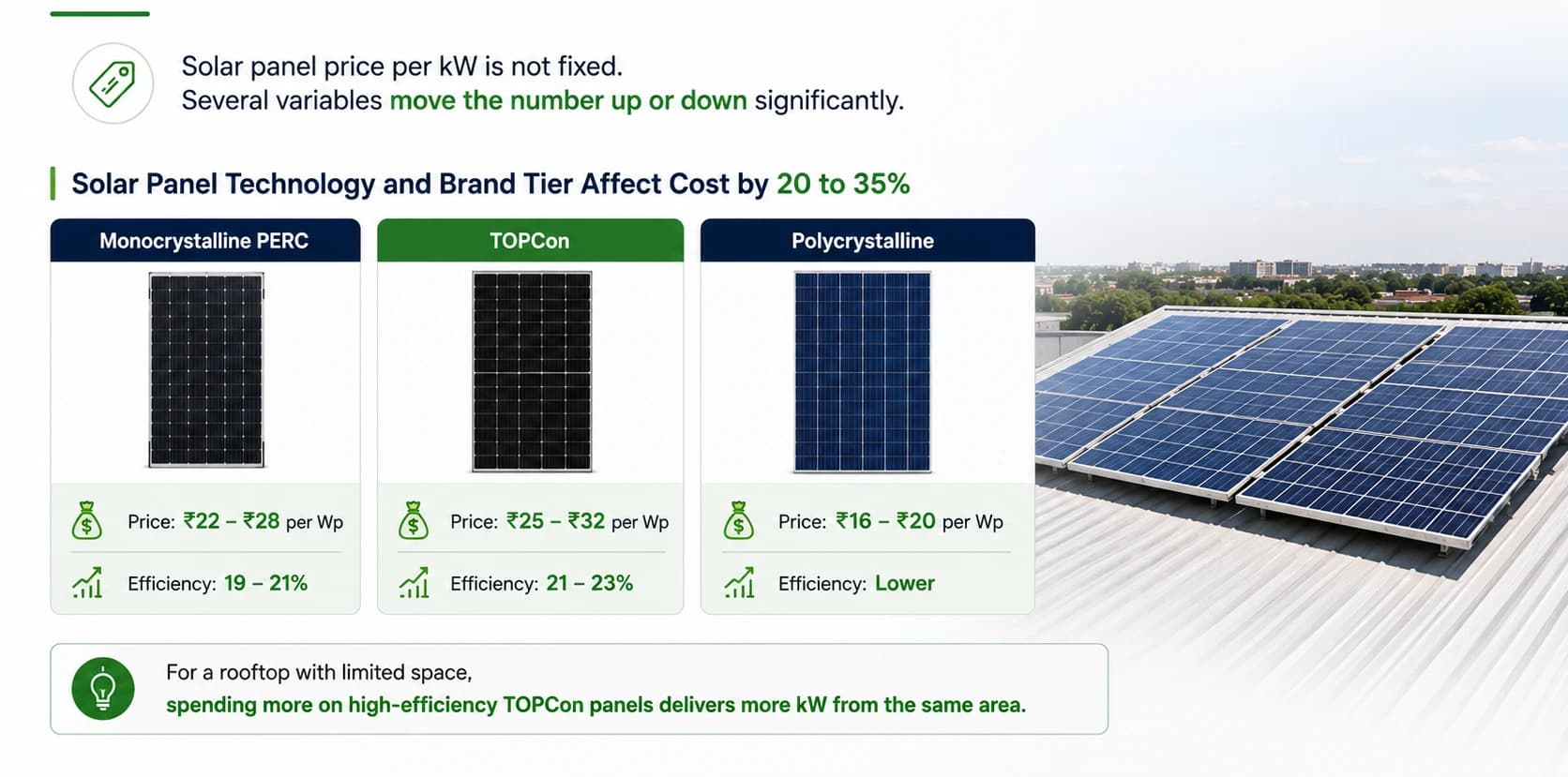
Solar panel price per kW is not fixed. Several variables move the number up or down significantly.
Monocrystalline PERC panels
cost Rs. 22 to Rs. 28 per Wp and deliver 19 to 21 percent efficiency.
TOPCon panels
cost Rs. 25 to Rs. 32 per Wp and deliver 21 to 23 percent efficiency.
Polycrystalline panels
cost Rs. 16 to Rs. 20 per Wp but are losing market share due to lower efficiency.
For a rooftop with limited space, spending more on high-efficiency TOPCon panels delivers more kW from the same area.
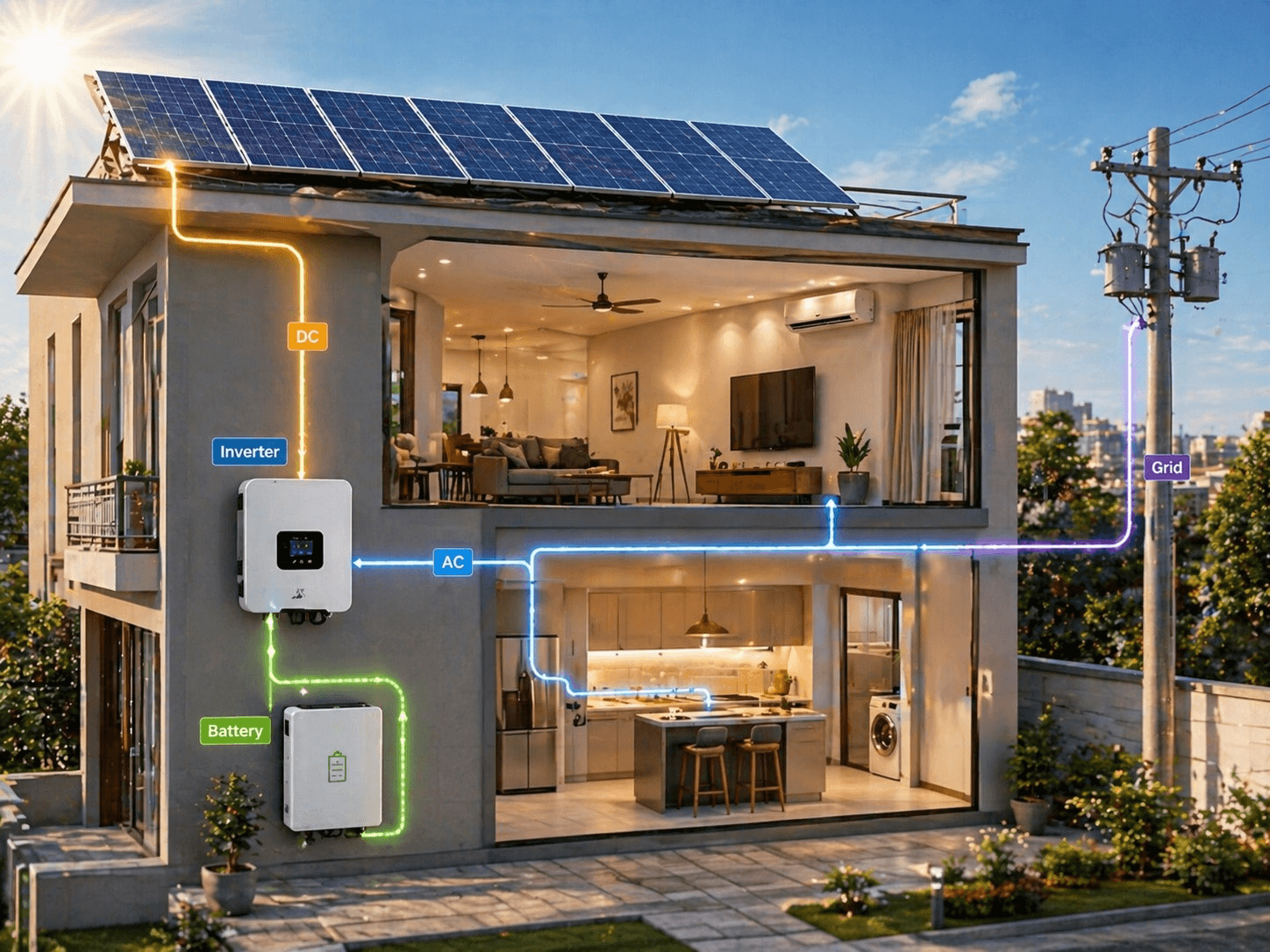
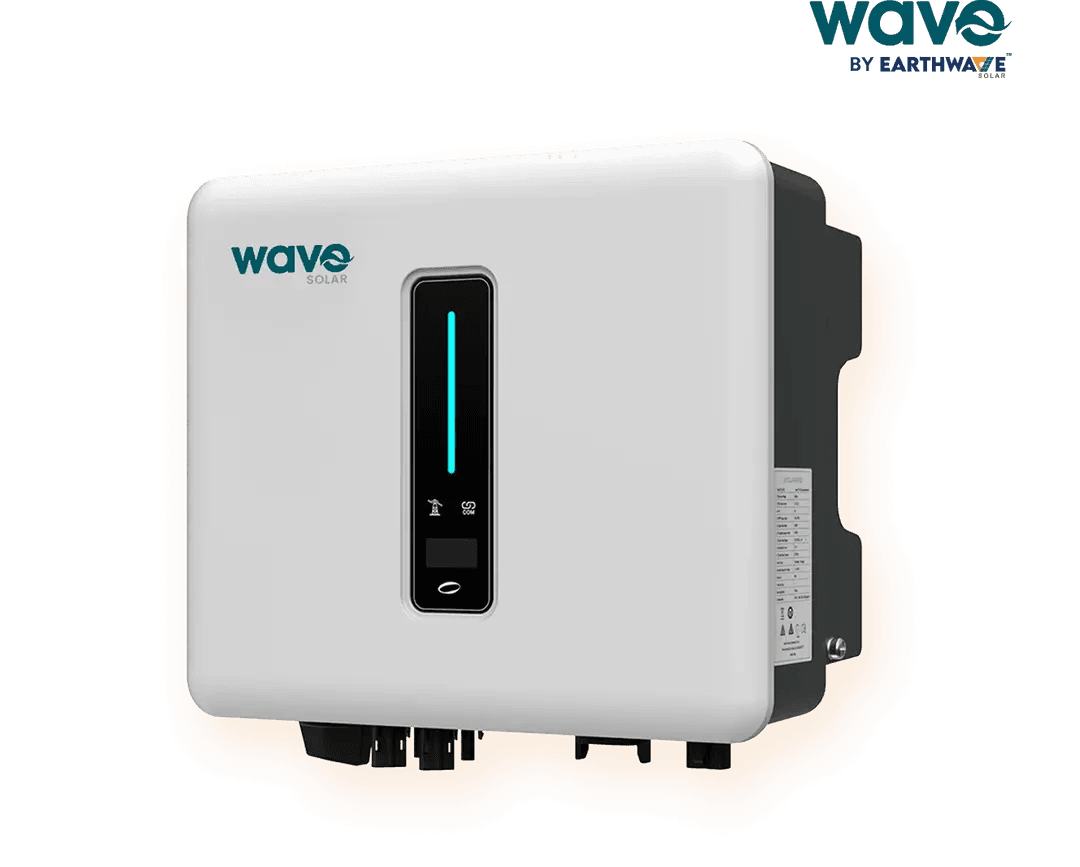
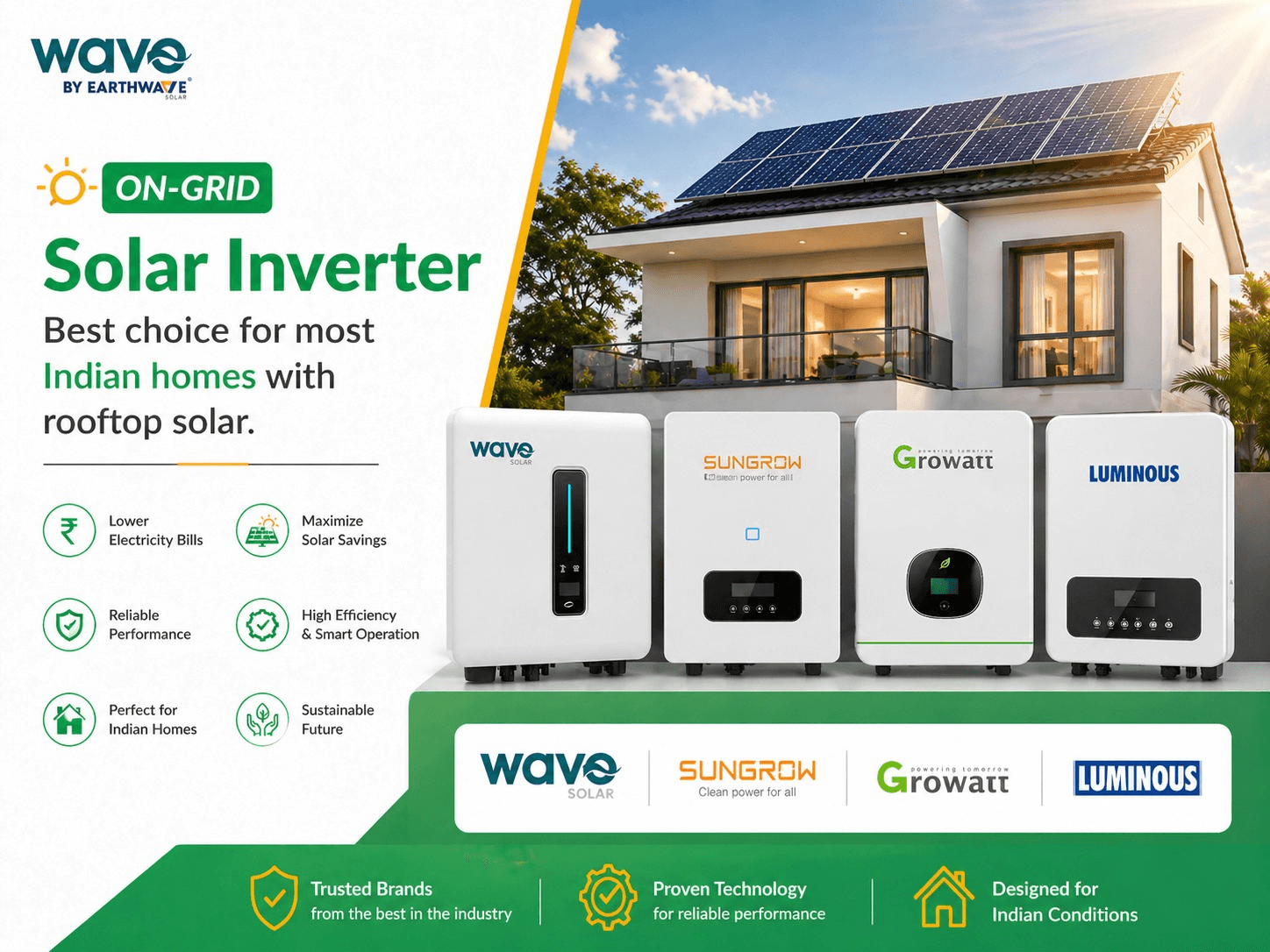
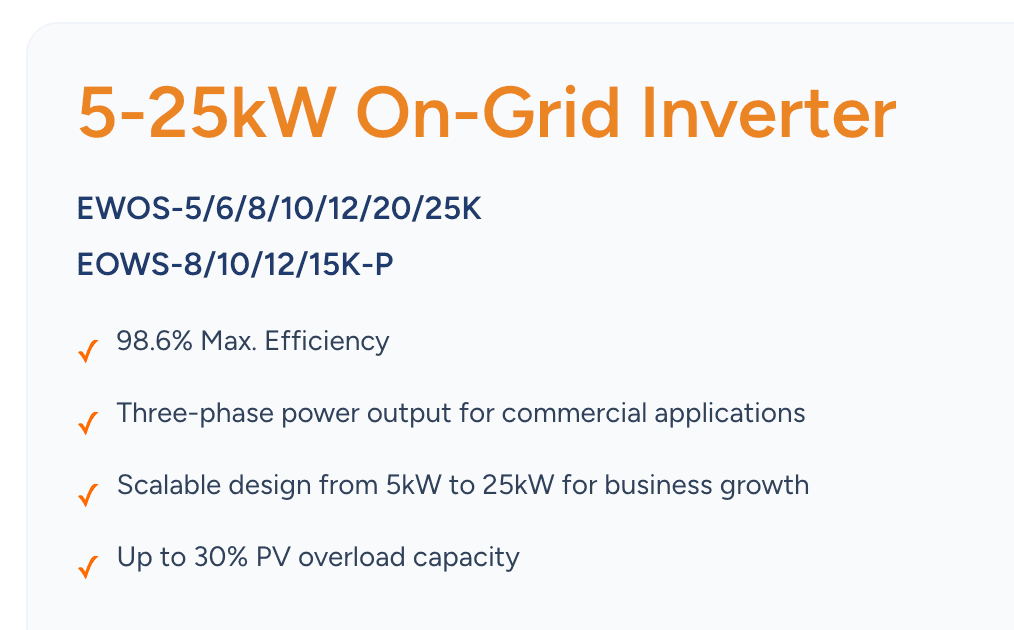
The inverter converts DC solar power to AC power your appliances use. If you want to compare equipment quality before choosing, read best solar inverter brands India.
Inverter Type | Cost Range (per kW) | Best For |
String Inverter (On-Grid) | Rs. 8,000 - Rs. 14,000 | Homes and standard commercial |
Microinverters | Rs. 18,000 - Rs. 28,000 | Shaded or complex rooftops |
Hybrid Inverter (Solar + Battery) | Rs. 15,000 - Rs. 30,000 | Homes wanting backup |
Central Inverter | Rs. 5,000 - Rs. 9,000 | Large industrial plants above 500 kW |
String inverters from brands like SolarEdge, Sungrow, Fronius, and ABB are the most common choice for residential and commercial systems in India today.
States with higher solar irradiation generate more units per kW installed.
Rajasthan, Gujarat, Madhya Pradesh, Maharashtra 4.5 to 6.5 peak sun hours per day.
Tamil Nadu, Karnataka, Andhra Pradesh 4.0 to 5.5 peak sun hours.
West Bengal, Assam, Kerala 3.5 to 4.5 peak sun hours.
A 5 kW system in Rajasthan generates approximately 7,500 to 8,000 units per year. The same system in Kerala generates approximately 5,500 to 6,500 units. This directly affects your annual savings and payback period.
System size is the most searched dimension of solar pricing because most buyers already have a rough idea of their consumption. Here is a detailed breakdown.
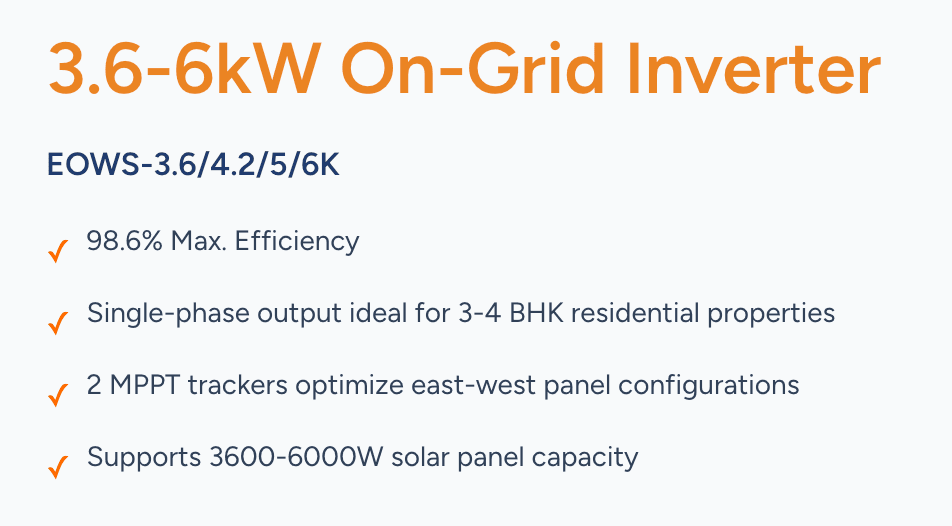
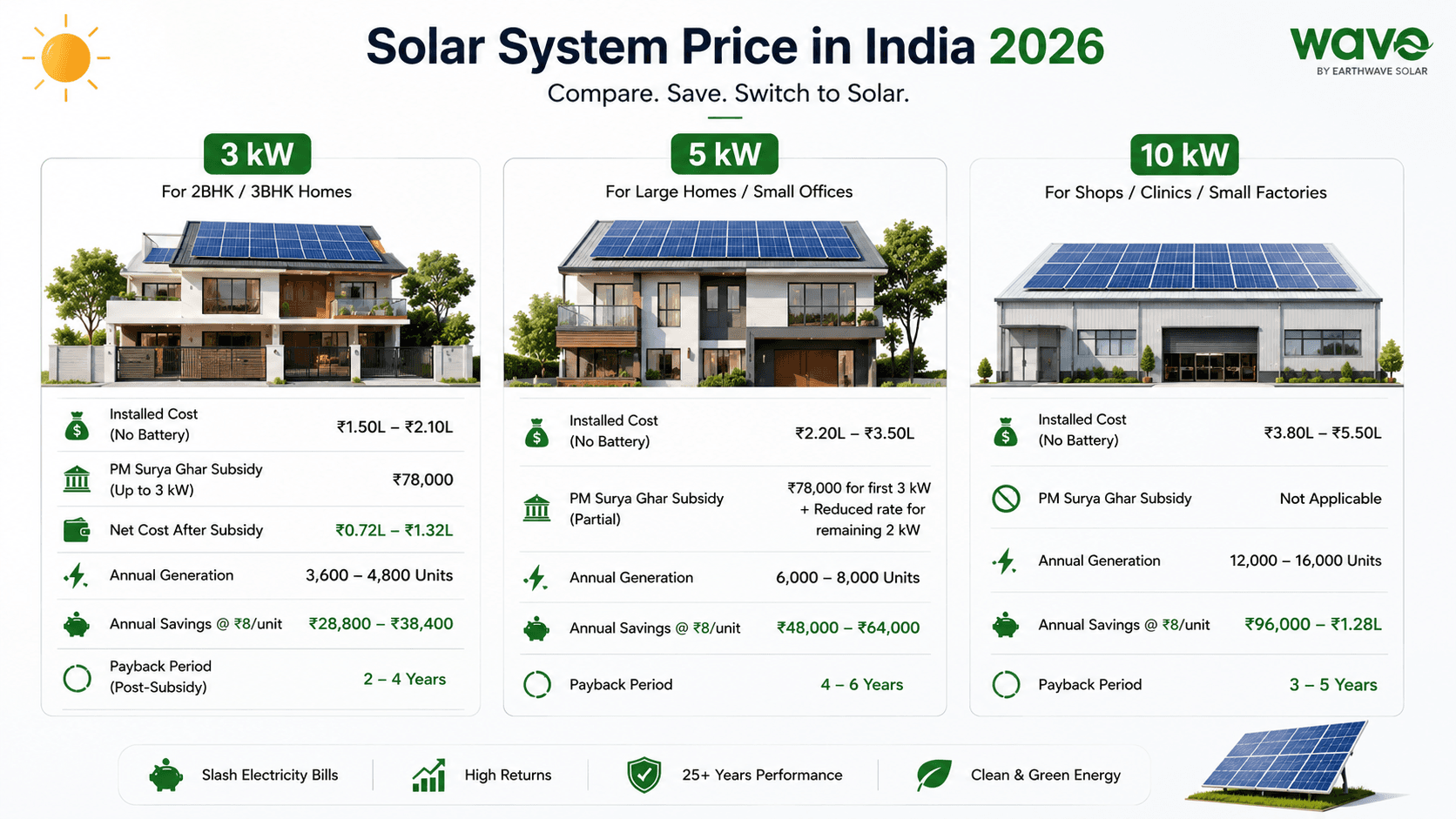
A 3 kW system suits a 2BHK or 3BHK home with monthly electricity consumption between 250 and 400 units. Buyers comparing this segment should also review residential solar system installation for homes in India.
Installed cost (grid-tied, no battery) Rs. 1.50 lakh to Rs. 2.10 lakh.
After PM Surya Ghar subsidy (applicable to systems up to 3 kW) subsidy of Rs. 78,000 is available for systems up to 3 kW.
Net cost after subsidy approximately Rs. 72,000 to Rs. 1.32 lakh.
Annual generation 3,600 to 4,800 units depending on location.
Annual savings at Rs. 8 per unit grid tariff Rs. 28,800 to Rs. 38,400.
Payback period post-subsidy 2 to 4 years.
For a typical middle-class Indian household, a 3 kW system with the PM Surya Ghar subsidy is the single best financial investment available today.
A 5 kW system suits large homes, independent bungalows, or small offices consuming 500 to 800 units per month.
Installed cost (grid-tied, no battery) Rs. 2.20 lakh to Rs. 3.50 lakh.
PM Surya Ghar subsidy applies partially (Rs. 78,000 for the first 3 kW, reduced rate for remaining 2 kW).
Annual generation 6,000 to 8,000 units.
Annual savings at Rs. 8 per unit Rs. 48,000 to Rs. 64,000.
Payback period 4 to 6 years.
A 10 kW system suits commercial shops, clinics, small factories, and apartment common areas. Businesses comparing this size should review commercial solar installation for businesses.
Installed cost (grid-tied) Rs. 3.80 lakh to Rs. 5.50 lakh.
No residential subsidy at this capacity under PM Surya Ghar.
Annual generation 12,000 to 16,000 units.
Annual savings at Rs. 8 per unit Rs. 96,000 to Rs. 1.28 lakh.
Payback period 3 to 5 years for commercial consumers at higher tariff slabs.
System Size | Installed Cost (Grid-Tied) | Annual Generation | Annual Savings (@ Rs. 8/unit) | Payback Period |
1 kW | Rs. 50,000 - Rs. 75,000 | 1,200 - 1,600 units | Rs. 9,600 - Rs. 12,800 | 4 - 6 years |
2 kW | Rs. 95,000 - Rs. 1,40,000 | 2,400 - 3,200 units | Rs. 19,200 - Rs. 25,600 | 4 - 6 years |
3 kW | Rs. 1,50,000 - Rs. 2,10,000 | 3,600 - 4,800 units | Rs. 28,800 - Rs. 38,400 | 4 - 5 years |
5 kW | Rs. 2,20,000 - Rs. 3,50,000 | 6,000 - 8,000 units | Rs. 48,000 - Rs. 64,000 | 4 - 6 years |
10 kW | Rs. 3,80,000 - Rs. 5,50,000 | 12,000 - 16,000 units | Rs. 96,000 - Rs. 1,28,000 | 3 - 5 years |
The PM Surya Ghar Muft Bijli Yojana is the Government of India's flagship residential solar subsidy program that directly reduces the upfront cost of rooftop solar for homeowners.
Gujarat-focused readers can also check solar subsidy Gujarat 2026.
System Capacity | Central Subsidy Amount |
Up to 2 kW | Rs. 30,000 per kW (maximum Rs. 60,000) |
2 kW to 3 kW | Rs. 18,000 per kW for the incremental kW (maximum total Rs. 78,000) |
Above 3 kW | Fixed at Rs. 78,000 (no additional subsidy for capacity above 3 kW) |
Key points to understand
Subsidy is credited directly to the homeowner's bank account after system commissioning and DISCOM inspection.
Only systems installed by empanelled vendors under the PM Surya Ghar portal qualify.
The scheme targets 1 crore households and remains active through 2026 with strong budget allocation.
Some states like Gujarat and Maharashtra offer additional state subsidies on top of the central amount.
For a homeowner installing a 3 kW system at Rs. 1.80 lakh, the Rs. 78,000 subsidy brings the net investment to Rs. 1.02 lakh. At Rs. 8 per unit grid tariff, that investment pays back in under 3 years.
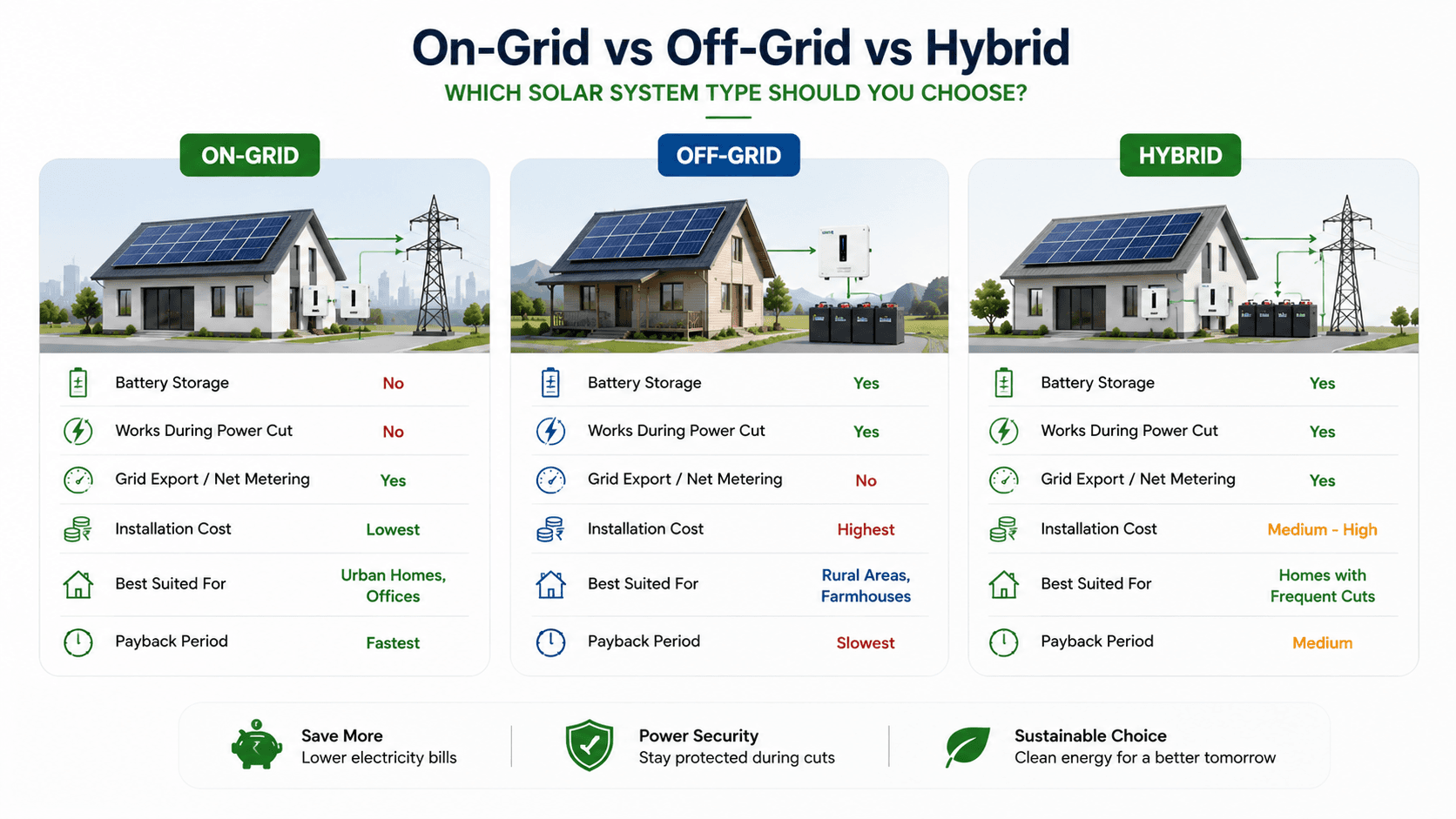
Choosing the wrong system type is one of the most common and costly mistakes in solar buying. Each type serves a different need.
For a deeper comparison, see on grid vs off grid vs hybrid solar. If you want backup-ready equipment, explore WAVE hybrid inverter solutions.
Feature | On-Grid | Off-Grid | Hybrid |
Battery storage | No | Yes | Yes |
Works during power cut | No | Yes | Yes |
Grid export / net metering | Yes | No | Yes |
Installation cost | Lowest | Highest | Medium-High |
Best suited for | Urban homes, offices | Rural, farmhouses | Homes with frequent cuts |
Payback period | Fastest | Slowest | Medium |
On-grid systems are the best financial choice for urban and semi-urban locations where grid power is available most of the day. They have the lowest cost, generate credits through net metering, and deliver the fastest ROI.
Off-grid systems make sense where grid connectivity is absent or highly unreliable. They cost 60 to 80 percent more than on-grid systems due to battery banks.
Hybrid systems combine the best of both they export excess power to the grid and provide backup during cuts. They suit homes in Tier 2 and Tier 3 cities where outages of 2 to 6 hours per day are common.
You do not need to guess your system size. A simple formula gives a reliable starting point.
Find your average monthly electricity consumption from your last 3 bills (in kWh or units).
Divide by 30 to get daily consumption. Example 300 units per month divided by 30 = 10 units per day.
Divide daily consumption by average peak sun hours in your city. Example 10 units divided by 5 hours = 2 kW.
Add 20 percent buffer for system losses and future load growth. Example 2 kW multiplied by 1.2 = 2.4 kW.
Round up to the nearest standard size 2.5 kW or 3 kW.
For a factory or commercial building, the same formula applies but your daily consumption may be 200 to 5,000 units, leading to systems in the 50 kW to 1 MW range.
A reliable solar EPC partner will run a detailed load analysis rather than guessing. Any installer who quotes a system size without reviewing your electricity bills is cutting corners.
Solar ROI in India is among the best available in any passive investment class for both homes and businesses. For more detailed ROI benchmarks, visit solar payback period India 2026.
System cost Rs. 2.80 lakh (installed, grid-tied).
PM Surya Ghar subsidy applicable Rs. 78,000 (subsidy capped at 3 kW equivalent).
Net investment Rs. 2.02 lakh.
Annual generation approximately 7,000 units.
Grid tariff Rs. 9 per unit (Maharashtra residential HT slab).
Annual savings Rs. 63,000.
Simple payback period approximately 3.2 years.
Savings over 25-year system life (at current tariffs, not accounting for tariff increases) Rs. 15.75 lakh.
Every 5 percent annual increase in grid tariff improves the effective ROI because solar cost per unit stays flat while grid cost rises.
Commercial and industrial consumers benefit even more from solar because they pay higher tariffs.
Consumer Type | Grid Tariff (Approx.) | Solar Cost Per Unit | Annual Savings Per kW Installed |
Residential | Rs. 5 - Rs. 9 per unit | Rs. 2.50 - Rs. 4 | Rs. 3,000 - Rs. 6,500 |
Commercial | Rs. 8 - Rs. 12 per unit | Rs. 2.50 - Rs. 3.50 | Rs. 6,500 - Rs. 11,000 |
Industrial HT | Rs. 7 - Rs. 12 per unit | Rs. 2 - Rs. 3.50 | Rs. 7,000 - Rs. 12,000 |
A factory paying Rs. 10 per unit for grid power and installing a 500 kW rooftop system at Rs. 2.80 per unit effective solar cost saves Rs. 7.20 per unit.
If you want an industrial benchmark, read solar for factories cut power costs 40%.
Earthwave Energy is a solar EPC company that specializes in residential, commercial, and industrial solar installations across India.
Earthwave brings practical engineering knowledge and honest financial modeling to every project, from a 3 kW home system to a 5 MW industrial plant.
What Earthwave delivers for every client
Free site assessment and load analysis
before any system sizing recommendation.
Transparent, itemized quotes
that break down panel, inverter, structure, and installation costs separately.
Subsidy processing support
for PM Surya Ghar applications including DISCOM documentation.
Tier 1 component sourcing
from Waaree, Adani, Vikram, Tata, and other bankable Indian brands.
Net metering and grid connectivity
handled end to end with your local DISCOM.
25-year O&M plans
to protect system performance and your investment over the long term.
Earthwave does not use a one-size-fits-all approach. Every proposal is based on your actual bills, your roof or land area, your grid connectivity, and your financial goals, not on a standard brochure template.
Whether you want to reduce your home electricity bill by 80 percent, eliminate your factory's HT tariff burden, or meet ESG targets as an industrial park developer, Earthwave sizes and executes the right solution.
The installed cost of a grid-tied solar system in India ranges from Rs. 50,000 to Rs. 75,000 per kW for residential systems. Commercial and industrial systems above 50 kW cost Rs. 35,000 to Rs. 55,000 per kW due to economies of scale. These are all-in prices including panels, inverter, mounting, and installation.
Yes, especially with the PM Surya Ghar subsidy. A 3 kW system after subsidy costs approximately Rs. 72,000 to Rs. 1.30 lakh and pays back in 2 to 4 years in most Indian cities. After payback, you generate essentially free electricity for 20+ years.
A 5 kW grid-tied system costs Rs. 2.20 lakh to Rs. 3.50 lakh installed in 2026. It generates approximately 6,000 to 8,000 units annually and saves Rs. 48,000 to Rs. 64,000 per year at Rs. 8 per unit grid tariff. Payback is typically 4 to 6 years.
It depends on the quote format. Always ask your installer for an all-in installed cost, not just the panel hardware price. A reliable quote will break down module cost, inverter cost, mounting structure, wiring, and installation labour separately. At Earthwave, every quote is itemized so you can verify each component.
Monocrystalline PERC or TOPCon panels from Tier 1 Indian brands like Waaree, Adani Solar, Vikram Solar, and Tata Power Solar are the best choices for Indian homes in 2026. They offer 21 to 23 percent efficiency, strong product warranties, and are Made in India which avoids import tariff exposure.
You now have a clear picture of solar panel prices, system sizes, subsidies, and savings for India in 2026. The next step is a site-specific quote based on your actual electricity bills and roof area.
Earthwave Energy offers a no-obligation solar consultation where we assess your consumption, calculate your exact system size, apply available subsidies, and show you a transparent payback model before you commit to anything.
You can contact Earthwave Solar directly or explore residential solar system installation for homes in India, rooftop solar systems for homes in India, and commercial solar installation for businesses.
FAQS
Can't find the answer you're looking for? Our team is here to help.
SUBSCRIBE NEWSLETTER
Switching to solar is easier than you think. Let us guide you to cleaner, more affordable energy.
