Rooftop Solar India
Solar Panel on Terrace: Permissions Guide 2026
2026-04-07T00:00:00.000Z•9
You need three core approvals to legally install rooftop solar in India: a DISCOM feasibility approval, a net metering agreement, and a Chief Electrical Inspector (CEI) commissioning certificate.
If you live in a housing society or are a tenant, you also need a society or landlord NOC before you apply.
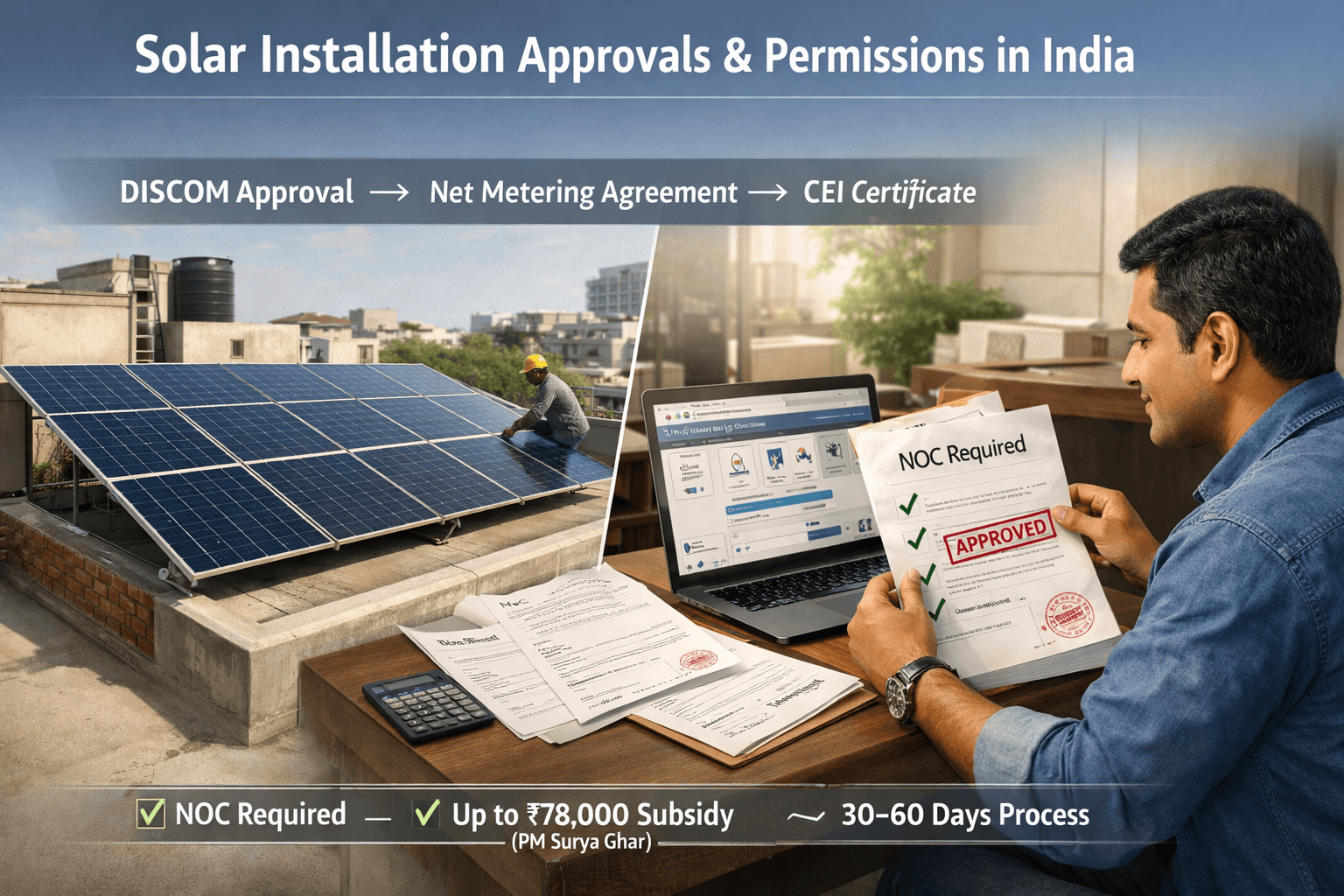
You cannot connect a solar system to the grid without DISCOM approval. No approval means no subsidy and no net metering.
The full approval process takes 30 to 60 days if documents are in order.
Society NOC is mandatory if you live in an apartment or do not own the terrace outright.
PM Surya Ghar Yojana (2026) offers subsidies up to ₹78,000 for systems up to 3 kW. Check your full solar subsidy under PM Surya Ghar eligibility before you apply.
You can apply on pmsuryaghar.gov.in
and track your approval status online.
Most people skip the paperwork research and call an installer first. That is the wrong sequence.
Getting your approvals in order before installation protects your subsidy claim and ensures your system is legally commissioned.
Installing without DISCOM sanction means your excess units cannot flow back to the grid, and your subsidy gets blocked.
If you are still deciding between system types, read our guide on on-grid vs off-grid vs hybrid solar before you proceed.
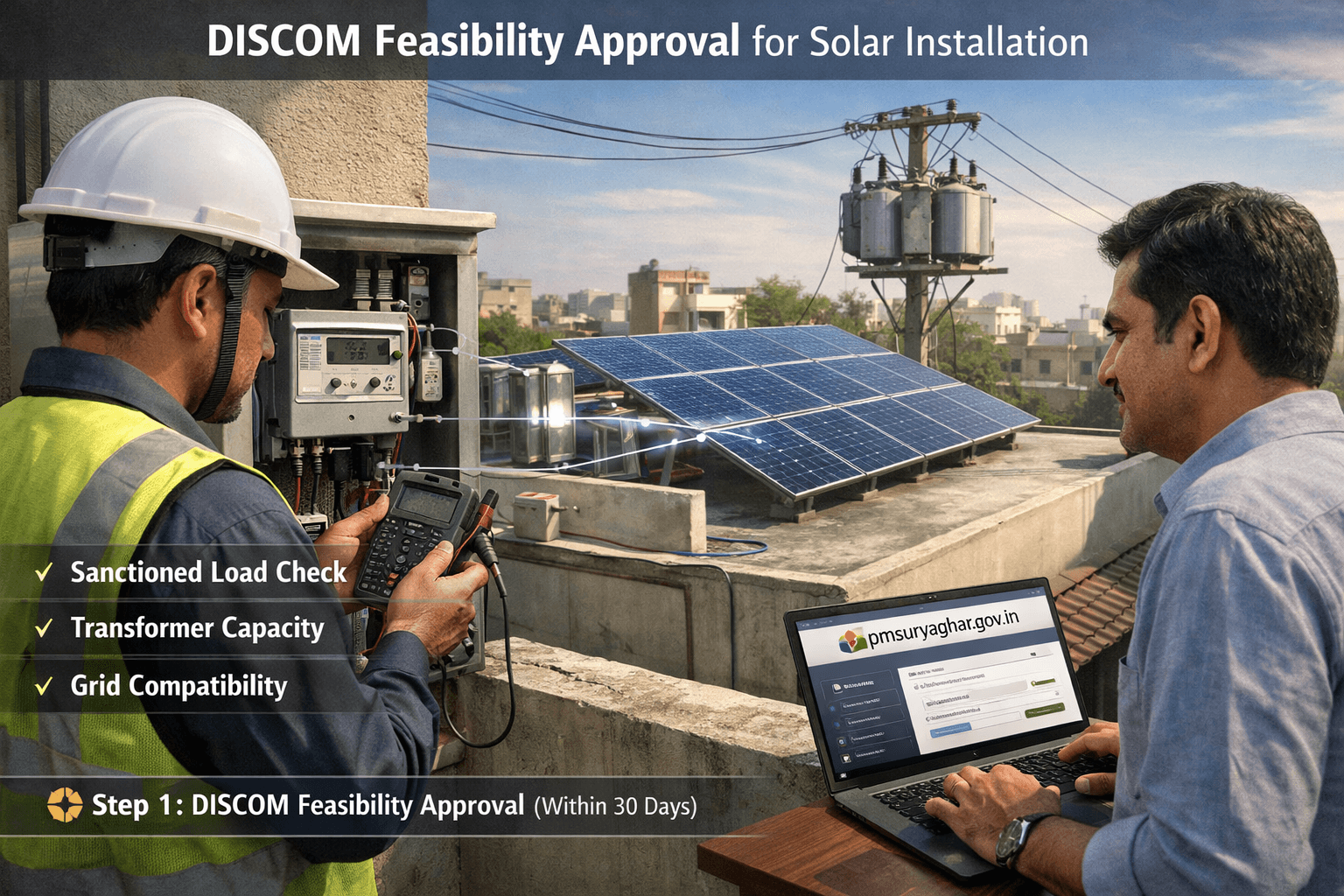
This is the first and most important step. Your local DISCOM (Distribution Company) inspects your site and confirms the grid can handle your system capacity.
The approval confirms:
Your sanctioned load against proposed solar capacity
Transformer capacity at your connection point
Technical compatibility of your proposed system
By regulation, DISCOM must complete this feasibility check within 30 days of your application.
How to apply: Register on pmsuryaghar.gov.in or your state DISCOM's portal, enter your consumer number, proposed system size, and upload basic documents.
Once you get feasibility approval, you sign a net metering agreement with your DISCOM. This is your legal contract that governs how exported energy is billed.
Learn more about how net metering works and earns you income from your rooftop system.
Key points in the agreement:
Your billing cycle under net metering
Energy export and import terms
DISCOM access rights to your meter
Safety and shutdown compliance
The agreement is typically on stamp paper and must be signed within the DISCOM's stipulated window.
The Ministry of Power has directed all states in 2025 to move toward standardized digital net metering agreements to remove delays that previously ranged from 2 weeks to 6 months.
For systems above 10 kW, most states require a commissioning certificate from the Chief Electrical Inspector or the state electrical authority.
This certificate confirms:
Safe installation by a certified technician
Electrical compliance as per state regulations
Readiness for grid synchronization
Residential systems under 10 kW typically bypass this step, but check your state's specific rule before finalizing.
You must install through a vendor registered on the MNRE national portal to be eligible for the PM Surya Ghar subsidy.
Unregistered vendors = no subsidy eligibility. Verify your installer's MNRE registration number before signing any contract.
A society or landlord NOC is mandatory in three scenarios. Read our complete apartment solar installation guide if you are in a multi-floor building.
Situation | NOC Required From |
Apartment in a housing society | Resident Welfare Association (RWA) or society committee |
Tenant installing on rented property | Property owner (notarized) |
Shared terrace in a multi-unit building | All co-owners or managing committee |
Delhi/NCR properties | DDA/MCD terrace permission also required |
The NOC should be on stamp paper and must clearly mention the address, system capacity, and consent for grid connectivity.
Tip: Get the NOC before you apply to DISCOM. It is a required attachment in most DISCOM application portals.
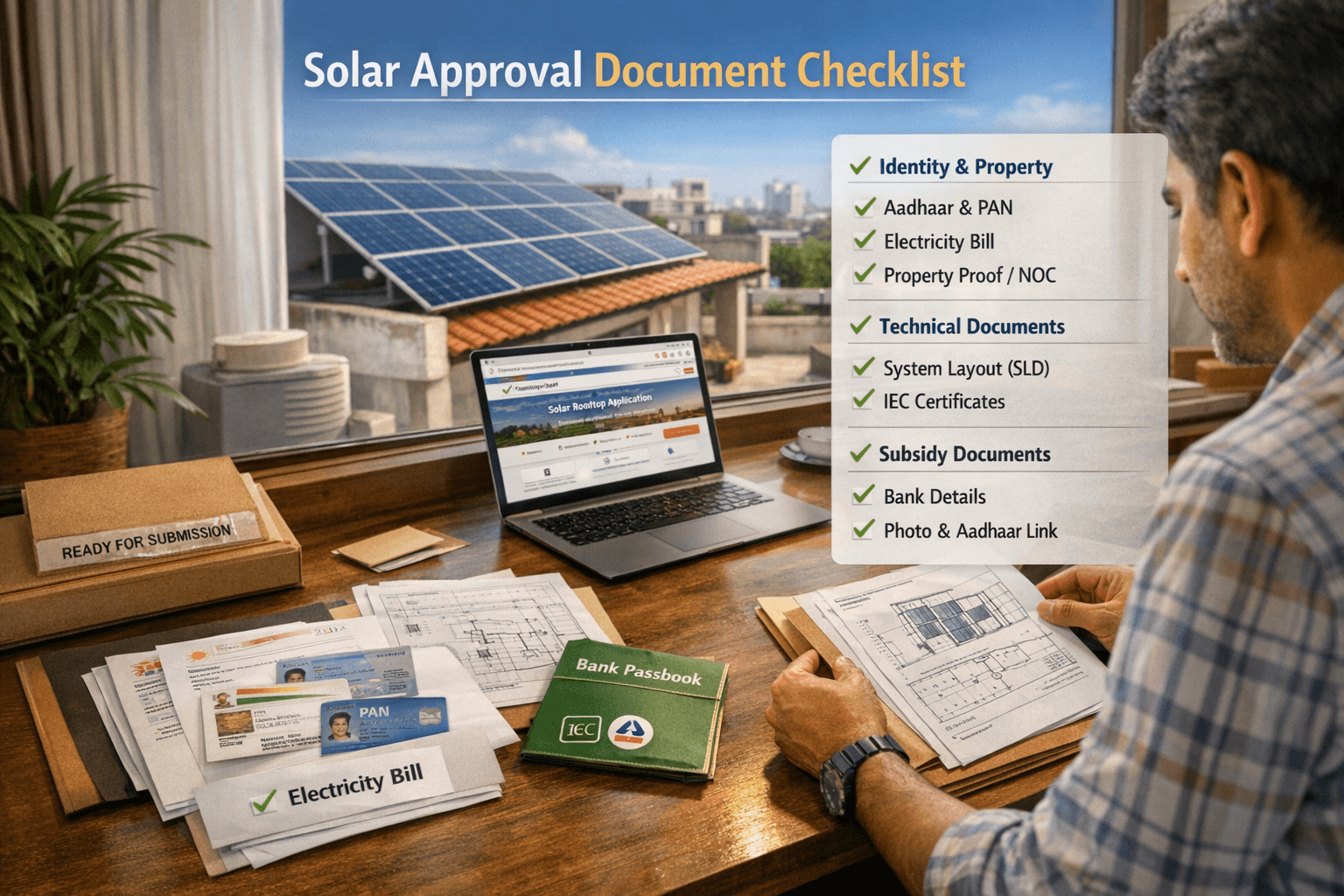
Keep all of these ready before you start the application process.
Not sure which panel suits your home? Check our guide on best solar panels for home in India before choosing your system.
Aadhaar card
PAN card
Latest electricity bill (consumer number must be visible)
Property ownership proof (if electricity bill is not in your name)
Society or landlord NOC (if applicable)
Proposed system capacity and layout sketch
Single Line Diagram (SLD) signed by the installer
IEC certificate of solar module and inverter
Bank passbook or cancelled cheque
Passport-size photograph
Aadhaar-linked mobile number
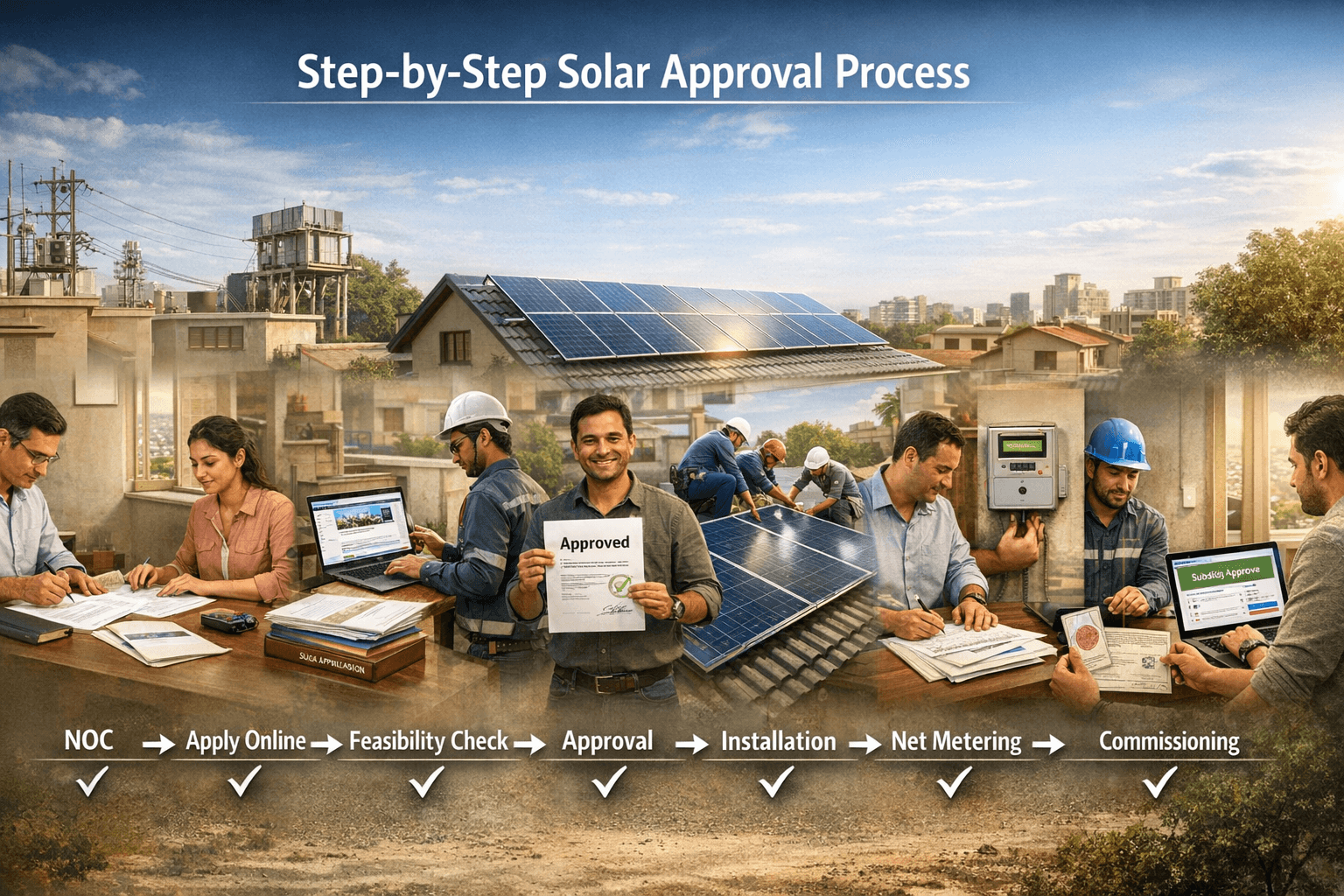
Follow this exact sequence to avoid rejection or delays.
Get society or landlord NOC(if applicable)
Register on pmsuryaghar.gov.in with your consumer number and state DISCOM
Submit feasibility application
with all documents and pay the processing fee (usually a few hundred rupees)
Wait for DISCOM site inspection
(within 30 days by regulation)
Receive Technical Sanction / Feasibility Approval Letter
Engage an MNRE-registered vendor
to install the system
Sign the net metering agreement
on stamp paper
DISCOM installs the bi-directional net meter
at your premises
Get CEI certificate
(if applicable for your system size)
Submit plant commissioning details
on the portal to trigger subsidy disbursement
From 1 June 2026, all grid-connected solar systems in India must use DCR (Domestic Content Requirement) modules. This directly affects your solar panel cost in India and budgeting.
This applies to:
PM Surya Ghar installations
Net-metering rooftop projects
Open access and KUSUM installations
Non-DCR modules will not qualify for subsidy or net metering after this date.
If you are planning to install before June 2026, you can still lock in current pricing before costs increase by approximately ₹8 to ₹10 per Watt.
The core process is the same across India, but state-level variations exist. Gujarat homeowners should read the full Gujarat Rooftop Solar Policy 2026 for state-specific rules.
State | Key Difference |
Gujarat | GERC approves net metering from 1 kW to 1 MW; DGVCL handles approvals |
Delhi NCR | DDA/MCD terrace permission required; BSES/Tata Power as DISCOMs |
Rajasthan | No feasibility study needed for systems up to 10 kW under new RERC rules |
All States | Core portal: ; DISCOM registration + net meter mandatory |
Earthwave Solar is a full-service EPC company based in Surat, Gujarat, with operations across Gujarat and Madhya Pradesh.
Before you hire any installer, run through our solar EPC company checklist to know what to look for.
Founded in 2018, Earthwave has grown from its first 100 kW installation in 2019 to executing 80 MW ground mount projects for Mahindra Sustain and multi-megawatt residential projects like True Colors, Palsana (2 MW).
Learn more on the About Earthwave Solar page.
Step 1: Free Consultation
- Understand your energy needs, no sales pressure
Step 2: Site Visit
- Roof condition, sun exposure, and electrical setup assessment
Step 3: Design and Quotation
- Full system design with A-to-Z transparent pricing, no hidden costs
Step 4: Documentation
- All paperwork, DISCOM approvals, subsidy claims, and NOC support handled by their experts
Step 5: Installation
- Certified technicians execute every detail from structure to wiring
Final Handover
- Thorough system check, monitoring guidance, and post-installation support
Explore Earthwave's Rooftop Solar Service and Residential Solar Service to see what is included.
Earthwave also manufactures its own Wave inverters vs leading brands (2.5 kW to 125 kW), which means you get quality-controlled components with a 10-year warranty.
Gujarat:
Office No. 2, 1st Floor, Savlia Circle, near Bapasitaram Chowk, Surat 395011 | +91 90336 07212
Madhya Pradesh:
Durga Tower, Rohit Nagar, Bawadiya Kalan, Bhopal 462039 | +91 90336 02156
Email:
|
Website:
Yes. You must receive technical feasibility approval from your local DISCOM before installing a grid-connected solar system. Installing without it means your system cannot be connected to the grid, and you lose all subsidy eligibility under PM Surya Ghar.
Yes, but you need a notarized NOC from your landlord allowing the installation and grid connectivity. Your DISCOM application will not be processed without it. Read our apartment solar installation guide for a full walkthrough.
The DISCOM feasibility check should be completed within 30 days by regulation. Registration and sanction take another 10 to 15 days. Total process from application to meter installation is typically 45 to 60 days if your documents are complete.
The scheme offers a central subsidy of up to ₹78,000 for a 3 kW system. It provides up to 300 units of free electricity per month. Check the full solar subsidy breakdown for Gujarat 2026 for exact figures and eligibility.
For most residential rooftop systems, no separate building permit is required from the municipal body. However, in Delhi, DDA or MCD permission for terrace use may be needed. Always verify with your local DISCOM and municipal body before applying.
You now know every approval, document, and step required to legally install solar on your terrace in 2026.
Before you calculate your return on investment, check the solar payback period in India to set realistic expectations.
Earthwave Solar's team manages your DISCOM application, society NOC coordination, subsidy documentation, and commissioning from start to finish, so you never have to chase government offices on your own.
Book your free site consultation with Earthwave Solar today.
FAQS
Can't find the answer you're looking for? Our team is here to help.
SUBSCRIBE NEWSLETTER
Switching to solar is easier than you think. Let us guide you to cleaner, more affordable energy.
