Solar Plant Maintenance Checklist
Solar Plant Maintenance Checklist for Business Owners
2026-05-27T00:00:00.000Z•8
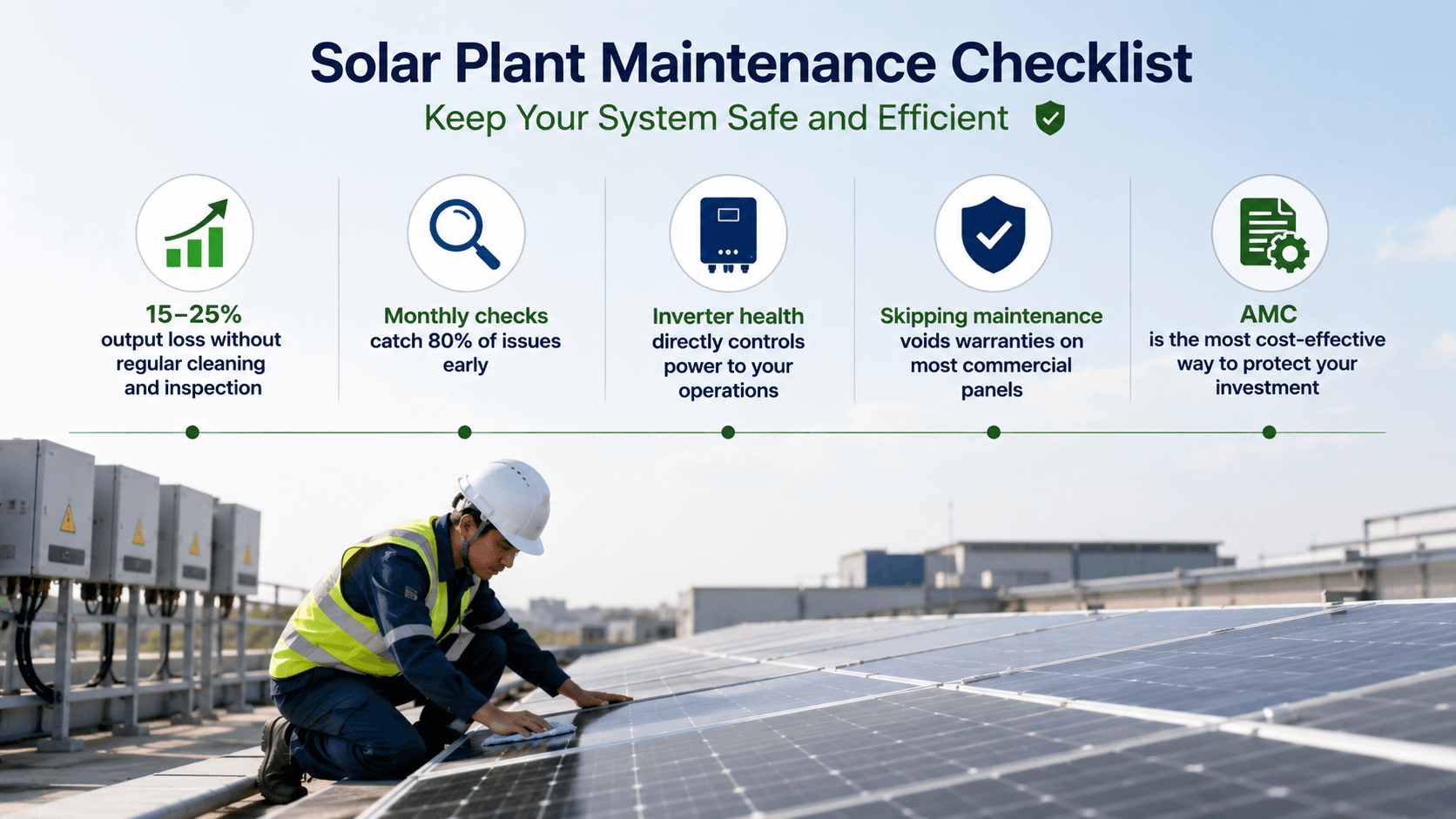
A properly maintained solar plant delivers consistent ROI, longer equipment life, and fewer emergency breakdowns.
The key is following a structured maintenance routine, whether monthly, quarterly, or annual, so small issues never become costly shutdowns.
Solar plants lose 15 to 25% output without regular cleaning and inspection
Monthly visual checks catch 80% of early-stage issues before they escalate
Inverter health directly controls how much power reaches your operations
Skipping preventive maintenance voids warranties on most commercial panels
An Annual Maintenance Contract (AMC) is the most cost-effective way to protect your investment
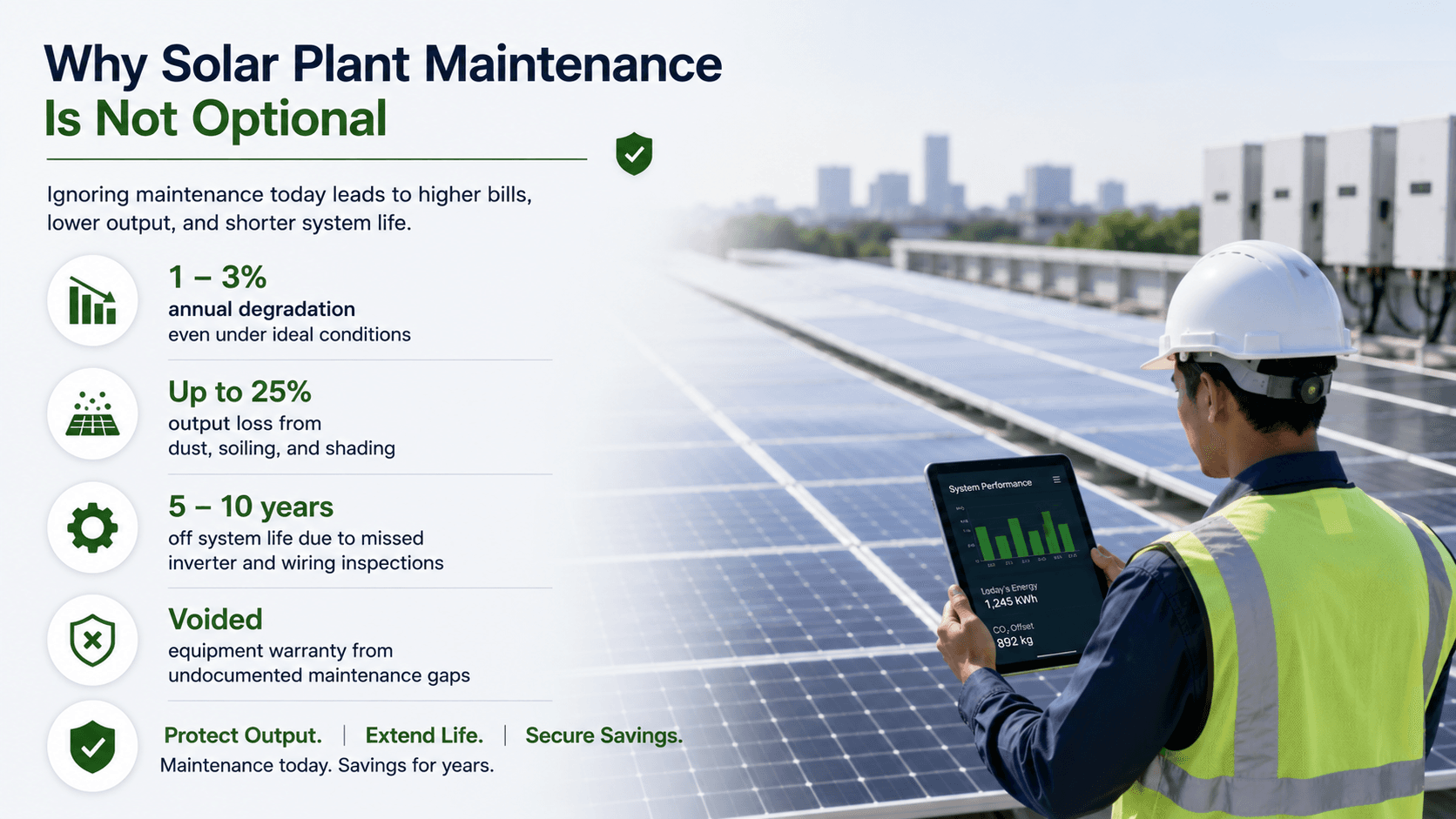
Ignoring solar maintenance is one of the most expensive mistakes a business owner can make.
A commercial solar plant is a capital asset. It depreciates, accumulates wear, and loses efficiency without proper care.
Most businesses notice the problem only when the electricity bill starts climbing again or a sudden fault triggers an alarm.
Here is what unmanaged solar plants typically cost:
1 to 3% annual degradation even under ideal conditions
Up to 25% output loss from dust, soiling, and shading
5 to 10 years off system life due to missed inverter and wiring inspections
Voided equipment warranty from undocumented maintenance gaps
The goal of this checklist is simple: protect your plant's output, extend its life, and keep your electricity savings real.
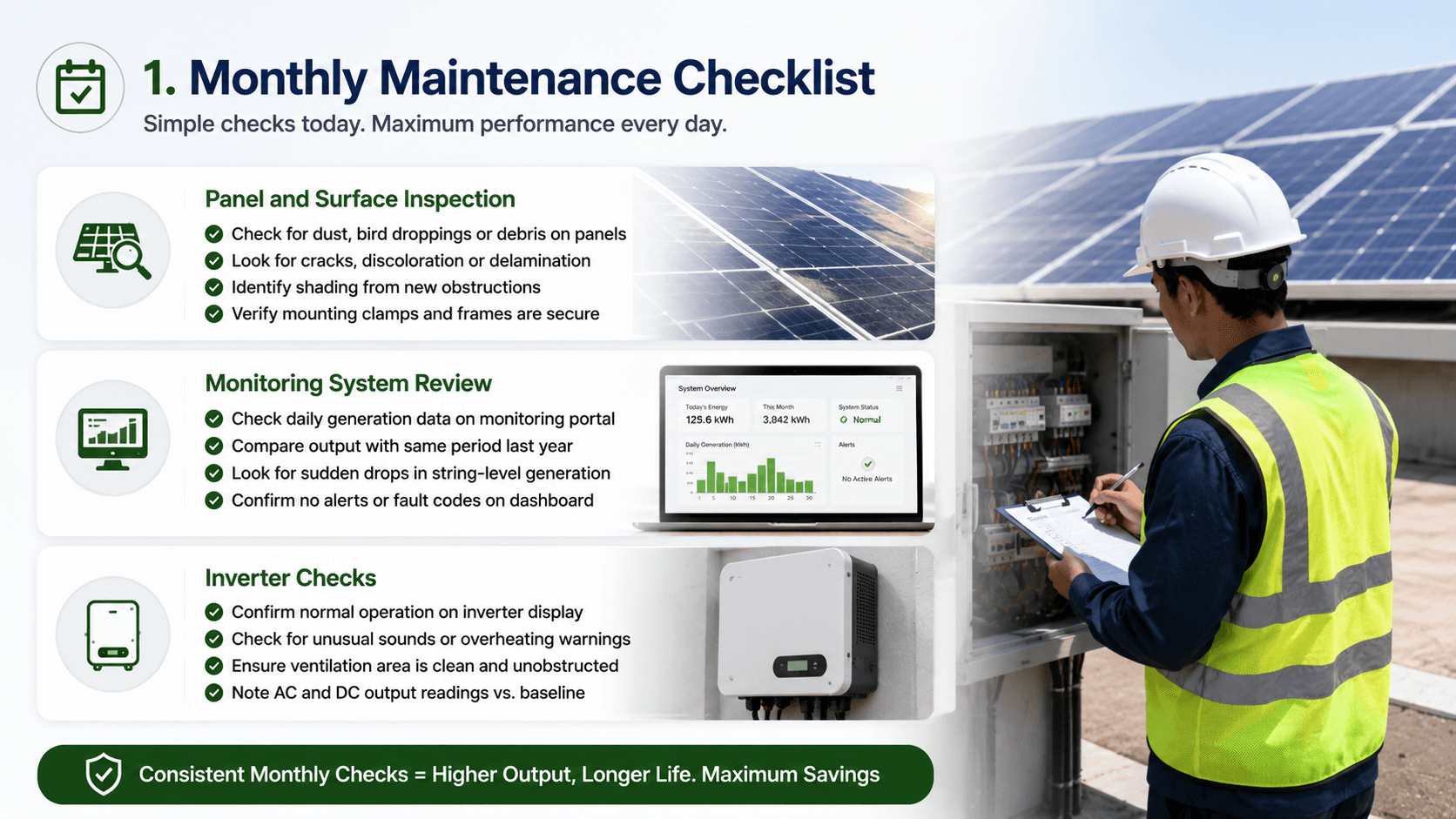
Monthly checks are your first line of defense against performance drop.
These tasks require no specialist equipment. A trained facility staff member or an O&M team can complete them in under two hours per site.
Check for visible dust accumulation, bird droppings, or debris on panels
Look for cracked glass, discoloration, or delamination on any panel surface
Identify shading caused by new obstructions, such as tree growth or rooftop additions
Verify that panel mounting clamps and frames are intact with no visible loosening
Log in to your solar monitoring portal and check daily generation data
Compare current month output to the same period in the previous year
Look for any sudden drops in generation on individual string reports
Confirm no alerts or fault codes are active on the dashboard
Confirm the inverter display shows normal operation status
Check for unusual sounds such as buzzing, clicking, or overheating warnings
Verify that the inverter ventilation area is free of dust and blocked airflow
Note the current AC and DC output readings against your system baseline
If you are unsure which inverter type your system runs on, our guide on on-grid, off-grid, and hybrid solar systems explains the differences clearly.
Confirm all cable trays and conduits are intact with no exposed wiring
Check that junction boxes are properly closed and sealed against moisture
Verify that no vegetation is growing onto or near panel edges
Look for any physical damage from recent weather, wind, or foot traffic
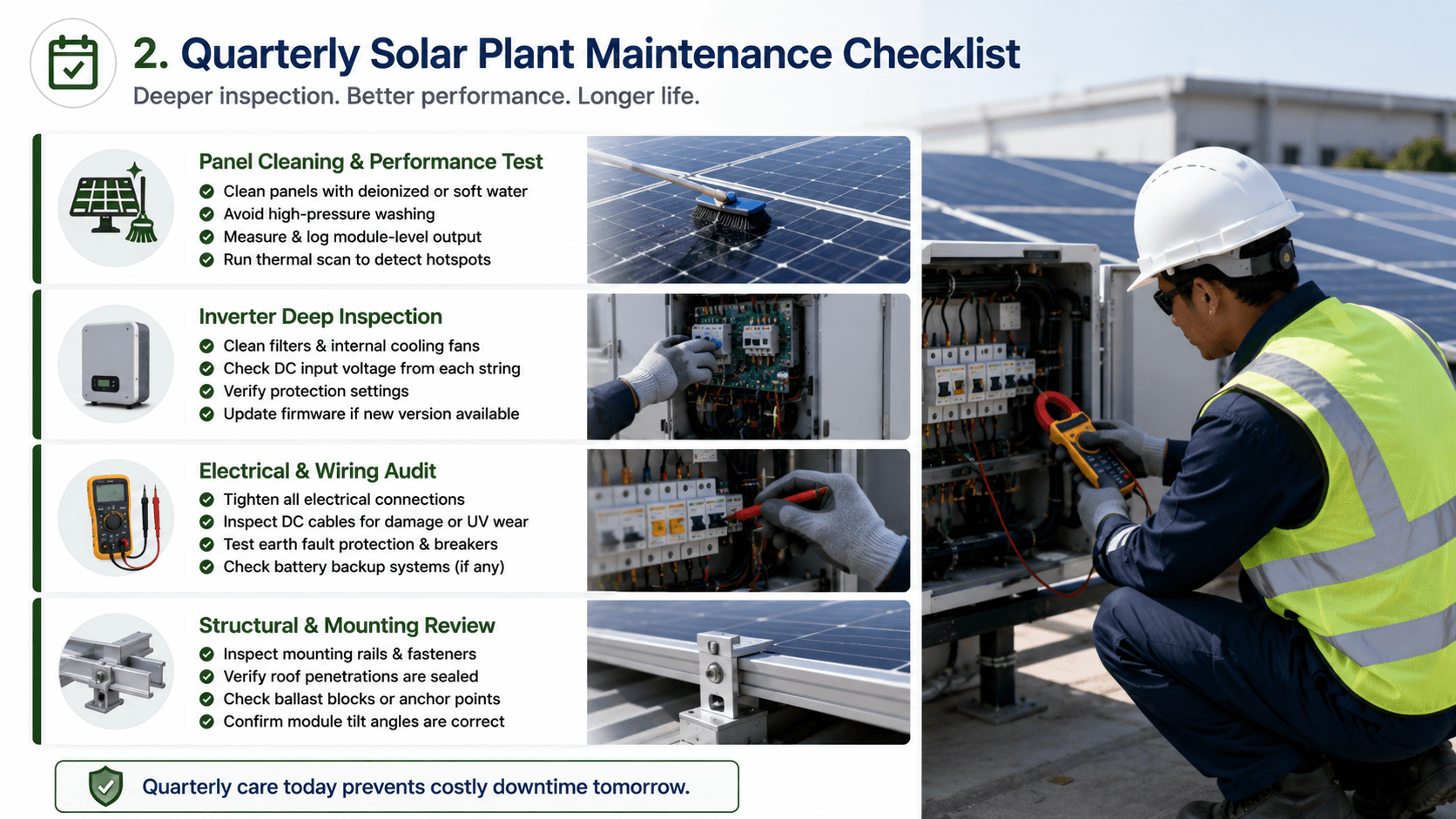
Quarterly maintenance catches what monthly visual checks miss.
This level requires a trained solar technician or your AMC partner. Budget two to four hours per site depending on plant size.
Clean all panels with deionized or soft water using approved cleaning equipment
Avoid high-pressure washing as it can damage panel frames and seals
Measure and log module-level output using a clamp meter or string testing tool
Run a thermal scan if available to detect hotspots on underperforming panels
Clean inverter filters and internal cooling fans
Check DC input voltage from each string against expected values
Verify all protection settings such as over-voltage, under-voltage, and temperature are correctly configured
Update firmware if a new version is released by the manufacturer
For businesses evaluating inverter reliability, our comparison of best solar inverter brands in India gives a useful reference point.
Tighten all electrical connections from combiner boxes to the main distribution board
Inspect DC cables for chafing, cracking, or UV degradation on exposed sections
Test earth fault protection and circuit breakers for proper operation
Check battery backup systems if your plant includes storage units
Inspect module mounting rails and fasteners for rust or corrosion
Verify roof penetrations are properly sealed and watertight
Check ballast blocks or anchor points for any displacement after rain or wind
Confirm module tilt angles are still aligned to design specifications
Businesses with ground-mounted systems have additional structural considerations. Read our detailed guide on ground-mounted vs rooftop solar for industrial use for site-specific maintenance context.
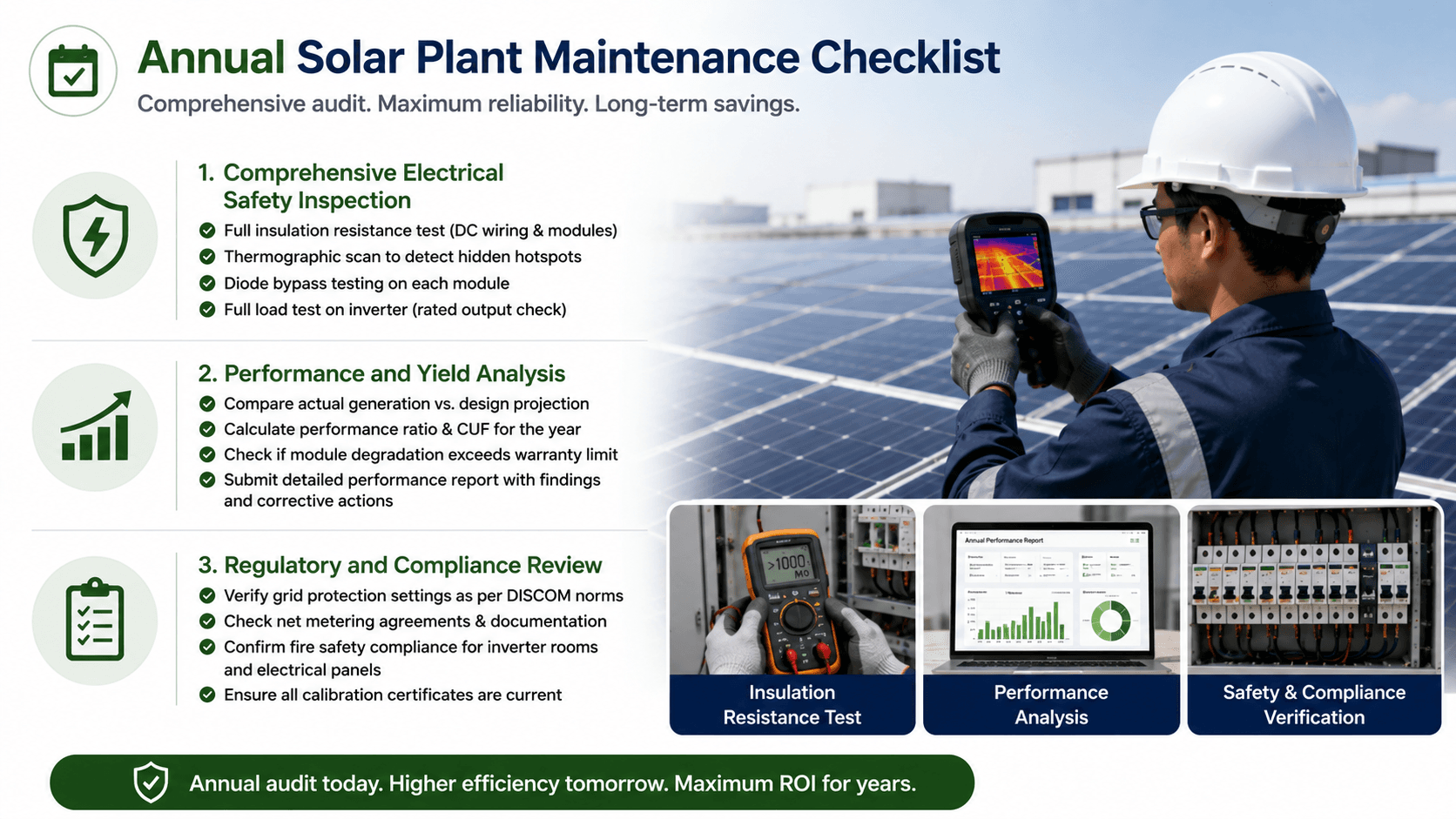
The annual audit is the most comprehensive inspection your plant will receive all year.
This requires a qualified solar engineer and should ideally be scheduled before summer peak season or monsoon season in India.
Full insulation resistance test across all DC wiring and modules
Thermographic infrared scan of the entire array to identify hidden hotspots
Diode bypass testing on each module to detect failed bypass diodes
Full load test on the inverter to verify rated output capacity
Compare actual annual generation against the design projection in the original project report
Calculate performance ratio and capacity utilization factor for the full year
Identify if any module degradation has exceeded the manufacturer's warranty threshold
Submit a written performance report that documents findings, test results, and corrective actions
Verify that all grid interconnection protection settings are current as per DISCOM requirements
Check that net metering agreements and connection documentation are up to date
Confirm fire safety compliance for inverter rooms and electrical panels
Ensure all equipment calibration certificates are current and stored properly
Before your annual audit, it is also worth reviewing what a reliable solar EPC partner should deliver. Our solar EPC company checklist for India covers the key verification points.
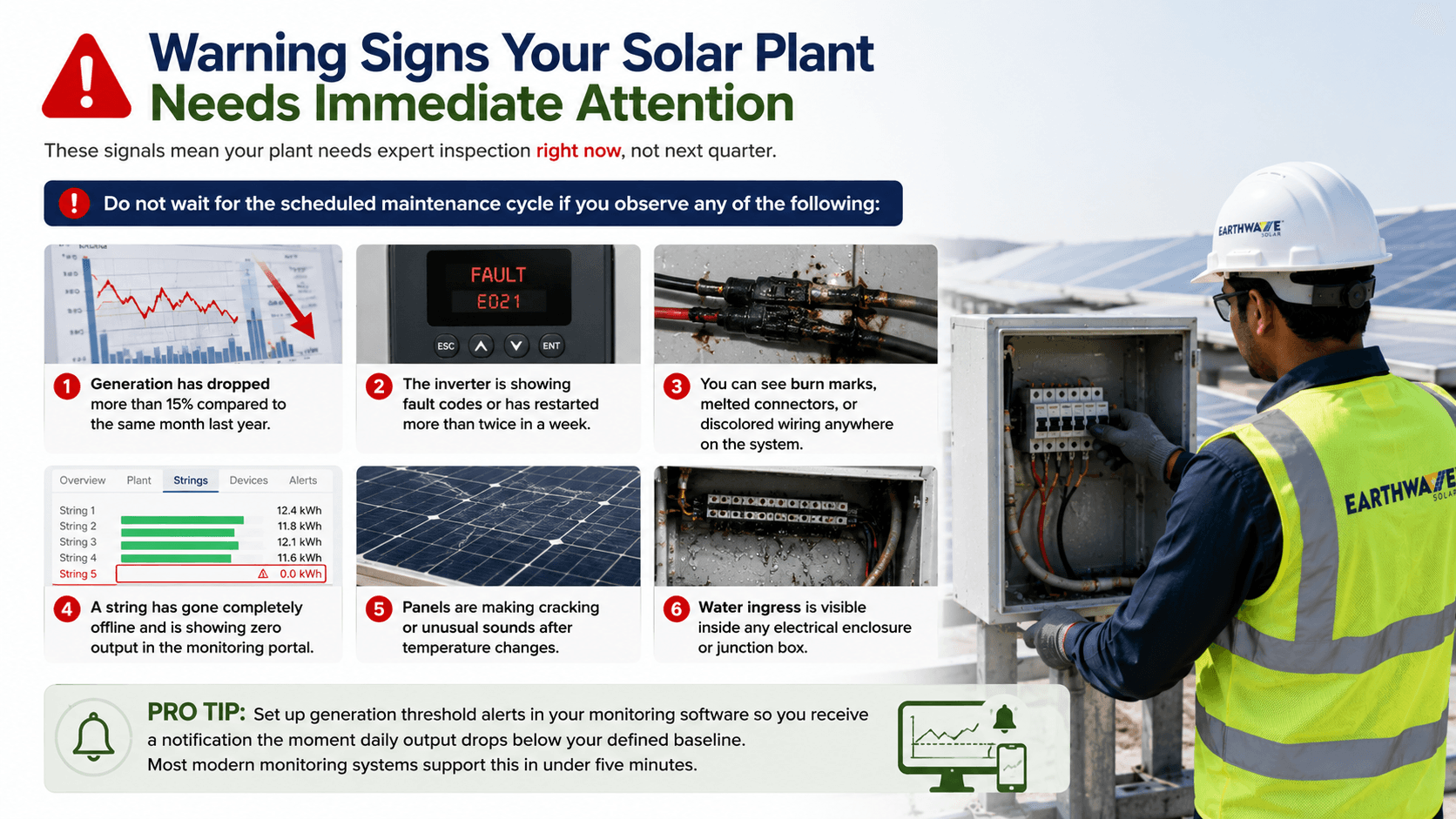
These signals mean your plant needs expert inspection right now, not next quarter.
Do not wait for the scheduled maintenance cycle if you observe any of the following:
Generation has dropped more than 15% compared to the same month last year
The inverter is showing fault codes or has restarted more than twice in a week
You can see burn marks, melted connectors, or discolored wiring anywhere on the system
A string has gone completely offline and is showing zero output in the monitoring portal
Panels are making cracking or unusual sounds after temperature changes
Water ingress is visible inside any electrical enclosure or junction box
Pro tip: Set up generation threshold alerts in your monitoring software so you receive a notification the moment daily output drops below your defined baseline. Most modern monitoring systems support this in under five minutes.
Cleaning frequency directly determines how much power your plant actually delivers.
In India, the cleaning schedule varies by location and season:
Environment | Recommended Frequency |
Industrial or dusty areas | Every 7 to 14 days |
Urban rooftop | Every 15 to 30 days |
Coastal or high-humidity | Every 10 to 21 days |
Clean suburban environment | Every 30 days |
Clean panels early morning or evening, never under midday sun
Use non-abrasive soft cloth or automated cleaning brushes
Always use clean, soft water to avoid mineral deposits
Never walk on panels or lean directly on module surfaces
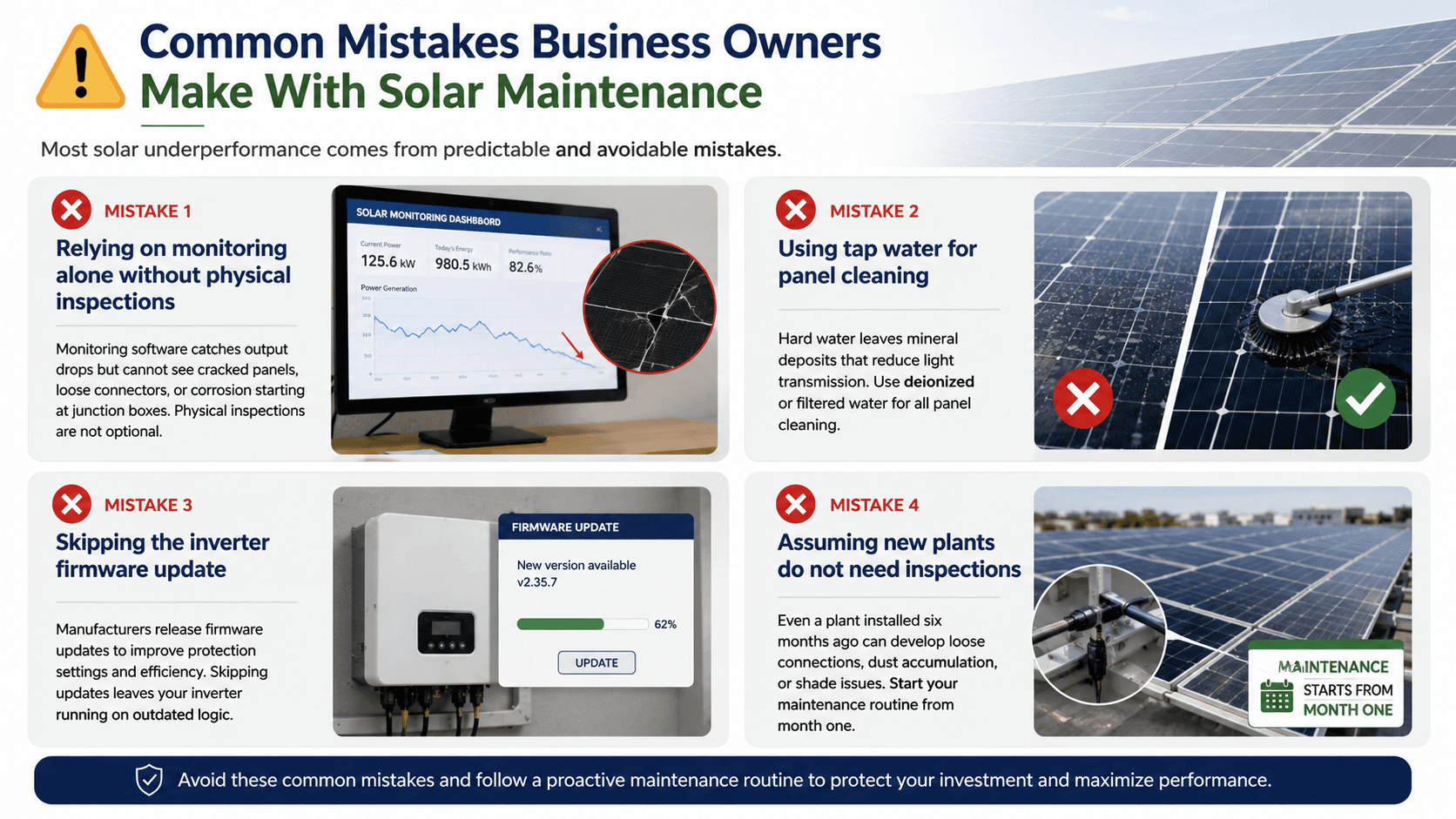
Most solar underperformance comes from predictable and avoidable mistakes.
Monitoring software catches output drops but cannot see cracked panels, loose connectors, or corrosion starting at junction boxes. Physical inspections are not optional.
Hard water leaves mineral deposits that reduce light transmission. Use deionized or filtered water for all panel cleaning.
Manufacturers release firmware updates to improve protection settings and efficiency. Skipping updates leaves your inverter running on outdated logic.
Even a plant installed six months ago can develop loose connections, dust accumulation, or shade issues. Start your maintenance routine from month one.

Earthwave helps business owners keep solar systems reliable after installation, not just before it.
Their services cover rooftop solar, commercial and industrial solar, ground-mounted solar, and EWOS WAVE on-grid inverter solutions.
,
solar, and
solutions.
support with reliable system performance.
A full process from consultation and site visit to design, documentation, installation, and final handover.
Transparent pricing, certified installation, and continued support for homes and businesses.
A solar plant performs best when design, installation, and monitoring all work together. Earthwave supports that full lifecycle, which helps reduce downtime, protect output, and keep operations stable.
Factories.
Warehouses.
Offices.
Commercial buildings.
Ground-mounted solar sites.
Apartments and business properties that need dependable solar support.
Earthwave focuses on clear guidance, professional installation, and ongoing support.
Want to learn more before reaching out? Read our detailed guide on how to maintain your solar system for additional context.
Contact Earthwave to schedule a plant health assessment or discuss an AMC plan
A: Monthly visual inspections are the minimum standard. Full technical maintenance should be done quarterly, and a comprehensive audit with infrared scanning should be completed once a year. High-dust or coastal environments may need more frequent cleaning cycles.
A: An Annual Maintenance Contract is a service agreement with a solar O&M provider that covers scheduled preventive maintenance visits, monitoring, and fault response. It protects your generation output, keeps warranties valid, and reduces the risk of unexpected repair costs.
A: Log in to your monitoring portal and compare current month generation to the same month last year. A drop of more than 10 to 15% that cannot be explained by weather or shading is a clear sign your plant needs a technical inspection.
A: Basic cleaning with soft water and a non-abrasive brush is manageable for trained facility staff. However, electrical testing, inverter inspection, and thermographic scanning require a qualified solar technician to do safely and accurately.
A: Skipping maintenance for 12 months typically results in 15 to 25% output loss from soiling alone, a higher probability of inverter faults, risk of warranty claim rejection, and potential safety hazards from degraded wiring or loose connections. The cost of neglect is almost always higher than the cost of regular maintenance.
A solar plant that runs without a maintenance routine is a plant that silently loses money every month.
The checklist in this guide gives you a complete monthly, quarterly, and annual process to protect your system's output, keep your equipment healthy, and avoid expensive emergency repairs.
Start with the monthly checks, build quarterly visits into your facility calendar, and schedule your annual audit before each peak season.
Reach out today to schedule a plant health assessment or discuss an AMC plan that fits your system size and budget.
FAQS
Can't find the answer you're looking for? Our team is here to help.
SUBSCRIBE NEWSLETTER
Switching to solar is easier than you think. Let us guide you to cleaner, more affordable energy.
