Captive solar power India
Captive Solar Plant: Cut Grid Use for Business
2026-04-21T00:00:00.000Z•8
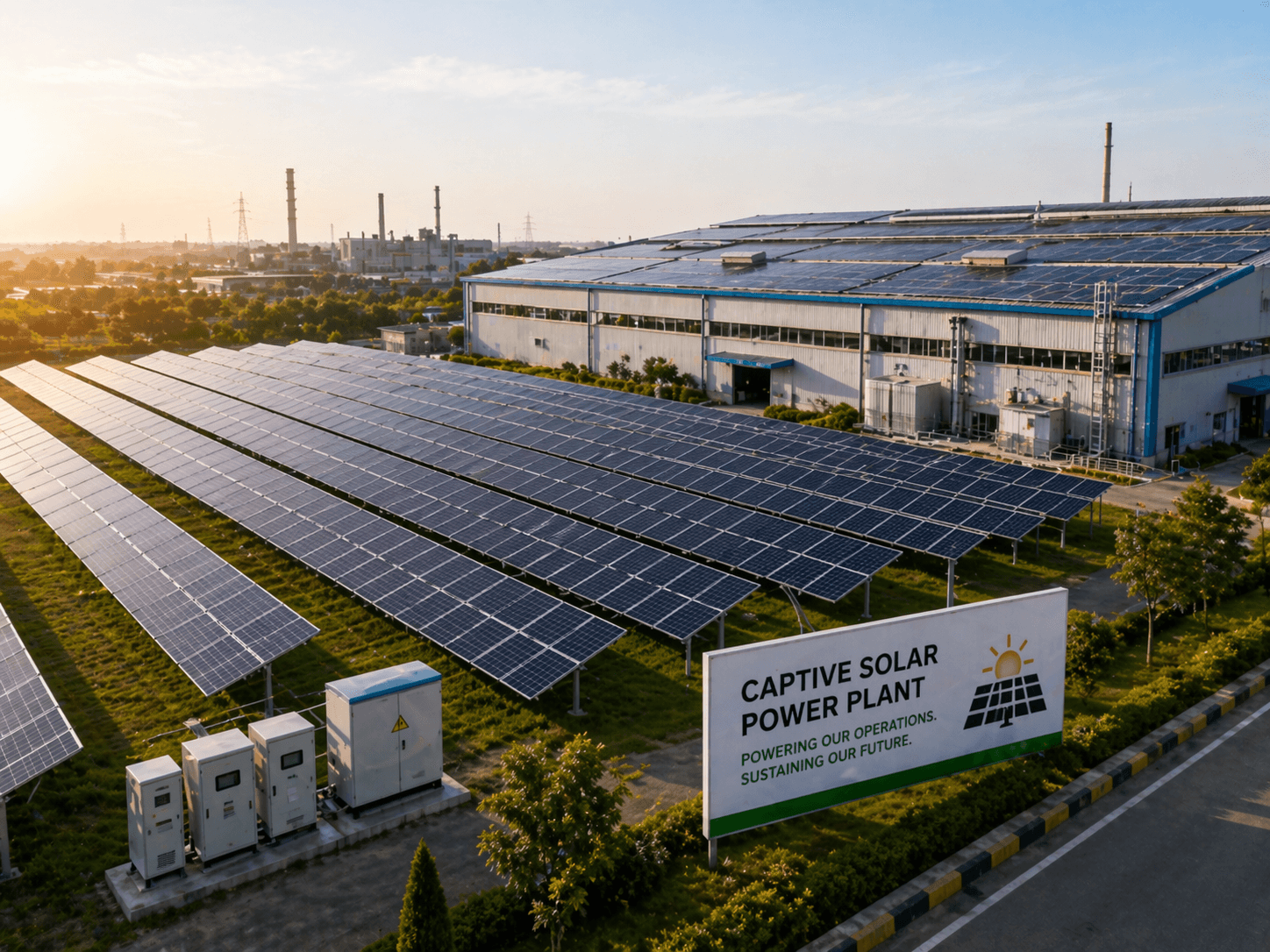
Yes. A captive solar power plant lets your business generate, own, and consume its own solar electricity, reducing DISCOM dependency by 40-70% and locking in energy costs for 25+ years while grid tariffs keep rising.
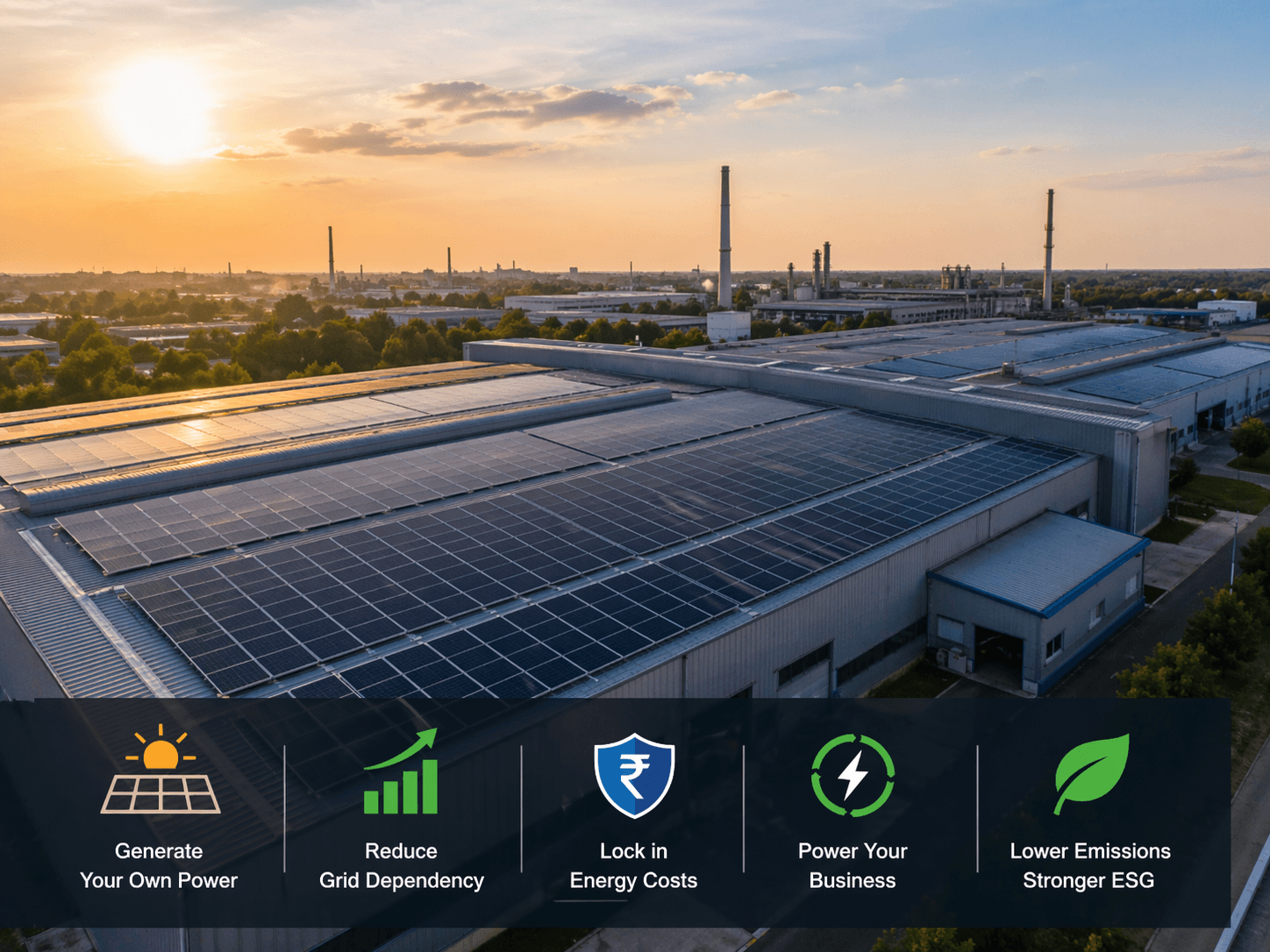
A captive solar plant is a solar system owned by your business, generating power exclusively for your operations.
Indian businesses paying ₹5 Lakhs to ₹2 Crore+ monthly in electricity bills see payback periods of 4 to 6 years.
You own the asset, you control the cost, and you eliminate exposure to annual DISCOM tariff hikes of 8-12%.
Captive plants qualify for accelerated depreciation benefits and ESG Scope 2 emission reduction reporting.
The EPC process covers site assessment, design, documentation, installation, and handover with zero operational disruption.
See Earthwave's
commercial and industrial solar services
to understand what full EPC delivery looks like.
A captive solar power plant is a solar energy system installed specifically for your business's own consumption, not for selling power to the grid.
Unlike a standard commercial rooftop system, a captive plant is sized and designed to meet your facility's full or majority load.
For businesses where rooftop area is limited, ground mount systems deliver the same captive power output from available land.
It operates under a clear legal framework in India: the Electricity Act, 2003 defines captive generation as any plant where at least 26% ownership is held by the consuming entity and at least 51% of the generated power is consumed captively.
Feature | Standard Rooftop Solar | Captive Solar Plant |
Ownership model | Business or leased | Business owned (captive entity) |
Scale | Typically 10 kW to 500 kW | 100 kW to 10 MW+ |
Power consumption | Partial offset | Majority or full load coverage |
Grid dependency | Moderate reduction | Significant to near-zero |
Open access eligibility | No | Yes (above 1 MW in most states) |
Depreciation benefit | Standard | Accelerated depreciation (40%) |
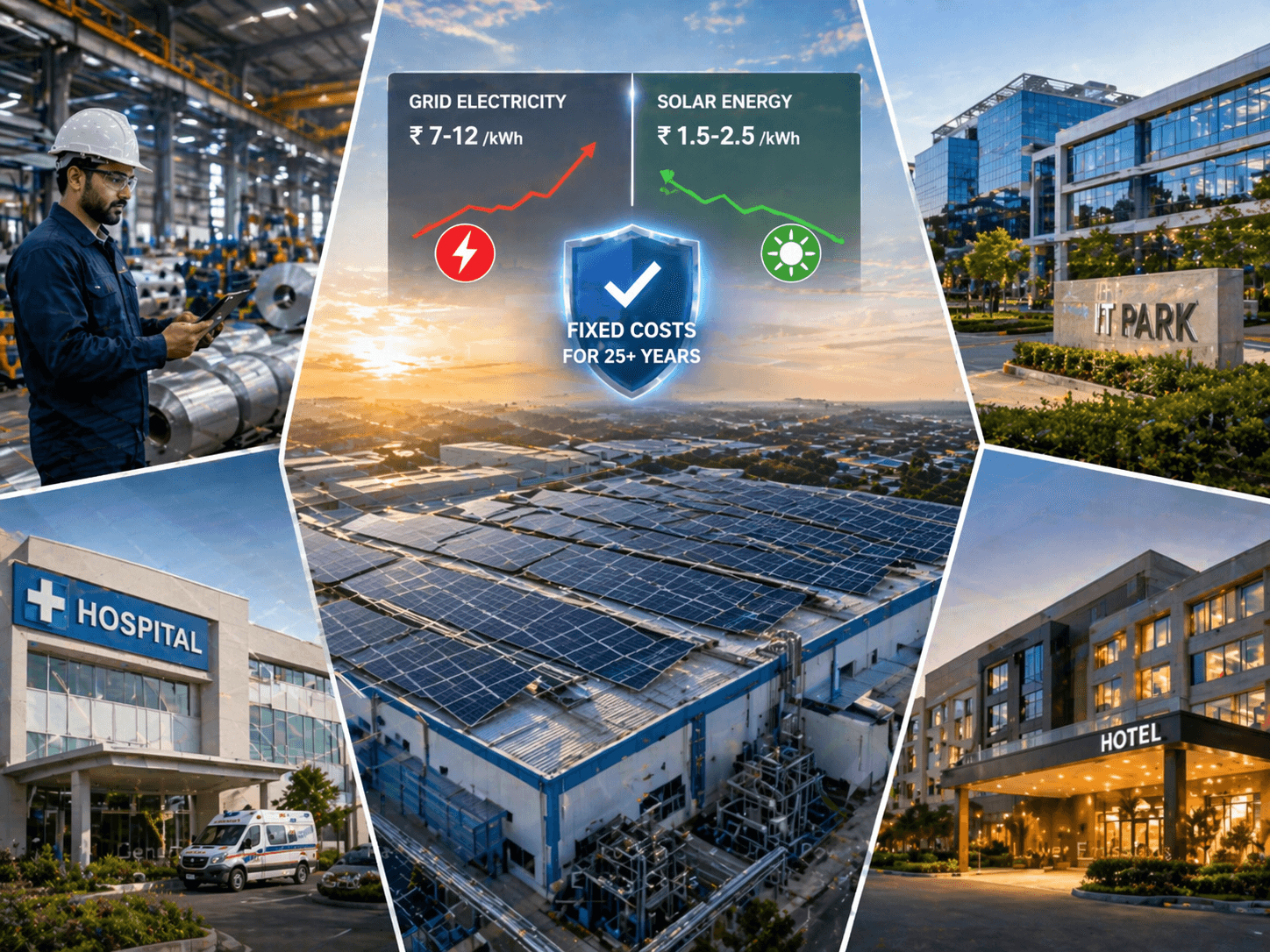
Your electricity bill is the clearest reason to act. DISCOM tariffs in India have increased 8-12% annually over the last five years in major industrial states like Gujarat, Maharashtra, Karnataka, and Telangana.
Read the full breakdown on how to reduce your electricity bill with solar in Gujarat.
For a manufacturing unit paying ₹50 Lakhs per month, that means the grid cost compounds to ₹90+ Lakhs monthly within five years with zero increase in consumption.
A captive solar plant converts that variable, rising cost into a fixed capital asset. Once installed, the cost per unit of solar power drops to ₹1.5-2.5 per kWh versus ₹7-12 per kWh from the DISCOM.
Manufacturing units facing compressed margins from raw material and energy cost inflation
IT parks and corporate campuses
under HQ-driven ESG Scope 2 reduction mandates
needing power cost certainty alongside backup reliability
Retail chains and hospitality groups where electricity is 15-20% of operating cost
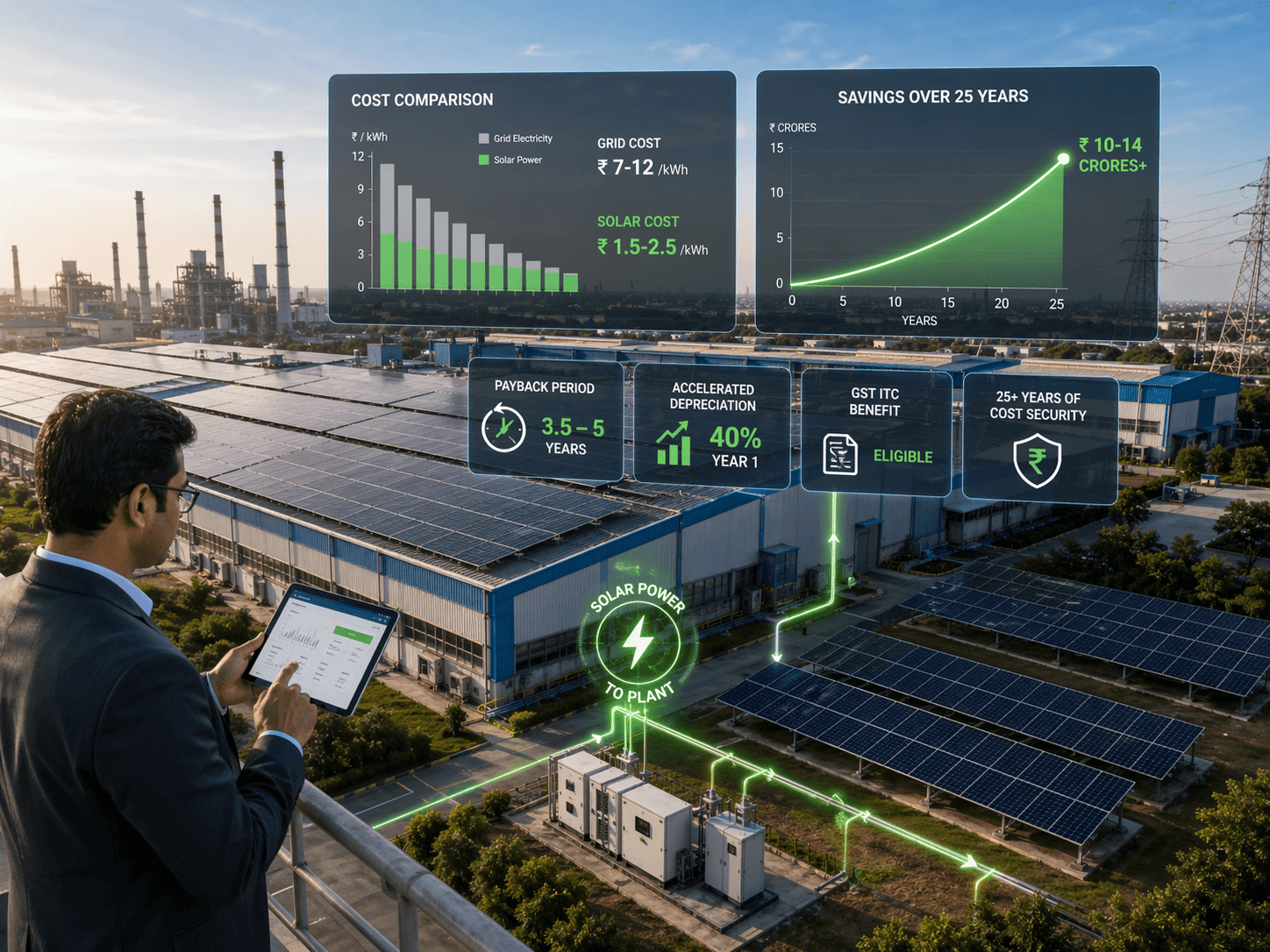
The math is straightforward. You invest capital upfront, generate cheap solar power for 25 years, and the system pays itself back well within the first quarter of its life.
Indicative financial model for a 500 kW captive plant (Gujarat):
Estimated CAPEX: ₹2.0 to 2.5 Crore (varies by panel grade, structure, and inverter)
Monthly generation: approximately 65,000-70,000 units (kWh) at Gujarat's solar irradiation levels
Current DISCOM tariff displacement: ₹7-9 per unit
Monthly saving: ₹4.5 to 6.3 Lakhs
Simple payback period: 3.5 to 5 years. See detailed state-wise data in our
solar payback period guide for India 2026
.
Net saving over 25 years (post payback): ₹10 to 14 Crore (conservative, not accounting for annual tariff increases)
Additional financial advantages:
Accelerated depreciation at 40%
under Income Tax Act reduces tax liability in Year 1
No GST input credit lost; solar plant CAPEX qualifies for ITC under GST
No fuel cost, no price volatility for the next 25 years
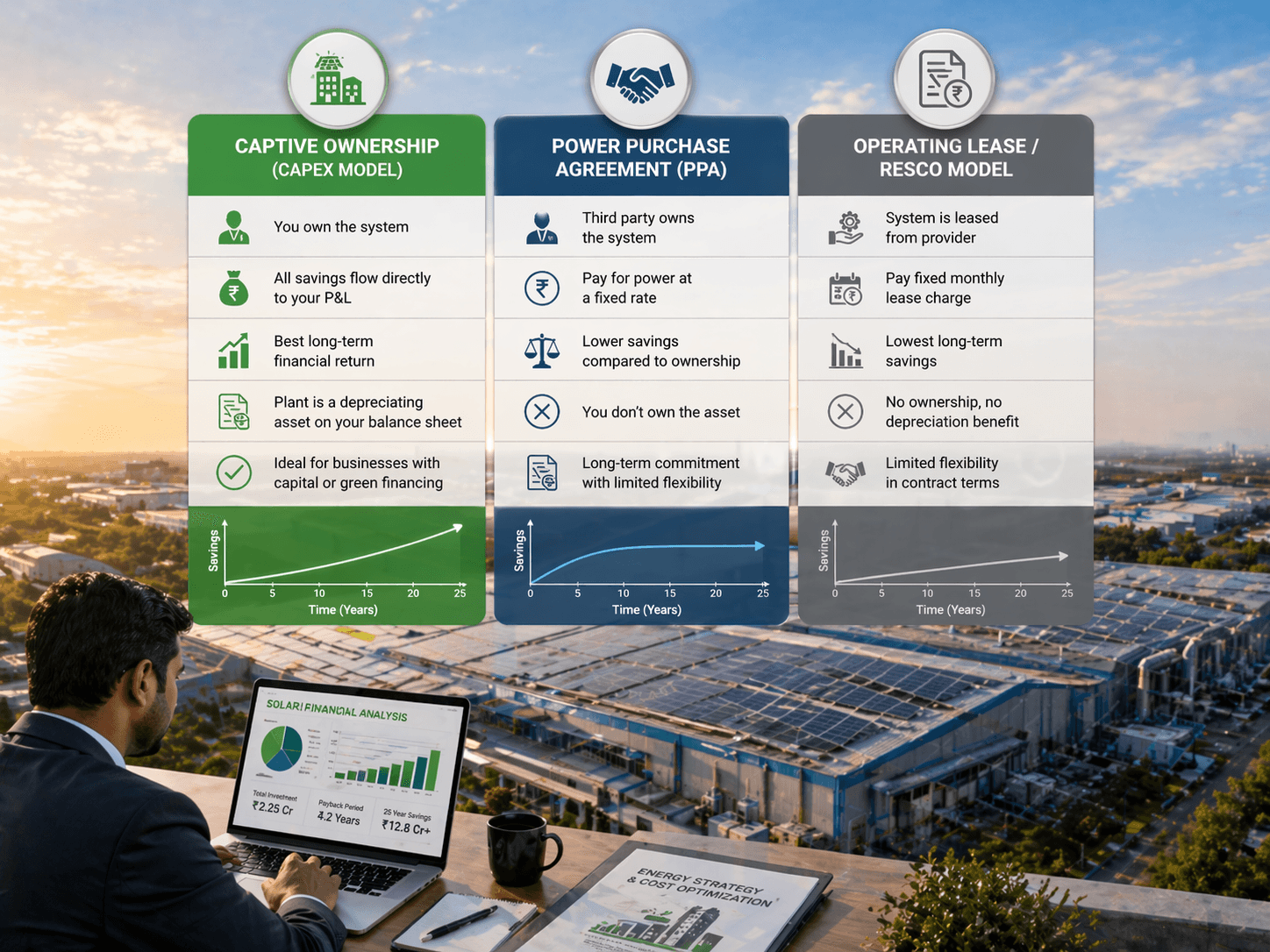
Owning a captive plant outright gives you the best long-term financial return. Other models exist, but they come with trade-offs worth understanding before you decide.
For a complete side-by-side breakdown, read our dedicated guide on CAPEX vs. RESCO solar financing.
Captive Ownership (CAPEX model):
You own the system. All savings flow directly to your P&L. The plant is a depreciating asset on your balance sheet. Best for businesses with capital available or access to green financing.
Power Purchase Agreement (PPA):
A third party installs the system on your premises and sells you power at a fixed rate. Lower upfront cost but you do not own the asset and savings are lower long-term.
Operating Lease / RESCO model:
You lease the system and pay a monthly fixed charge. Minimal upfront, but no ownership, no depreciation benefit, and limited contract flexibility.
If your business pays more than ₹10 Lakhs monthly on electricity and you plan to operate at this facility for 10+ years, the CAPEX ownership model returns far more value than PPA or lease.
Open access allows your business to source renewable power from a solar plant located off-site and wheel it to your facility through the state grid.
This is a viable option when your rooftop or premises cannot accommodate the system size you need.
Ground mount solar systems are typically the generation source in open access arrangements.
Applicable for consumers above 1 MW load (threshold varies by state)
Power is generated at a remote solar site (ground mount or large rooftop) and transmitted via state grid transmission lines
Your business pays wheeling charges and cross-subsidy surcharge (CSS) to the DISCOM
Net landed cost is still 30-50% lower than direct DISCOM tariff in most states. See also
how solar reduces peak demand charges
for additional savings beyond base tariff.
Gujarat
Karnataka
Rajasthan
Telangana
Maharashtra (improving framework as of 2024-25)
Open access under the Electricity Act, 2003, combined with the Renewable Energy Certificate (REC) mechanism, also supports ESG reporting and carbon credit generation.
Consider a textile manufacturing unit in Surat operating a 170 kW industrial solar installation.
For a detailed look at how this sector benefits, read our full post on solar for textile units in Surat.
Over a 25-year system life, that is over ₹5 Crore in saved electricity costs from a single mid-scale captive installation.
Precise load analysis before system sizing
High-efficiency panel selection matched to rooftop orientation and shadow-free area
(5-25 kW three-phase units) enabling modular expansion
Real-time monitoring so the finance team sees savings data, not just generation data
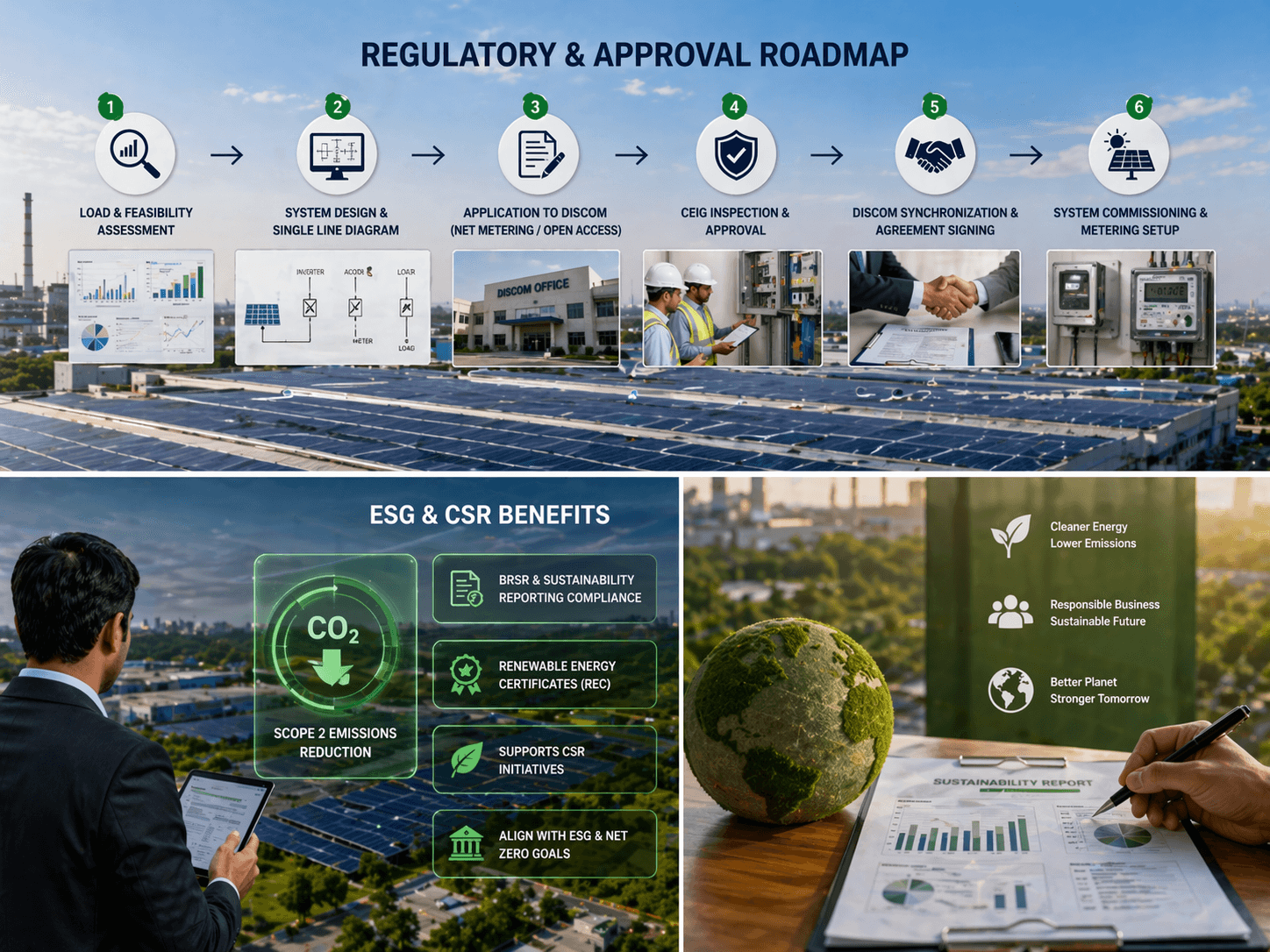
Getting your captive plant commissioned requires a structured regulatory process. This is not complicated, but it does require an experienced EPC partner to handle it without delays.
Before you engage a vendor, review the solar EPC company checklist for India to know exactly what to verify.
Load and feasibility assessment by your EPC company
System design and single-line diagram preparation
Application to your state DISCOM for
or open access registration
CEIG (Chief Electrical Inspector to Government) inspection and approval
DISCOM synchronization approval and net metering agreement signing
System commissioning and metering setup
Timelines vary by state: Gujarat typically takes 45 to 90 days from application to commissioning. States with online DISCOM portals (like DGVCL in Gujarat) have significantly faster approval cycles.
Owning a captive solar plant directly reduces your Scope 2 GHG emissions under the GHG Protocol framework. This is the emissions category most scrutinized by investors, HQ compliance teams, and sustainability auditors.
Compliance benefits of captive solar ownership:
Directly reduces Scope 2 (purchased electricity) emissions on your sustainability report
Generates documentation for BRSR (Business Responsibility and Sustainability Reporting) disclosures required by SEBI for listed entities
Supports REC (Renewable Energy Certificate) generation for voluntary carbon markets
Qualifies under CSR expenditure norms if structured appropriately under Companies Act, 2013
For IT parks, hospitals, and institutions under reporting pressure, captive solar is one of the few interventions that simultaneously reduces cost and improves compliance posture.
See how commercial solar solutions enhance business sustainability for a broader picture.
Earthwave Solar is a full-service EPC (Engineering, Procurement, and Construction) solar company established in 2018 and headquartered in Surat, Gujarat, with operations across Gujarat and Madhya Pradesh.
Earthwave has executed projects ranging from 30 kW rooftop systems to 80 MW ground mounts, with active industrial installations including Pari Textile (170 kW) and Sahaj Textile (120 kW). In 2021, Earthwave delivered an 80 MW ground mount project for Mahindra Susten, demonstrating large-scale execution capability.
What Earthwave delivers for commercial and industrial clients:
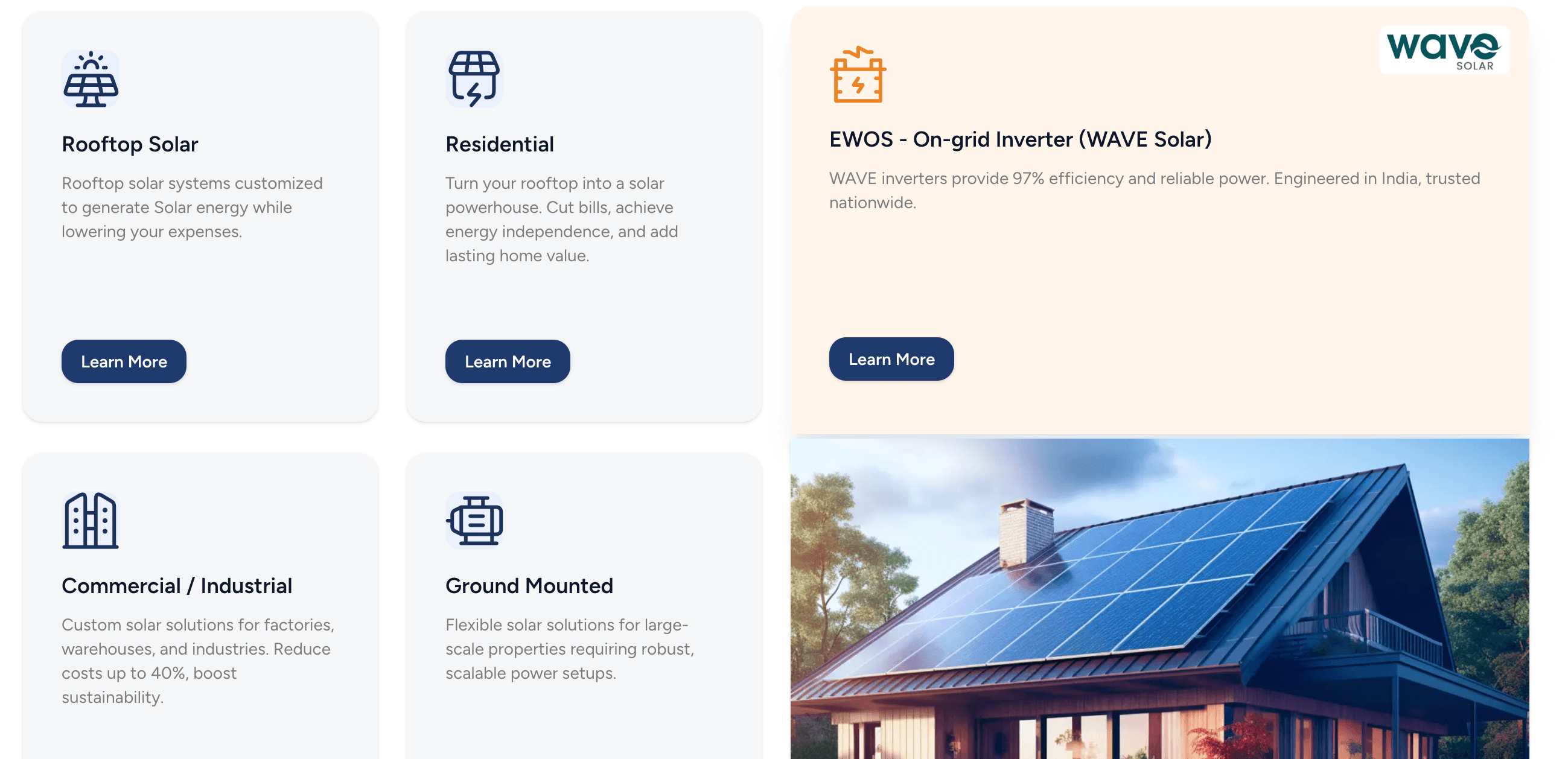
End-to-end EPC services: site visit, system design, documentation, DISCOM approvals, installation, and handover
Commercial and industrial solar systems built specifically for factories, warehouses, and large commercial buildings with 30-40% power cost reduction
Wave Series inverters (2.5 kW to 125 kW) manufactured in-house with 97% efficiency and a 10-year warranty, offering real-time smartphone monitoring
for businesses without adequate rooftop space, installed on steel structures optimized for maximum sun exposure
Complete documentation handling including DISCOM approvals, subsidy claims, and grid connection paperwork with zero complications
Earthwave's client list includes Goldi Solar, Torrent Power, Mahindra Susten, DGVCL, Solnce Solar, and Deon Energy, confirming credibility across both EPC execution and component supply.
Contact Earthwave Solar:
Surat, Gujarat: +91 90336 07212
Bhopal, M.P.: +91 90336 02156
Email:
Website:
A captive plant is owned by the consuming business and sized to cover the majority of its load, unlike a standard rooftop system that offsets only a fraction. Under the Electricity Act, 2003, at least 26% ownership must rest with the consuming entity and 51% of power must be self-consumed to qualify as captive generation.
A 500 kW industrial captive system typically costs ₹2 to 2.5 Crore depending on panel grade, mounting structure, inverter type, and state-specific civil requirements. Accelerated depreciation at 40% significantly reduces the effective first-year cost, improving the financial case further.
For businesses paying ₹7-9 per unit to the DISCOM, payback periods typically fall between 3.5 and 6 years depending on system size, local tariff, and plant load factor. After payback, you generate power at approximately ₹1.5-2.5 per unit for the remaining 20+ year system life.
Yes. Captive solar directly reduces Scope 2 GHG emissions under the GHG Protocol and generates documentation for BRSR disclosures mandated by SEBI for listed companies. Depending on structure, the expenditure can also qualify under CSR provisions of the Companies Act, 2013.
From initial site assessment to final commissioning, a well-managed EPC process in Gujarat typically takes 60 to 90 days. This includes DISCOM application, CEIG inspection, synchronization approval, and system installation. An experienced EPC partner with established DISCOM relationships can reduce this timeline significantly.
If your electricity bill is above ₹5 Lakhs per month, the numbers already justify a serious look at captive solar ownership.
Talk to Earthwave Solar for a no-obligation site assessment and savings calculation specific to your facility. Earthwave's team handles everything from system design to DISCOM approvals, so your operations stay uninterrupted from day one.
Get your free energy audit or call +91 90336 07212.
FAQS
Can't find the answer you're looking for? Our team is here to help.
SUBSCRIBE NEWSLETTER
Switching to solar is easier than you think. Let us guide you to cleaner, more affordable energy.
