Solar Installation India
Solar Installation Cost in India 2026: Price Factors
2026-05-18T00:00:00.000Z•9
Solar installation cost in India ranges from Rs. 35 lakh to Rs. 70 lakh per MW for industrial and commercial sites in 2026, depending on system type, panel brand, roof condition, and location.
The final price is not a fixed number. It shifts based on at least six major factors that every factory owner and finance manager should understand before requesting a quote.
Industrial solar costs Rs. 35 to 45 lakh per MW for rooftop and Rs. 47 to 70 lakh per MW for ground-mounted systems.
Panel brand, inverter type, roof structure, and system size are the four biggest cost drivers.
Government subsidies and accelerated depreciation can reduce the effective cost by 20 to 40%.
Payback period for industrial solar in India ranges from 4 to 7 years depending on site conditions and energy load.
Choosing the right EPC partner matters as much as the price, because poor installation creates hidden costs over 25 years.
Solar installation cost in India for industrial and commercial sites sits between Rs. 35 lakh and Rs. 70 lakh per MW in 2026.
This range is wide because the final cost depends on multiple site-specific variables.
Two factories in the same city can receive quotes that differ by Rs. 10 to 15 lakh per MW if one has a structurally strong RCC roof and the other needs civil work and ground-mounted structures.
System Type | Capacity Range | Estimated Cost Per MW |
Rooftop Solar (RCC roof) | 100 kW to 2 MW | Rs. 35 to 45 lakh |
Rooftop Solar (metal sheet roof) | 100 kW to 1 MW | Rs. 38 to 48 lakh |
Ground-Mounted Solar | 500 kW to 10 MW+ | Rs. 47 to 70 lakh |
Hybrid Solar System | 200 kW to 5 MW | Rs. 50 to 75 lakh |
These are all-inclusive project costs covering panels, inverters, structures, cables, earthing, net metering, and commissioning.
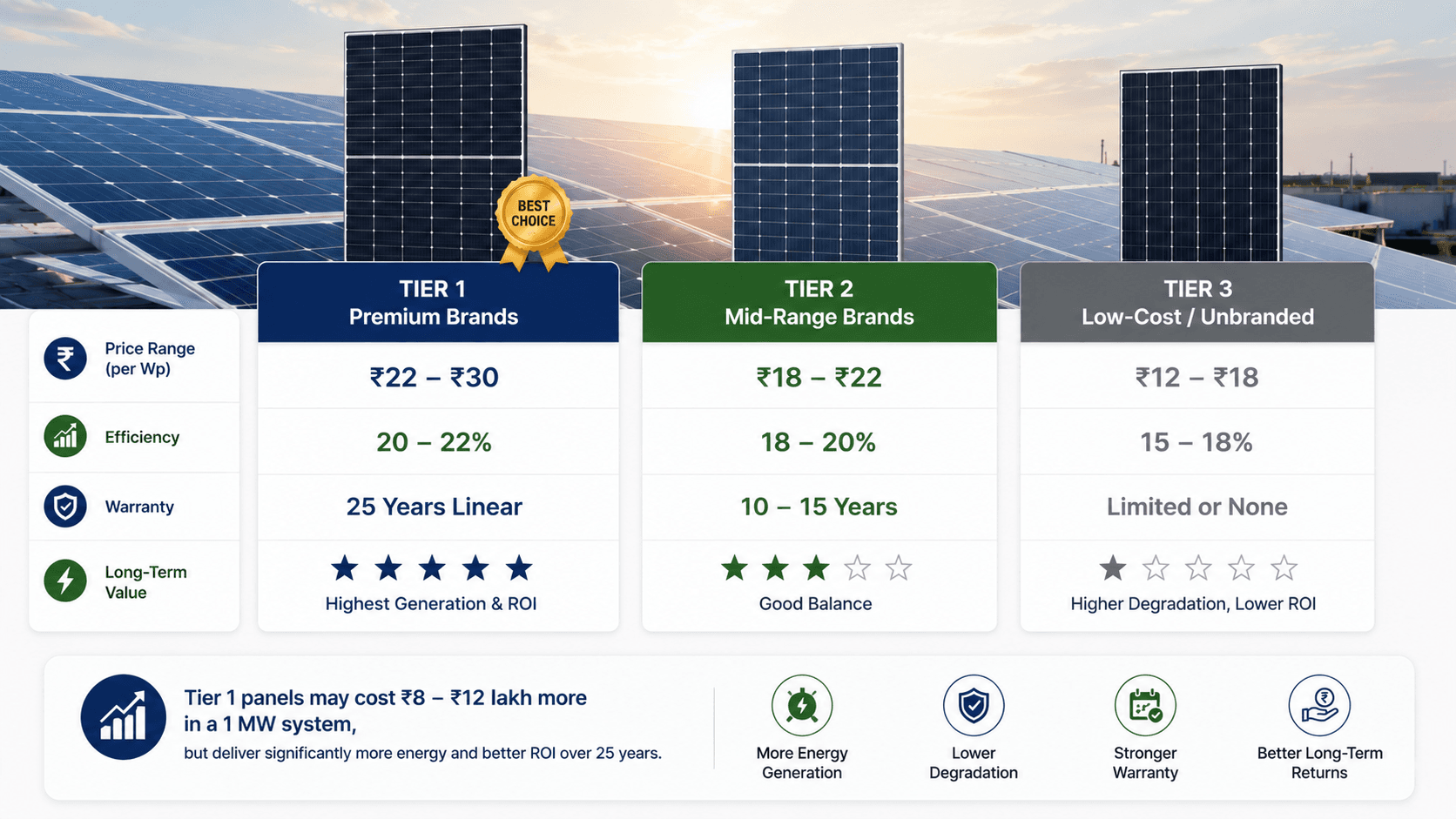
Panel quality is the single biggest variable in solar installation cost in India.
The market offers panels across three tiers.
Tier 1 brands from manufacturers like Veda Solar , Waaree, Adani Solar, Vikram Solar, and Tata Power Solar cost more upfront but deliver better efficiency, lower degradation, and stronger warranty coverage.
Panel Tier | Price Range (per Wp) | Efficiency | Warranty |
Tier 1 (Indian + Global brands) | Rs. 22 to 30 | 20 to 22% | 25 years linear |
Tier 2 (Mid-range brands) | Rs. 18 to 22 | 18 to 20% | 10 to 15 years |
Tier 3 (Low-cost, unbranded) | Rs. 12 to 18 | 15 to 18% | Limited or none |
For a 1 MW system, choosing Tier 1 over Tier 3 panels adds roughly Rs. 8 to 12 lakh to the project cost. But over 25 years, higher efficiency panels generate significantly more electricity, which directly improves your ROI.
Industrial buyers should never select panels on price alone. A panel that costs Rs. 5 lakh less today but degrades 10% faster will cost far more over the project lifetime.
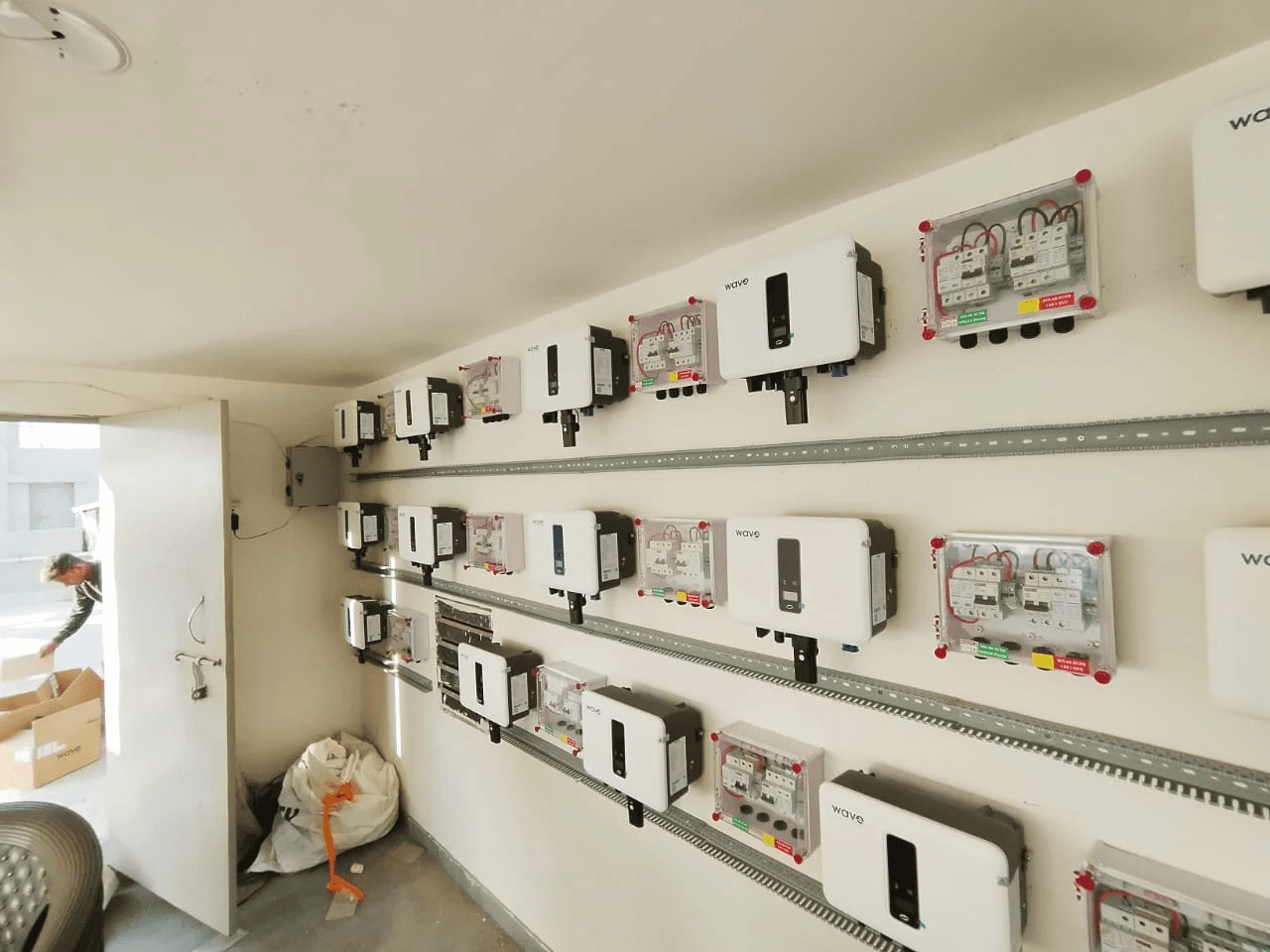
The inverter type you choose adds Rs. 3 to 8 lakh per MW to your solar installation cost in India.
Inverters convert DC power from panels into AC power your factory can use. The two main types for industrial solar are string inverters and central inverters. String inverters suit rooftop systems with varied shading. Central inverters work better for large ground-mounted plants with uniform exposure.
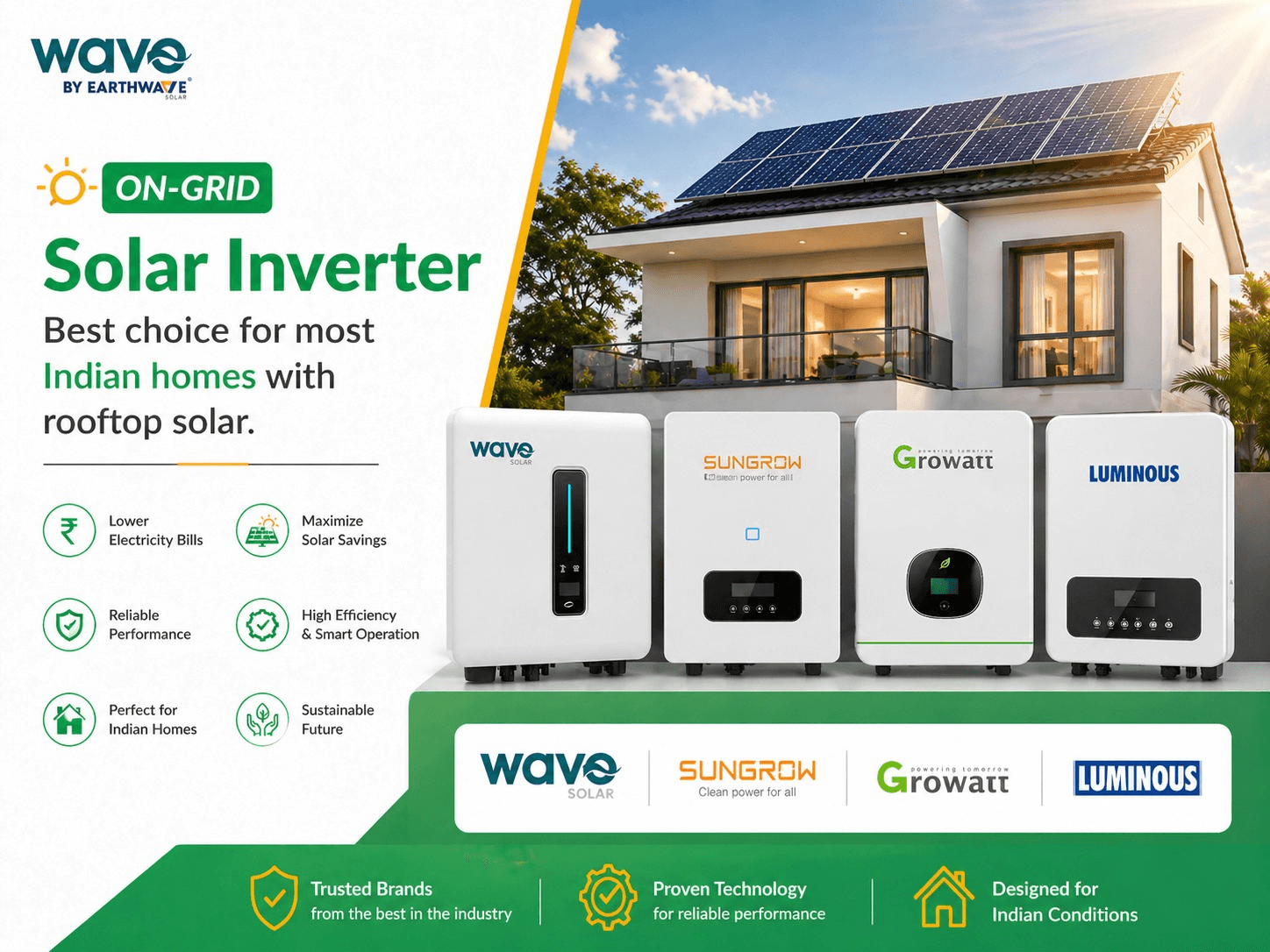
Inverter cost comparison:
Inverter Type | Cost Per MW | Best For |
String Inverter | Rs. 4 to 7 lakh | Rooftop, shading variation |
Central Inverter | Rs. 3 to 5 lakh | Ground-mounted, large capacity |
Hybrid Inverter (with battery) | Rs. 8 to 15 lakh | Backup power + solar |
For factories evaluating backup power alongside solar generation, our on-grid vs off-grid vs hybrid solar guide explains which inverter configuration fits which load profile.
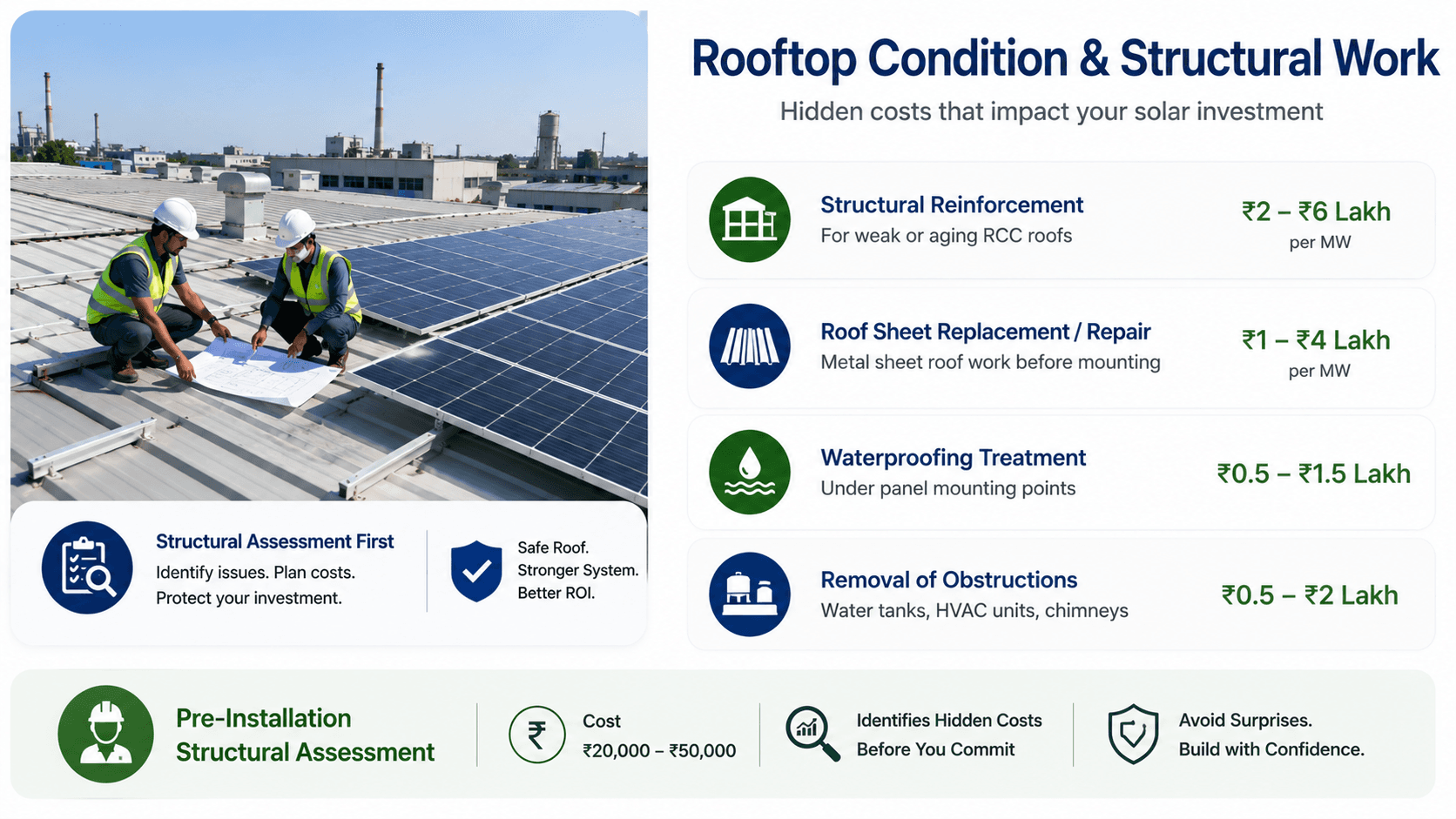
Roof condition is the most overlooked cost driver in rooftop solar installation.
Many industrial buildings in India, especially those built before 2000, were not engineered to carry the additional dead load of solar panels (typically 15 to 25 kg per square meter).
If your roof needs structural reinforcement, waterproofing repair, or sheet replacement before installation, that cost adds directly to your project budget.
Structural reinforcement for weak or aging RCC roofs: Rs. 2 to 6 lakh per MW
Metal sheet roof replacement or repair before mounting: Rs. 1 to 4 lakh per MW
Waterproofing treatment under panel mounting points: Rs. 50,000 to 1.5 lakh
Removal of obstructions (water tanks, HVAC units, chimneys): Rs. 50,000 to 2 lakh
Always insist on this before signing any EPC contract. Use our solar EPC company checklist to verify your installer includes this step.
For factories with structurally compromised roofs, ground-mounted solar often becomes the more cost-effective option overall. Read our detailed comparison of rooftop vs ground-mounted solar for industrial sites to understand when each option makes financial sense.
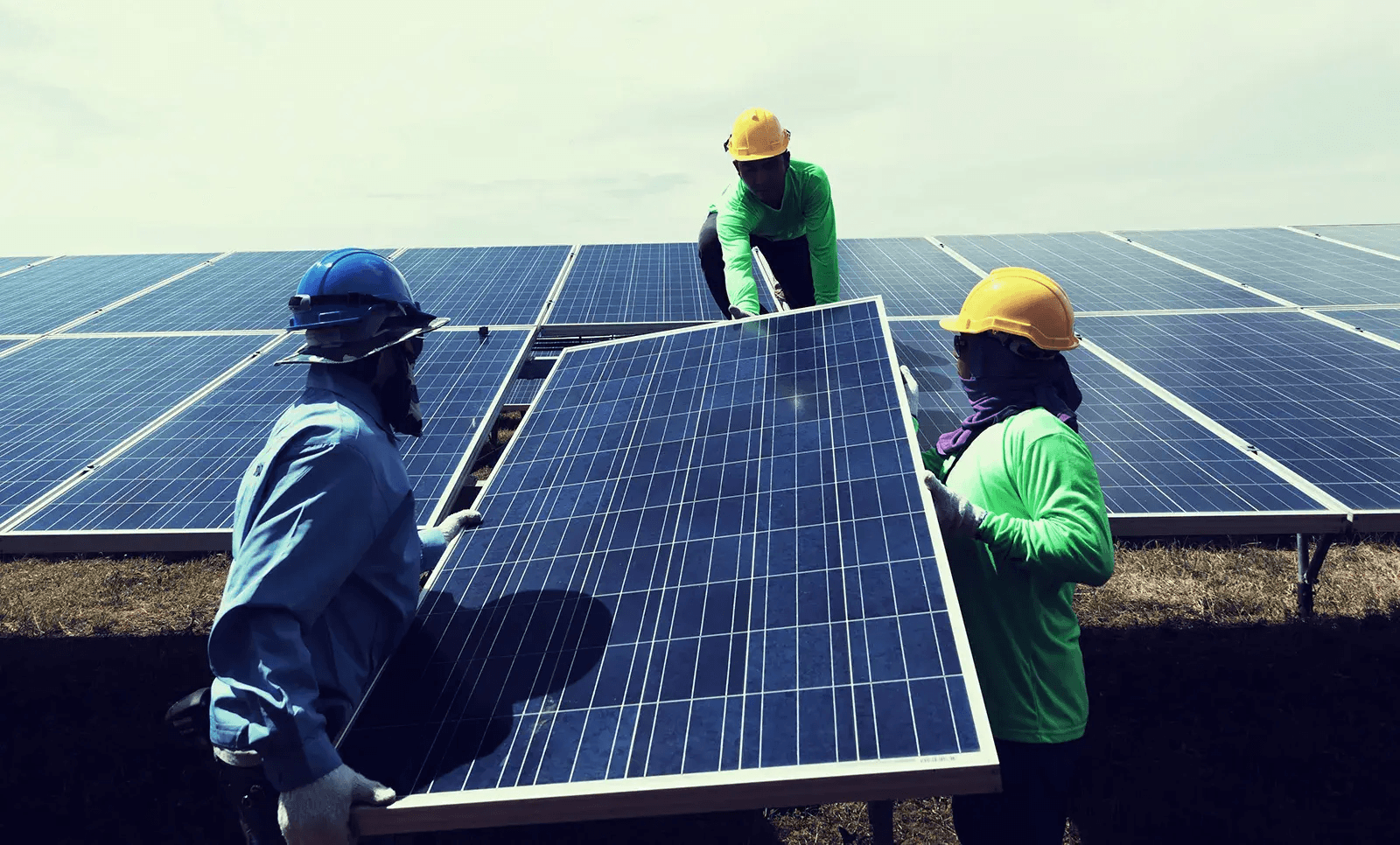
Larger solar systems cost less per kWp than smaller ones.
This is the economies of scale effect. When you install 1 MW instead of 100 kW, the fixed costs of design, documentation, site mobilization, and project management spread across more kilowatts. The per-unit cost of panels, inverters, and cables also drops as order size increases.
Cost per kWp by system size (approximate):
System Size | Estimated Cost Per kWp |
50 kW to 200 kW | Rs. 45 to 55 per Wp |
200 kW to 500 kW | Rs. 40 to 48 per Wp |
500 kW to 1 MW | Rs. 37 to 44 per Wp |
1 MW to 5 MW | Rs. 35 to 42 per Wp |
Above 5 MW | Rs. 32 to 38 per Wp |
A factory considering a phased installation should run the numbers on installing the full capacity upfront versus doing it in stages.
The per-unit savings on a 1 MW single installation versus two 500 kW installations spaced two years apart can be Rs. 5 to 8 lakh.
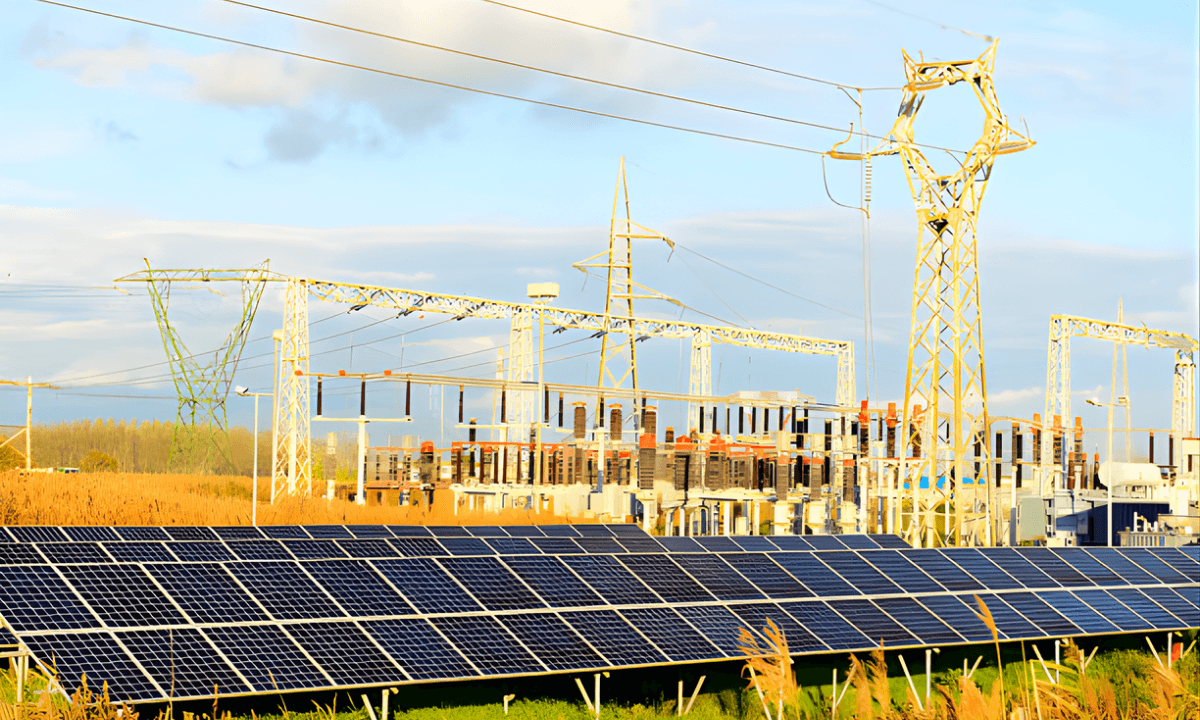
Your factory's location directly affects the balance of system cost and the ease of net metering approval.
Factories in industrial zones well-connected to the DISCOM grid face lower interconnection costs.
Remote sites or those far from the nearest substation may need longer LT or HT cable runs, additional switchgear, or even substation upgrades, all of which add to the project cost.
Distance from grid interconnection point: longer runs add Rs. 1 to 5 lakh per MW
DISCOM tariff category: higher industrial tariffs increase savings and improve ROI
State-level policy and subsidy availability: Gujarat, Rajasthan, and Maharashtra have active rooftop solar incentive programs
Gujarat industrial buyers should review the Gujarat rooftop solar policy 2026 and the current solar subsidy available in Gujarat before finalizing their project budget, as these can reduce net project cost meaningfully.
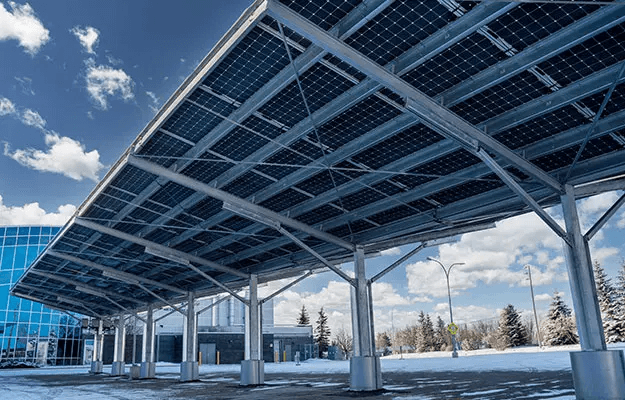
The mounting structure is a cost item that varies significantly between rooftop and ground-mounted systems.
For rooftop solar, GI or aluminium channel structures mount directly on the roof and cost Rs. 3 to 5 lakh per MW. For ground-mounted systems, hot-dip galvanized steel structures with civil foundation work cost Rs. 7 to 12 lakh per MW. The structure must withstand wind loads specific to your site's wind zone, which also affects material specification and cost.
Structure Type | Application | Cost Per MW |
GI channel (rooftop) | RCC or metal sheet roof | Rs. 3 to 5 lakh |
Aluminium rail (rooftop) | Lightweight roofs | Rs. 4 to 6 lakh |
Hot-dip GI (ground-mounted) | Open land, civil foundation | Rs. 7 to 12 lakh |
For a detailed breakdown of what goes into planning a ground-mounted solar plant in India, including structure selection and civil scope, refer to Earthwave's technical guide.
Government incentives can reduce your net solar installation cost in India by 20 to 40%.
Industrial and commercial buyers access two main financial benefits:
Allows 40% depreciation on solar assets in the first year under the Income Tax Act
Reduces taxable income significantly in Year 1
Effectively lowers the net project cost for profitable businesses by 10 to 20%
Read the full breakdown in our
Gujarat offers rooftop solar subsidies for certain commercial and MSME categories
Subsidy amounts vary by connected load and system size
Combined with AD, a factory can recover 25 to 35% of project cost within 12 to 18 months through tax savings and bill reduction
Allows export of excess solar power to the grid
Credited against your electricity bill, improving ROI further
Available across most Indian states for systems up to 1 MW or above depending on DISCOM policy
Before finalizing your project budget, always calculate the post-incentive cost, not just the gross installation quote.
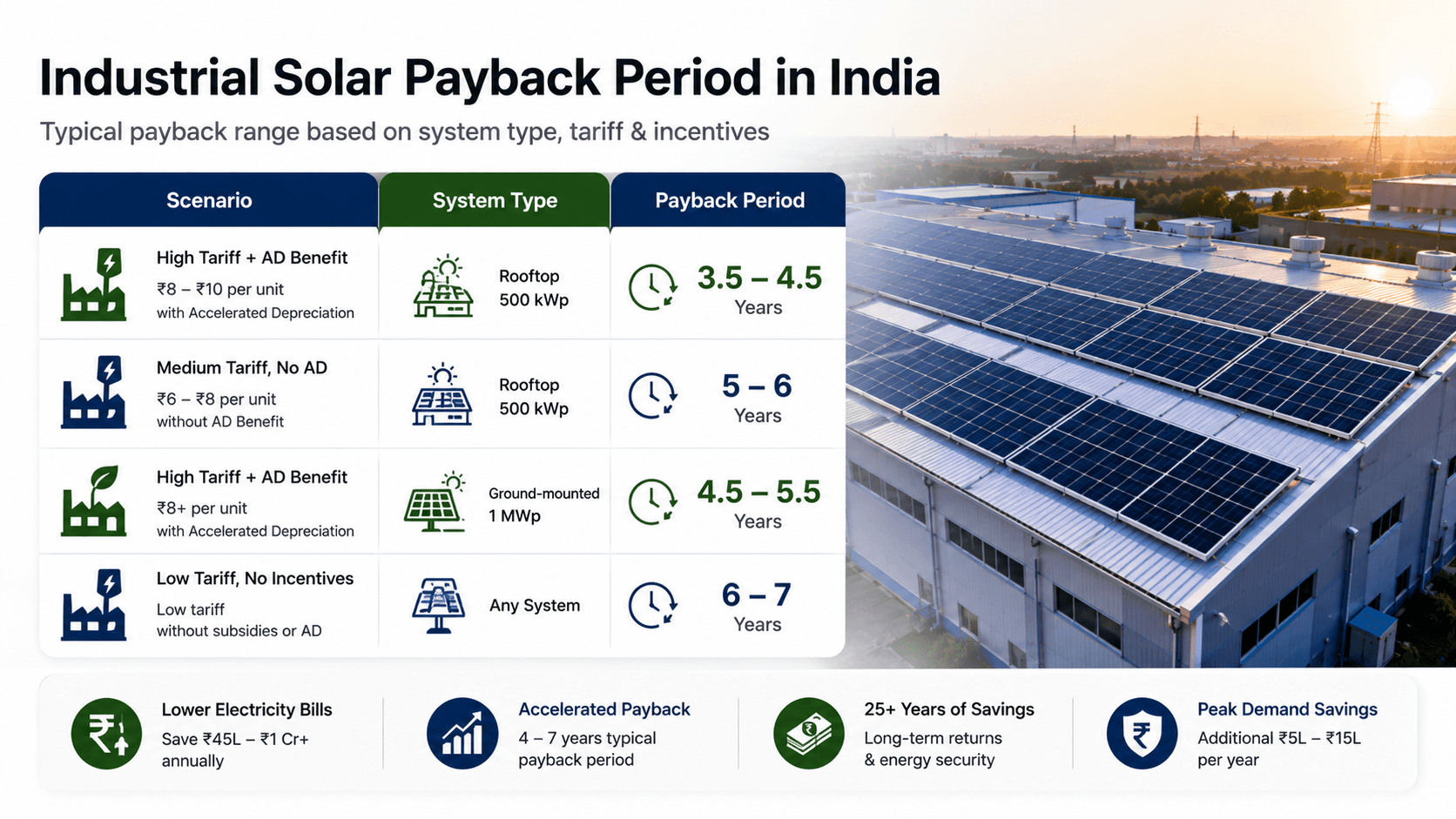
Industrial solar in India delivers a payback period of 4 to 7 years depending on system type, tariff rate, and incentive utilization.
Scenario | System Type | Payback Period |
Factory with Rs. 8 to 10 per unit tariff, AD benefit | Rooftop 500 kWp | 3.5 to 4.5 years |
Factory with Rs. 6 to 8 per unit tariff, no AD | Rooftop 500 kWp | 5 to 6 years |
Large plant, Rs. 8+ tariff, AD benefit | Ground-mounted 1 MWp | 4.5 to 5.5 years |
Factory with low tariff and no subsidies | Any system | 6 to 7 years |
For a full calculation model based on your actual electricity bill and load data, read our solar payback period guide for India.
Understanding how solar reduces peak demand charges is also important for industrial buyers, because peak demand reduction can save an additional Rs. 5 to 15 lakh per year on top of unit-cost savings.
Rooftop solar costs less to install. Ground-mounted solar generates more energy per kWp.
The right choice depends on your roof condition, available land, and total energy requirement. For factories with strong rooftops and loads up to 2 MW, rooftop solar gives faster payback. For larger loads or sites with limited usable roof area, ground-mounted solar gives better long-term value despite higher upfront cost.
Quick cost comparison:
Parameter | Rooftop Solar | Ground-Mounted Solar |
Installation cost per MW | Rs. 35 to 45 lakh | Rs. 47 to 70 lakh |
Land requirement | None | Required |
Energy output per kWp/year | 1,400 to 1,500 kWh | 1,500 to 1,600 kWh |
Typical payback period | 4 to 5 years | 5 to 7 years |
For a full side-by-side evaluation with ROI examples, read the complete rooftop vs ground-mounted solar comparison for industrial sites.
Industrial buyers in India have two main financing paths: CAPEX and RESCO.
CAPEX model:
You own the system from day one
Full benefit of AD, subsidies, and net metering goes to you
Higher upfront investment but maximum long-term savings
Best for businesses with available capital or access to solar loans
RESCO model (Renewable Energy Service Company):
Zero upfront cost
You pay a fixed tariff per unit lower than your current grid rate
The EPC company owns and operates the system
Lower savings than CAPEX but zero capital risk
For a clear breakdown of both options with financial scenarios, read our CAPEX vs RESCO solar financing guide.
Earthwave is a solar EPC company serving industrial and commercial clients across Gujarat and India.
Their team includes solar design engineers, structural consultants, and financial analysts who work together to give you a cost estimate built on your actual site data, not a generic quote.
You can view completed projects across factory, warehouse, and commercial installations on the Earthwave projects page.
Free site survey and load analysis
Rooftop structural assessment and shadow analysis
Detailed cost breakdowns with subsidy and AD calculations
and
system design and EPC execution
solutions for multi-building and campus deployments
for sites needing solar plus backup power
Net metering application and DISCOM coordination
Long-term AMC and O&M support
Earthwave's approach is cost-transparent. They show you what drives your project price, what subsidies you qualify for, and what your actual payback looks like before you sign anything.
If your factory is ready to move from comparison to decision, Earthwave gives you the numbers you need to make that call with confidence.
Stop working with generic price estimates. Get a site-specific cost report for your factory or industrial facility.
Contact Earthwave for a free solar feasibility study. Their team will assess your roof or land, calculate your energy savings, and give you a clear cost and ROI projection within days.
Visit www.earthwavetech.in or go directly to the contact page to book your free site survey today.
Solar installation cost for an industrial factory in India ranges from Rs. 35 to 45 lakh per MW for rooftop systems and Rs. 47 to 70 lakh per MW for ground-mounted systems in 2026. The final cost depends on panel brand, inverter type, roof condition, and system size. Larger systems above 500 kW benefit from lower per-unit costs due to economies of scale.
Industrial solar systems in India typically deliver a payback period of 4 to 7 years. Factories with higher electricity tariffs (Rs. 8 per unit and above) and access to accelerated depreciation benefits can achieve payback in as little as 3.5 to 4.5 years. Read our solar payback period guide for a detailed calculation.
Industrial and commercial solar buyers in India can access accelerated depreciation at 40% on solar assets in Year 1, which significantly reduces taxable income and effective project cost. State governments including Gujarat offer additional rooftop solar subsidies for MSMEs and certain commercial categories. Check the current solar subsidy options in Gujarat for the latest eligibility criteria.
Yes, rooftop solar is generally 10 to 20% cheaper to install than ground-mounted solar for the same capacity. Rooftop systems use the existing building structure, eliminating civil work and land cost. However, if your factory roof is structurally weak or too small to meet your energy load, ground-mounted solar becomes the more practical and cost-efficient choice overall.
Common hidden costs in solar installation quotes include structural reinforcement for weak roofs, roof waterproofing, longer cable runs for remote meter or substation connections, DISCOM application and inspection fees, and AMC costs after warranty. Always ask your EPC partner for an itemized quote and use our solar EPC company checklist to compare vendors properly before signing.
FAQS
Can't find the answer you're looking for? Our team is here to help.
SUBSCRIBE NEWSLETTER
Switching to solar is easier than you think. Let us guide you to cleaner, more affordable energy.
