Land and civil engineering checklist
Ground-Mounted Solar Civil Checklist for Gujarat
2026-05-30T00:00:00.000Z•9
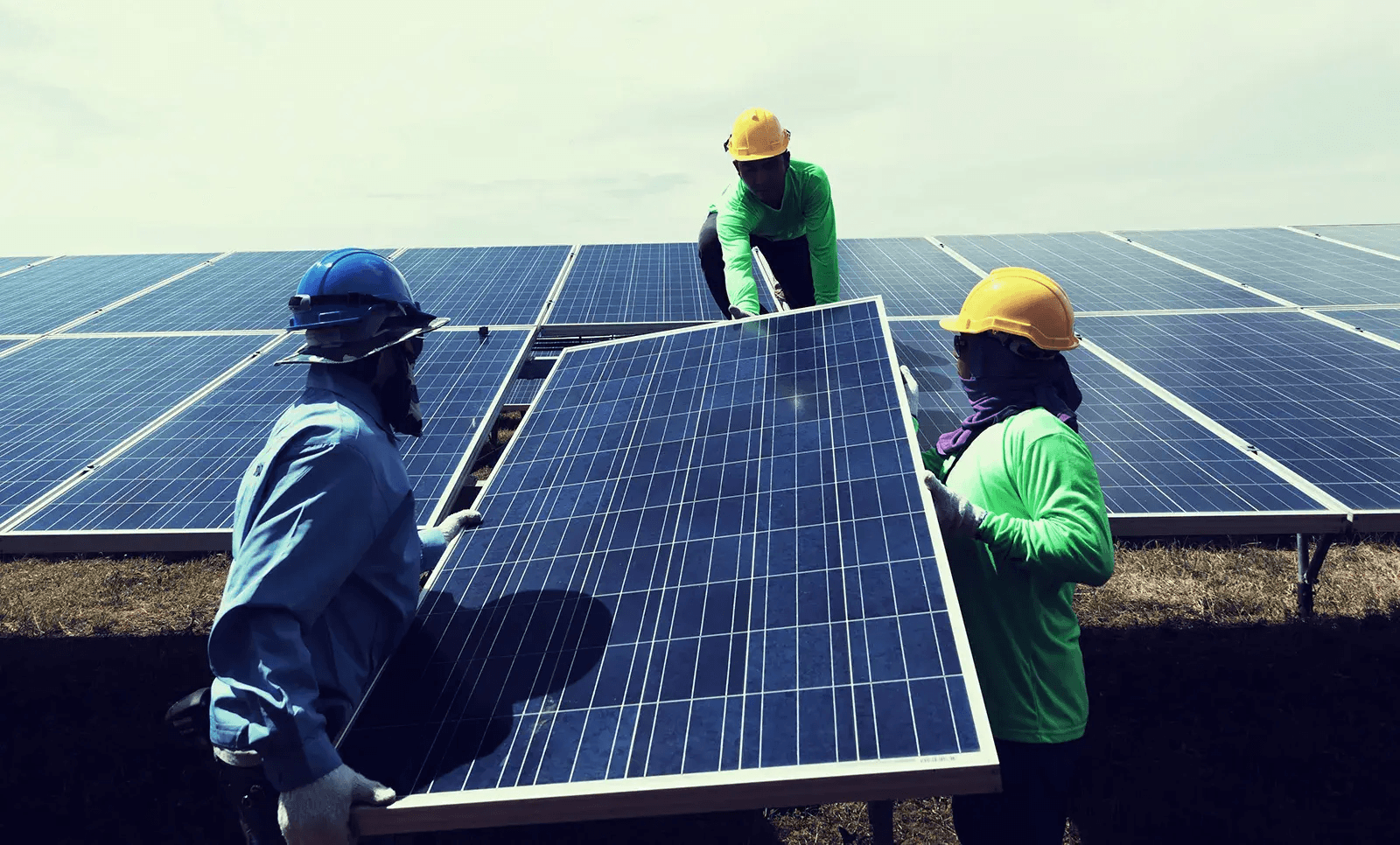
A ground-mounted solar project in Gujarat demands serious civil preparation before a single pile goes into the ground.
Skipping soil testing, drainage planning, or bunding can turn a well-funded solar investment into a costly rework within the first monsoon season.
Gujarat's climate, alluvial soils, and monsoon intensity create civil risks that require site-specific engineering, not generic assumptions.
Soil testing, drainage planning, bunding, and land leveling are non-negotiable steps before any structure installation.
Black cotton soil, waterlogging-prone land, and weak bearing capacity are the three most common civil failure points in Gujarat solar projects.
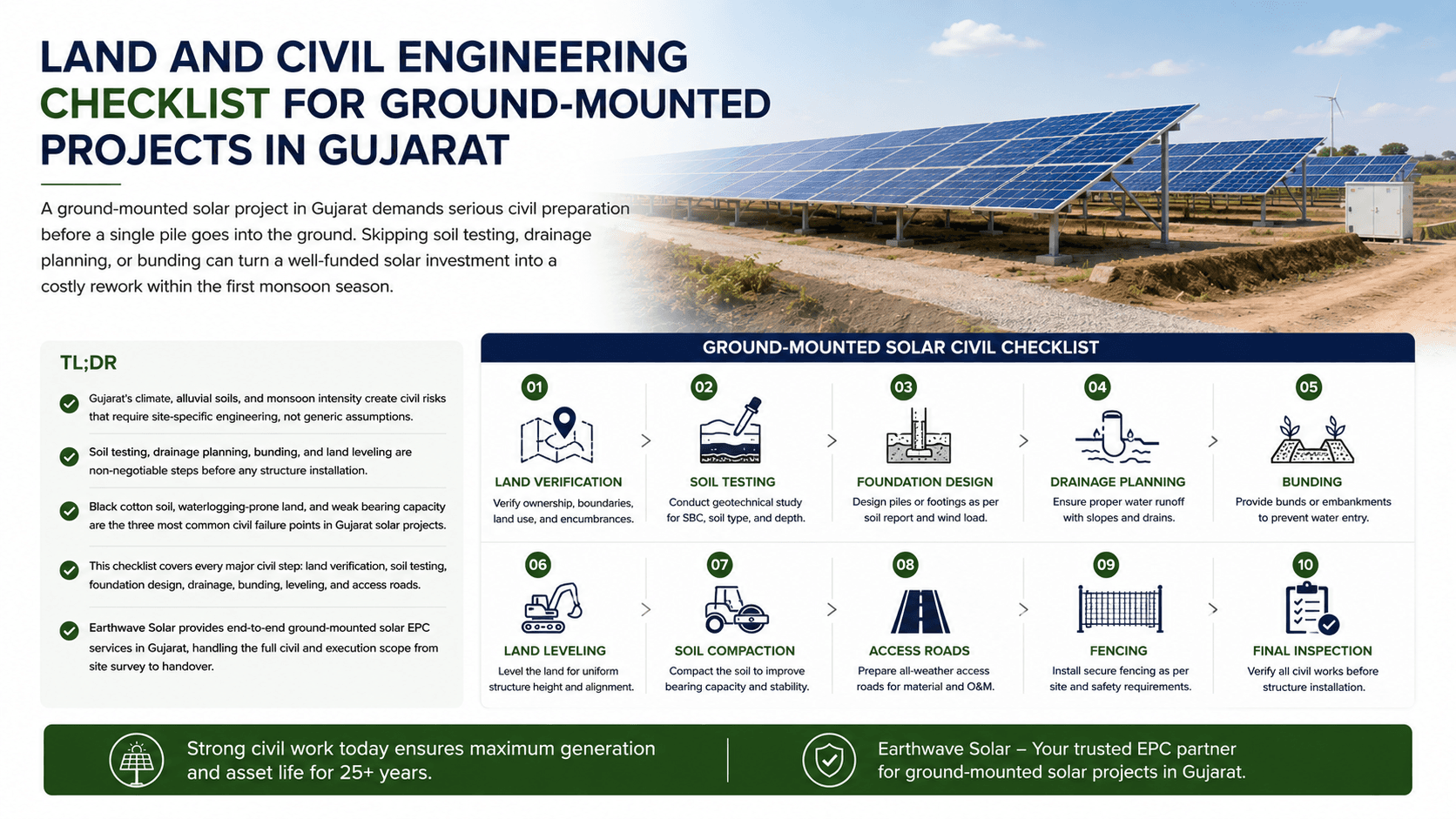
This checklist covers every major civil step: land verification, soil testing, foundation design, drainage, bunding, leveling, and access roads.
Earthwave Solar provides end-to-end
ground-mounted solar EPC services in Gujarat
, handling the full civil and execution scope from site survey to handover.
Civil preparation is not a preliminary formality. It is the foundation on which a 25-year solar asset either performs well or fails early.
Across Gujarat, especially in Surat, Bharuch, Navsari, and Valsad, projects have faced foundation redesigns, waterlogging damage, and panel misalignment because the civil phase was rushed or skipped.
A ground mount solar project in Gujarat is operating in one of India's most challenging land and climate environments.
The combination of seasonal flooding, soil variability, and industrial land conditions means every site needs its own engineering assessment.
A land and civil engineering checklist for ground-mounted projects is the starting point for protecting your investment.
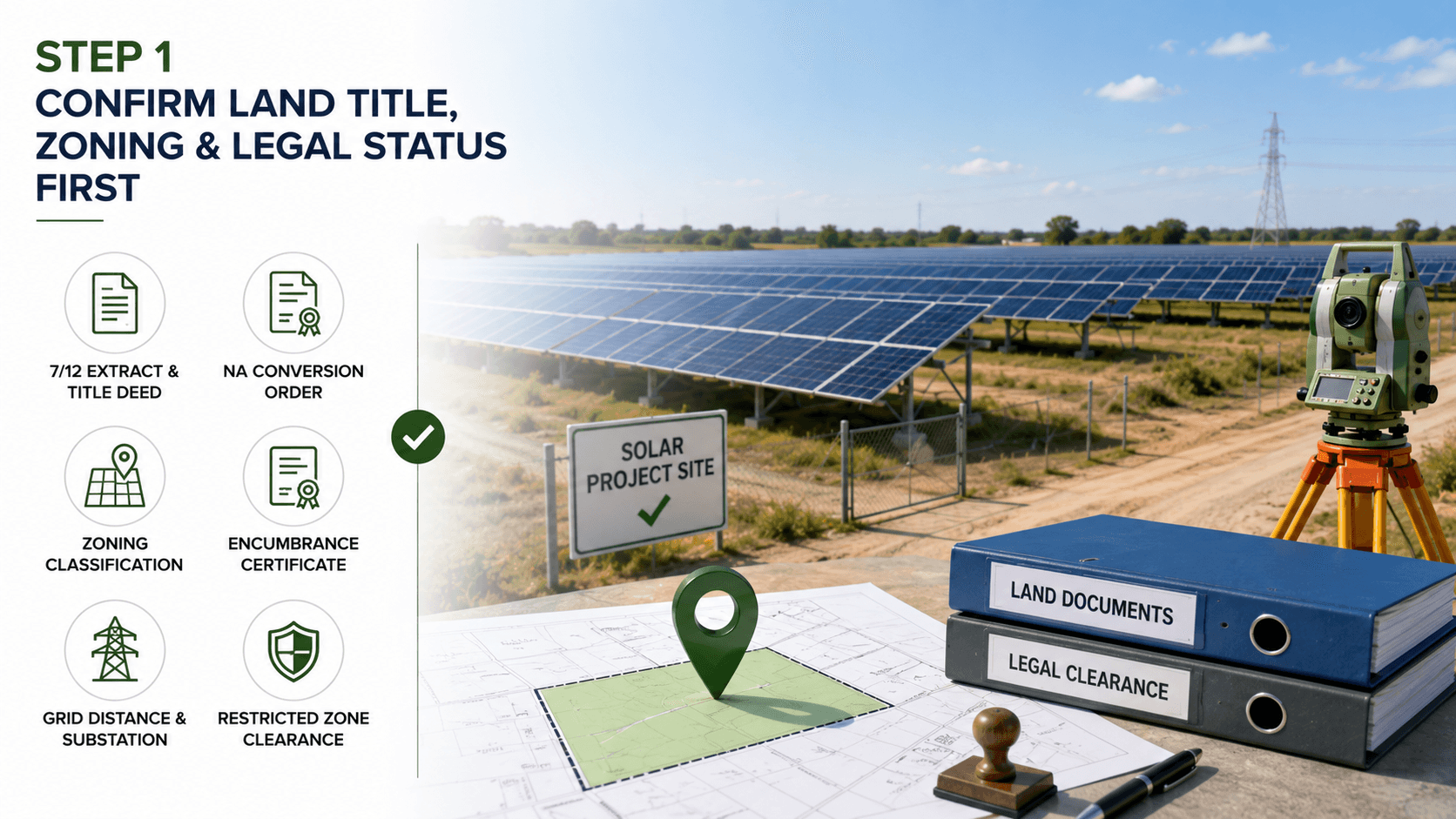
Before committing civil budget, verify that your land is legally clear and zoned correctly for solar development.
This step takes days, not weeks, and it prevents you from spending on soil testing or surveys on land that has unresolved legal issues.
7/12 extract and title deed
NA (Non-Agricultural) conversion order if applicable
Zoning: agricultural, industrial, or commercial classification
Encumbrance certificate and pending litigation check
Distance from grid infrastructure and nearest substation
Proximity to restricted zones such as airports, defense land, or forest areas
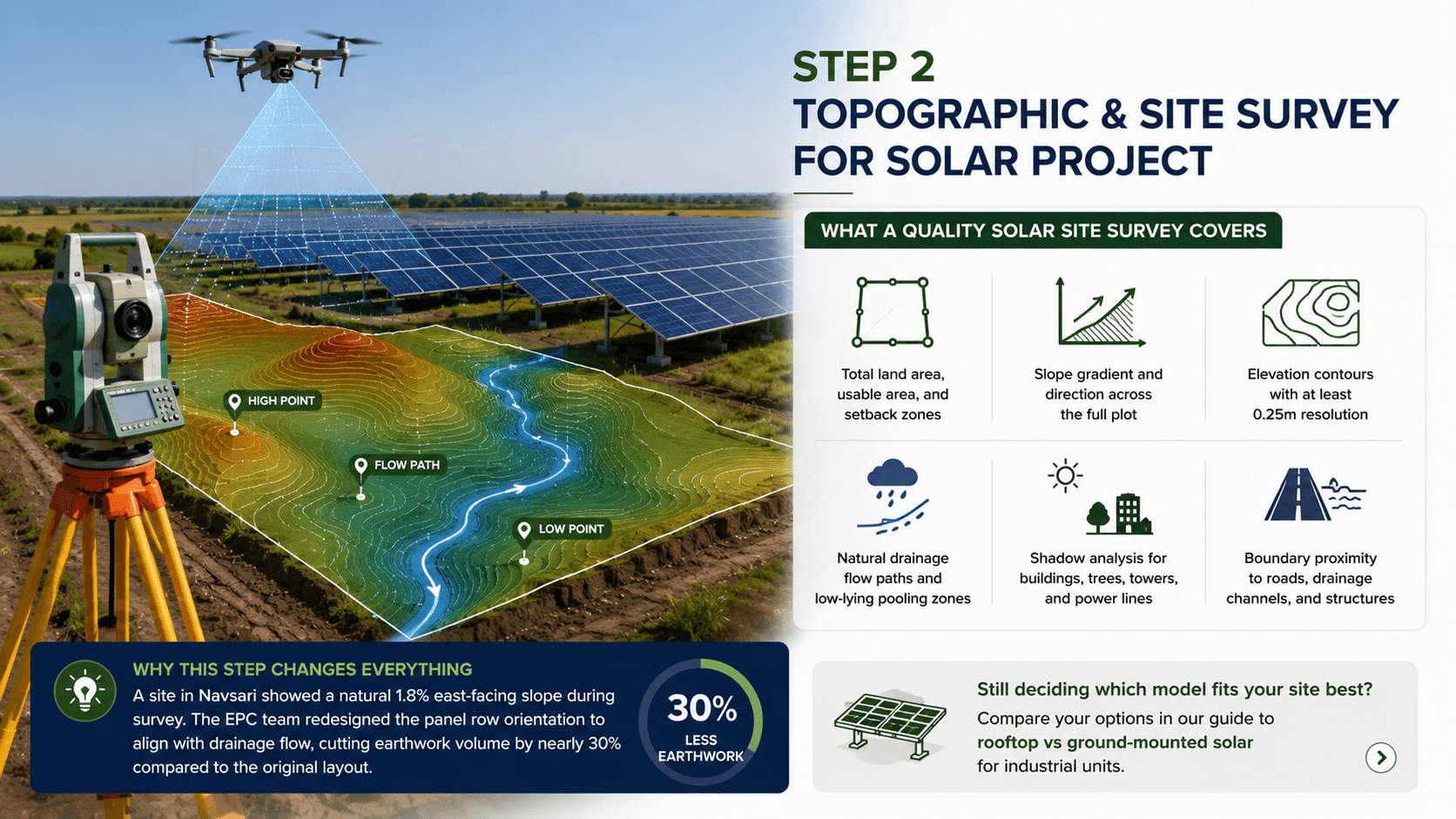
A proper site survey for a solar project gives you the elevation map, slope data, drainage flow paths, and obstruction inventory that every downstream civil decision depends on.
Without this data, your EPC team is designing in the dark.
Total land area, usable area, and setback zones
Slope gradient and direction across the full plot
Elevation contours with at least 0.25m resolution
Natural drainage flow paths and low-lying pooling zones
Shadow analysis for buildings, trees, towers, and power lines
Boundary proximity to roads, drainage channels, and structures
A site in Navsari showed a natural 1.8% east-facing slope during survey. The EPC team redesigned the panel row orientation to align with drainage flow, cutting earthwork volume by nearly 30% compared to the original layout.
If you are still evaluating whether ground-mounted is the right model for your site,
Compare your options in this guide to rooftop vs ground-mounted solar for industrial units before you commit to a civil scope.
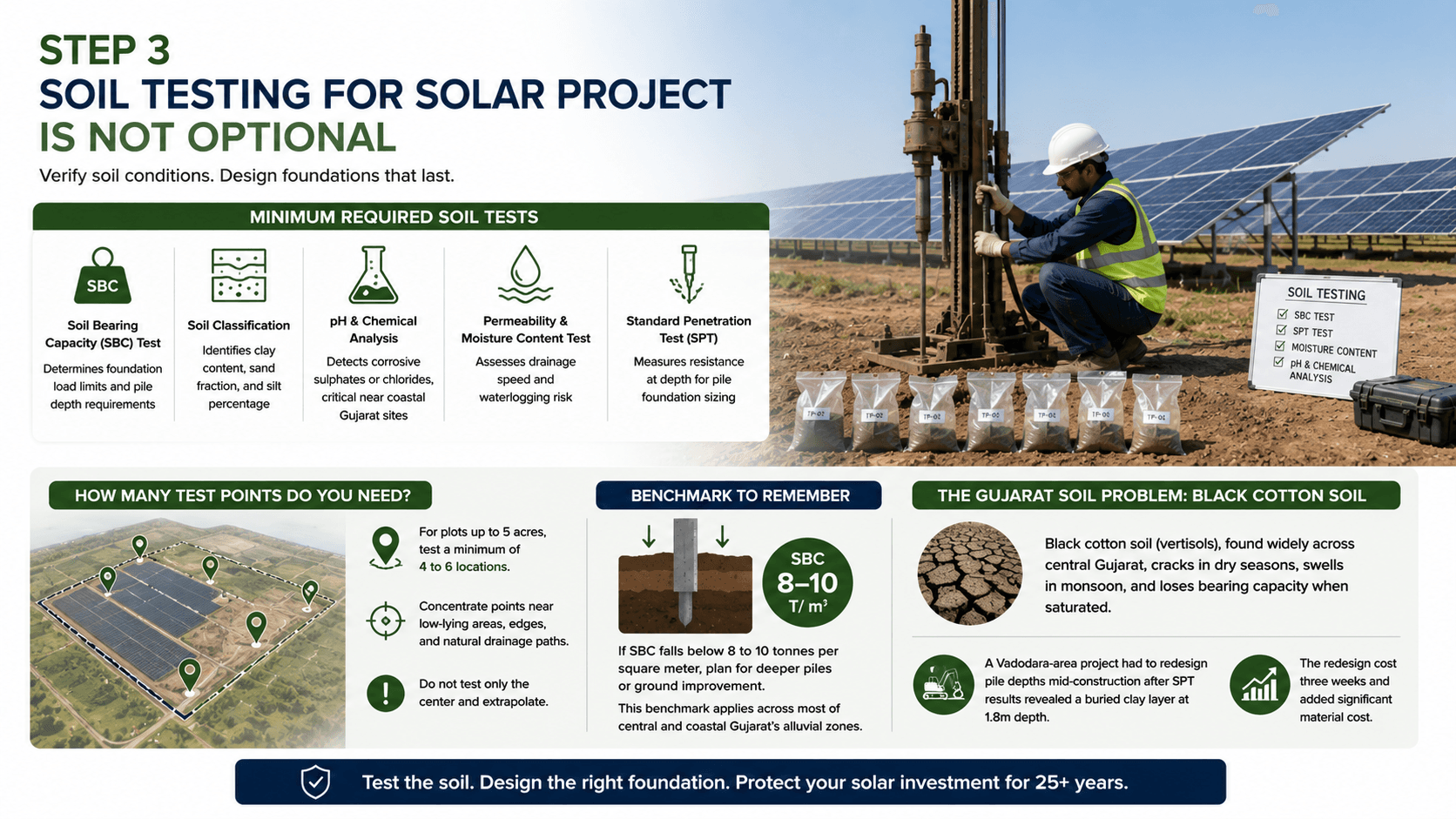
Soil testing is the most frequently skipped and most consequential step in solar site preparation in Gujarat. Most foundation failures trace back to assumed soil conditions that were never verified.
Soil bearing capacity (SBC) test:
Determines foundation load limits and pile depth requirements
Soil classification:
Identifies clay content, sand fraction, and silt percentage
pH and chemical analysis:
Detects corrosive sulphates or chlorides, critical near coastal Gujarat sites
Permeability and moisture content test:
Assesses drainage speed and waterlogging risk
Standard Penetration Test (SPT):
Measures resistance at depth for pile foundation sizing
For plots up to 5 acres, test a minimum of 4 to 6 locations. Concentrate points near low-lying areas, edges, and natural drainage paths. Do not test only the center and extrapolate.
Benchmark to remember: If SBC falls below 8 to 10 tonnes per square meter, plan for deeper piles or ground improvement. This benchmark applies across most of central and coastal Gujarat's alluvial zones.
Black cotton soil (vertisols), found widely across central Gujarat, cracks in dry seasons, swells in monsoon, and loses bearing capacity when saturated.
Standard pile designs applied without soil classification will fail within a few monsoon cycles.
A Vadodara-area project had to redesign pile depths mid-construction after SPT results revealed a buried clay layer at 1.8m depth. The redesign cost three weeks and added significant material cost. Soil testing before execution would have prevented both.
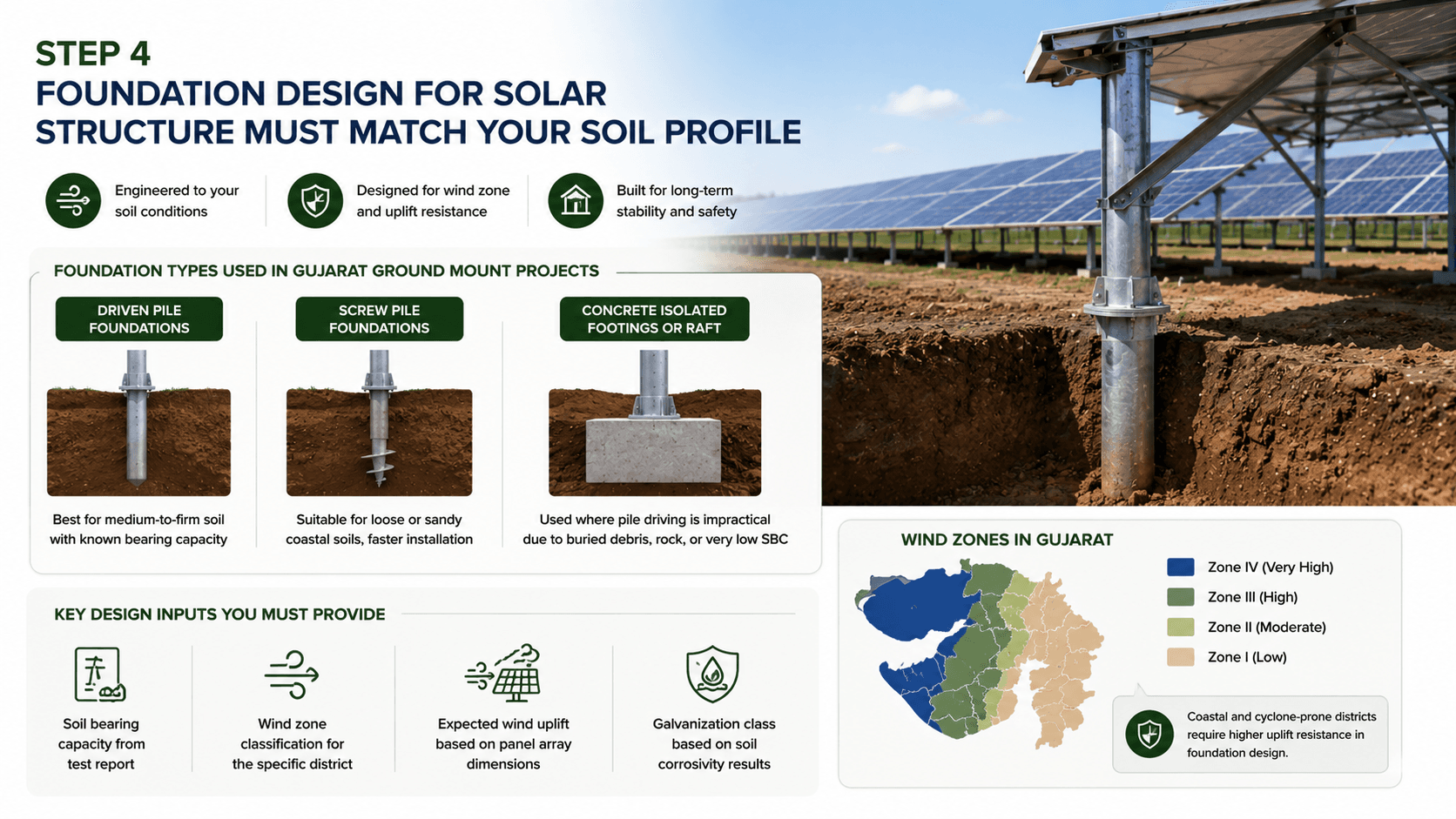
Foundation design for a solar structure is not a standard template job. It must be engineered to your specific soil conditions, wind zone, and mounting system.
Gujarat spans multiple wind zones, and cyclone-prone coastal districts require higher uplift resistance in foundation design.
Driven pile foundations:
Best for medium-to-firm soil with known bearing capacity
Screw pile foundations:
Suitable for loose or sandy coastal soils, faster installation
Concrete isolated footings or raft:
Used where pile driving is impractical due to buried debris, rock, or very low SBC
Soil bearing capacity from test report
Wind zone classification for the specific district
Expected wind uplift based on panel array dimensions
Galvanization class based on soil corrosivity results
For a deeper understanding of how mounting structure decisions affect long-term returns, read this guide on solar panel mounting structure performance and ROI.
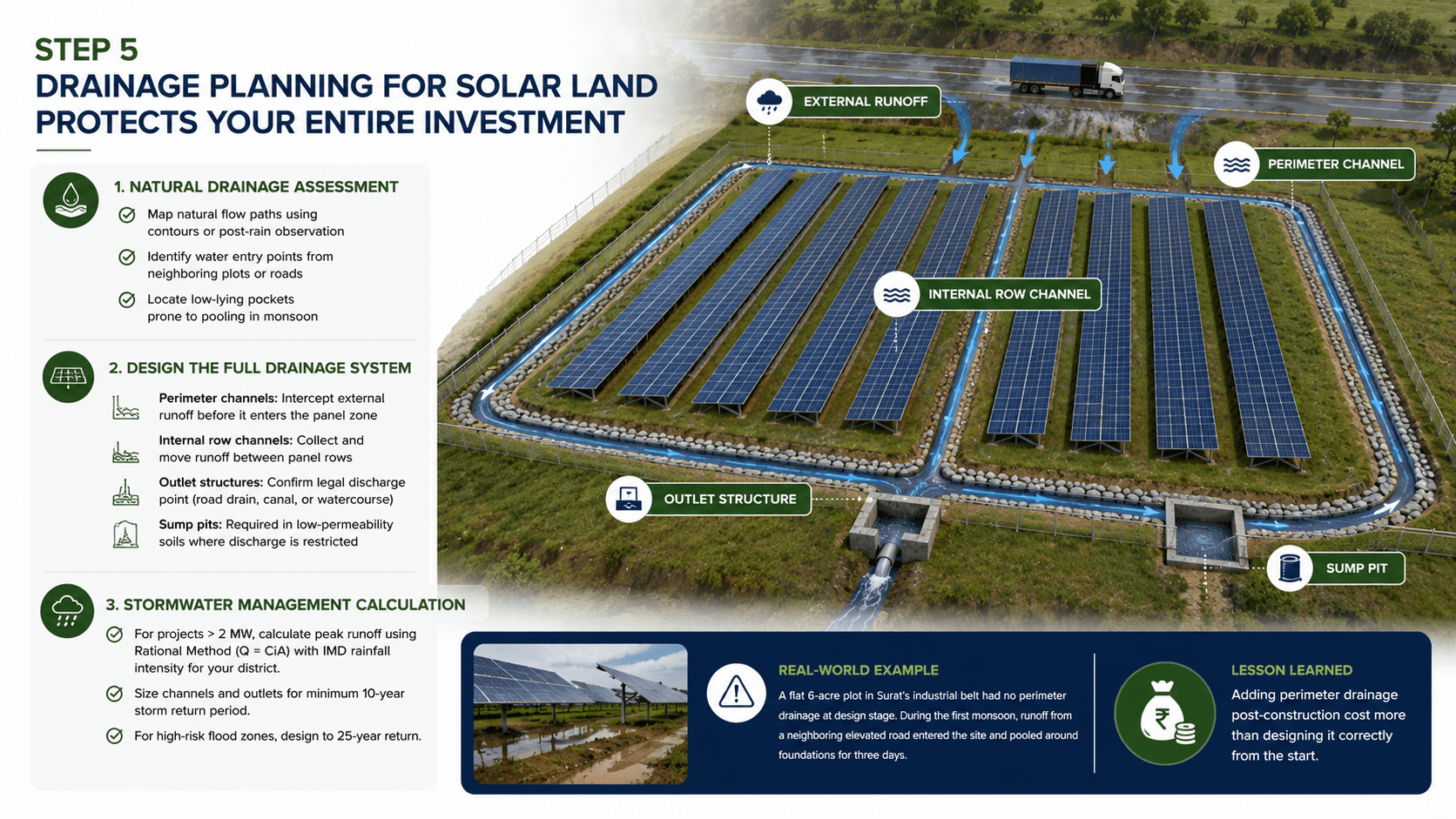
Poor drainage planning is the leading cause of long-term performance degradation in Gujarat ground mount solar projects. Water under structures causes foundation settling, corrosion, and module soiling.
Map natural flow paths using topographic contours or post-rain site observation
Identify where water enters from neighboring plots or roads
Locate low-lying pockets where pooling is most likely during monsoon
Perimeter channels:
Intercept external runoff before it enters the panel zone
Internal row channels:
Collect and move runoff between panel rows to site boundary
Outlet structures:
Confirm legal discharge point before design begins (road drain, canal, or watercourse)
Sump pits:
Required in low-permeability soils where external discharge is restricted
For projects above 2 MW, calculate peak runoff using the Rational Method (Q = CiA) with Gujarat IMD rainfall intensity data for your specific district.
Size channels and outlets for a minimum 10-year storm return period. For high-risk flood zones, design to 25-year return.
A flat 6-acre plot in Surat's industrial belt had no perimeter drainage at design stage. During the first monsoon, runoff from a neighboring elevated road entered the site and pooled around foundations for three days. Adding perimeter drainage post-construction cost more than designing it correctly from the start.
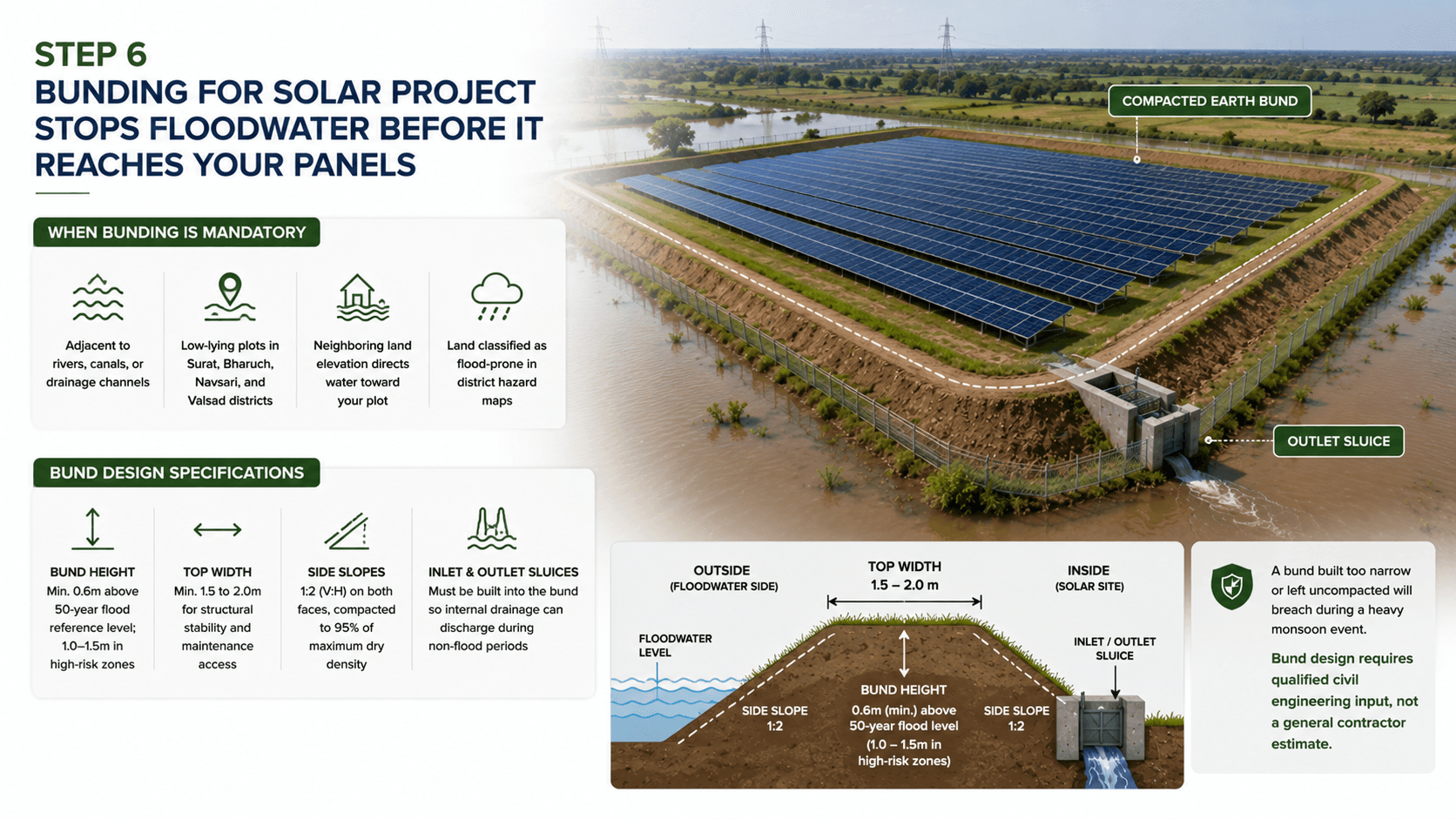
A bund is a compacted earthen embankment that prevents external floodwater from entering the solar site. In Gujarat's flood-prone zones, bunding is not a design option. It is a risk management requirement.
Sites adjacent to rivers, canals, or drainage channels
Low-lying plots in Surat, Bharuch, Navsari, and Valsad districts
Sites where neighboring land elevation directs water toward your plot
Land classified as flood-prone in district hazard maps
Bund height:
Minimum 0.6m above 50-year flood reference level; 1.0 to 1.5m in high-risk zones
Top width:
Minimum 1.5 to 2.0m for structural stability and maintenance access
Side slopes:
1:2 (vertical to horizontal) on both faces, compacted to 95% of maximum dry density
Inlet and outlet sluices:
Must be built into the bund so internal drainage can discharge during non-flood periods
A bund built too narrow or left uncompacted will breach during a heavy monsoon event. Bund design requires qualified civil engineering input, not a general contractor estimate.
The goal of land leveling for solar is a consistent, engineered slope that drains water naturally without creating row-level unevenness or stepped terrain.
A perfectly flat site actually traps water. A site graded to a uniform 1 to 3% slope in the drainage direction performs significantly better over time.
Target gradient: 1% to 3% toward the drainage outlet direction
Row-level elevation variation: Maximum 50 to 75mm within each panel row
Sub-grade compaction: Required after grading, before structure installation
Topsoil management: Strip and stockpile topsoil before grading if ground cover planting between rows is planned
Uncompacted fill under pile foundations leads to differential settling. This misaligns panels, stresses mounting connections, and eventually requires costly re-leveling.
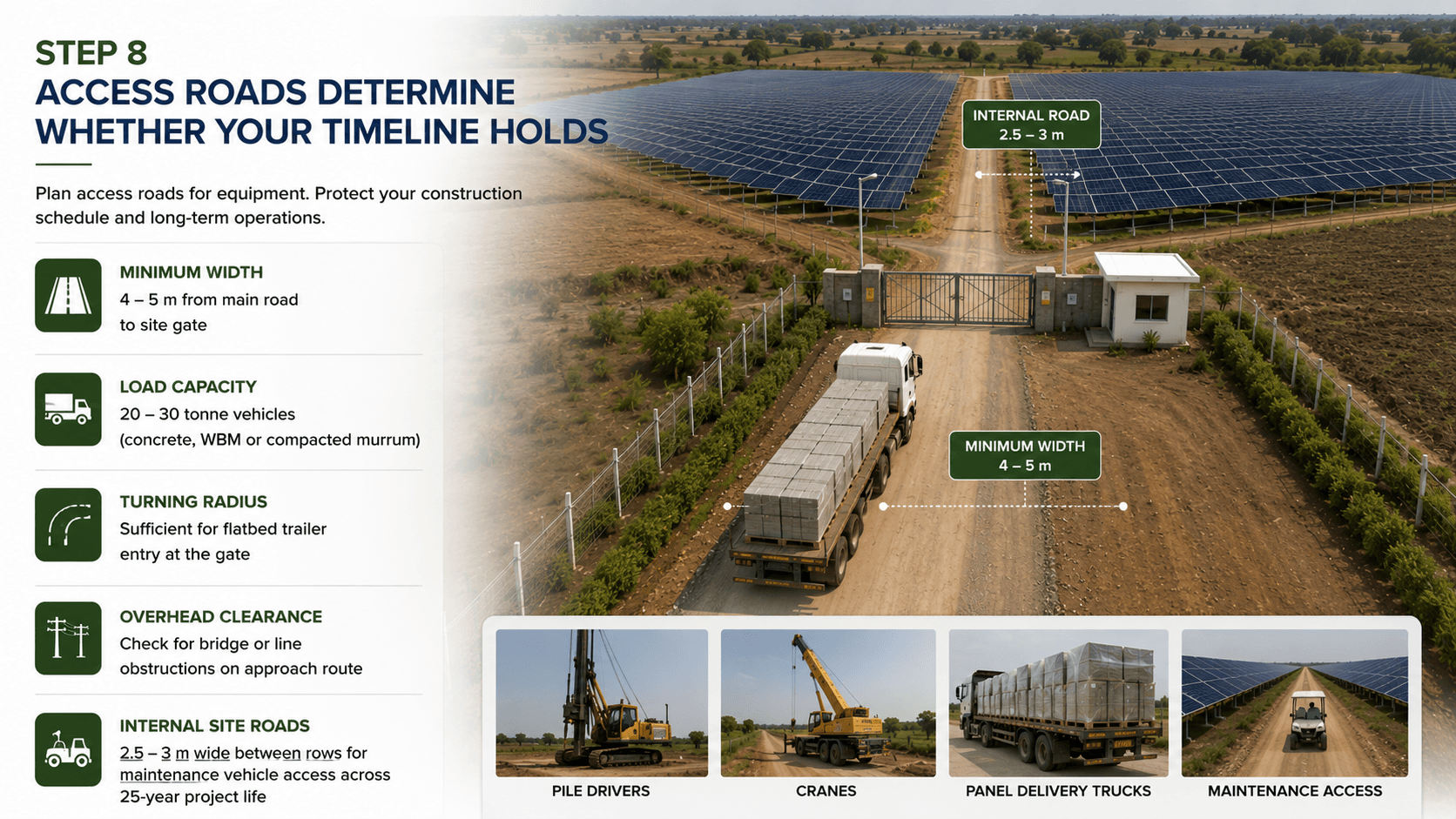
Solar construction requires pile drivers, cranes, cable machinery, and flatbed panel delivery trucks. An inadequate access road creates delays that cost more than building the road properly from the start.
Minimum width: 4 to 5m from main road to site gate
Load capacity: Capable of handling 20 to 30-tonne vehicles (concrete, WBM, or compacted murrum as minimum)
Turning radius: Sufficient for flatbed trailer entry at the gate
Overhead clearance: Checked for bridge or line obstructions on the approach route
Internal site roads: Minimum 2.5 to 3m wide between rows for maintenance vehicle access across the 25-year project life
Use this before committing to construction:
Land title, zoning, and legal clearances verified
Topographic survey and site survey for solar project completed
Soil testing at adequate density across the full plot
Foundation design for solar structure finalized with soil and wind inputs
Drainage planning for solar land completed with discharge point confirmed
Bunding for solar project designed for flood-risk zones
Land leveling to correct gradient with sub-grade compaction done
Access roads assessed and upgraded to construction load requirements
Long-term O&M protocol including post-monsoon inspection schedule prepared
Before you move to execution, it also helps to understand the full solar EPC project timeline in Gujarat, from survey and design through installation and grid commissioning.
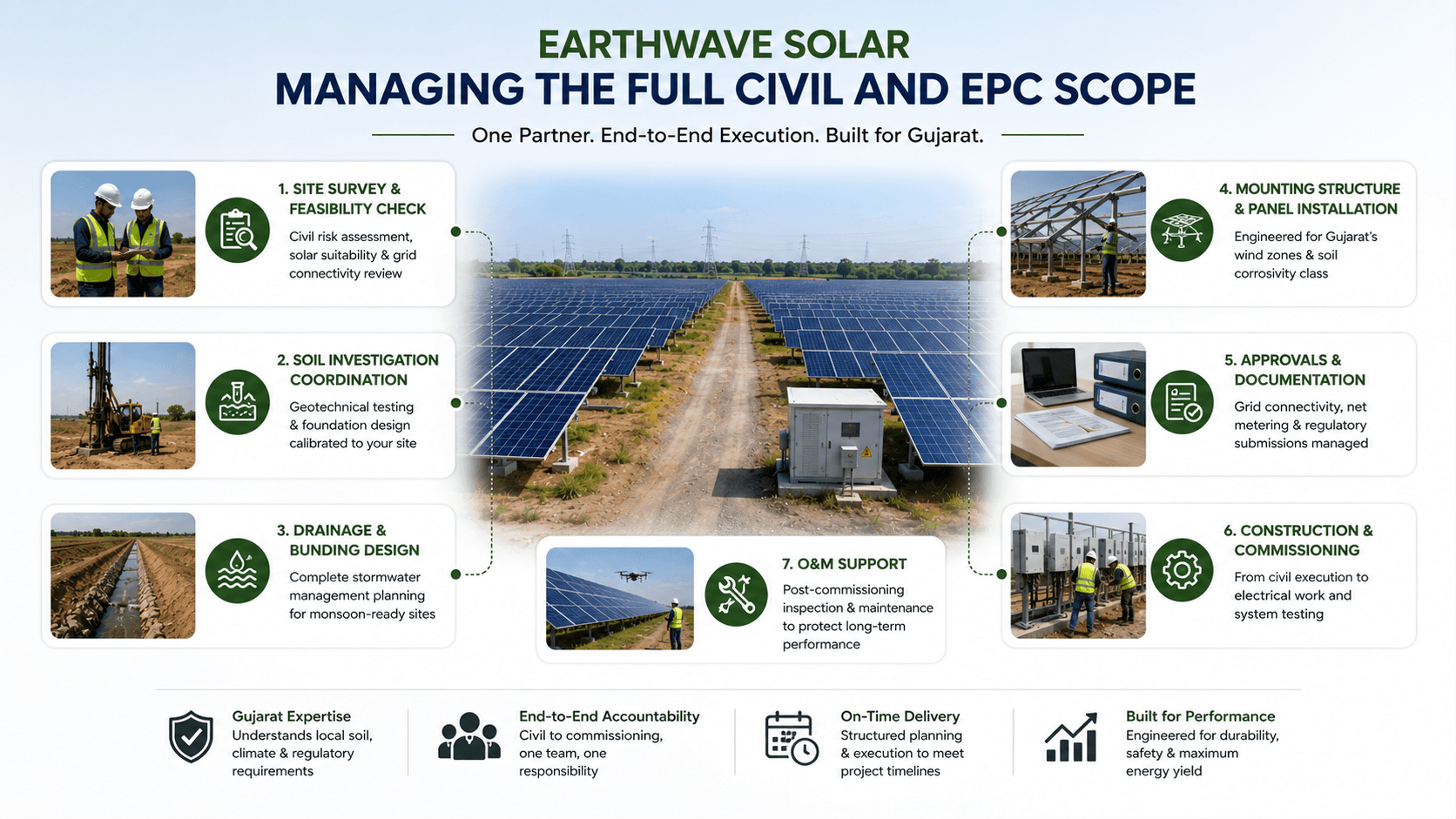
Earthwave Solar operates as a full-service EPC partner for ground-mounted solar projects in Gujarat, bringing civil engineering, site preparation, and project execution under one roof.
Before selecting any EPC partner, use this solar EPC company checklist to evaluate technical capability and project accountability.
And if you want to know what warning signs to watch for, review these solar EPC red flags in Gujarat before signing any contract.
Earthwave Solar's end-to-end EPC services in Gujarat include:
Site survey and feasibility check:
Civil risk assessment, solar suitability, and grid connectivity review in one structured visit
Soil investigation coordination:
Geotechnical testing and foundation design calibrated to your specific site
Drainage and bunding design:
Full stormwater management planning for Gujarat's monsoon conditions
Mounting structure and panel installation:
Engineered for Gujarat's wind zones and soil corrosivity class
Approvals and documentation:
Grid connectivity, net metering, and regulatory submissions managed by the project team
Construction and commissioning:
From civil execution through electrical work and system testing
O&M support:
Post-commissioning inspection and maintenance to protect civil and electrical infrastructure long-term
You can view completed Earthwave Solar projects across Gujarat to see how real commercial and industrial ground-mounted installations are executed at different scales.
For a full picture of project costs before you commit, review the typical ground-mounted solar plant cost in India and compare it against your land readiness and civil scope.
A ground mount solar project in Gujarat will perform well for 25 years only if the civil foundation is built correctly. Soil testing, drainage planning, bunding, and land leveling are not optional engineering steps.
They are the difference between a project that recovers ROI on schedule and one that spends its first few years managing civil problems.
Work through this checklist before any construction begins. Each item protects your investment from a different direction.
Contact Earthwave Solar to book a site survey or request a ground-mounted solar feasibility check. The team will assess your land's civil readiness, identify soil and drainage risks, and give you a clear project planning picture before you commit to execution.
Contact Earthwave Solar today for a project planning consultation across Gujarat.
Start with a topographic survey and land title verification. These two steps confirm site suitability and provide the elevation and drainage data that all downstream civil design depends on. Without them, every other planning decision is based on assumptions.
Gujarat has significant black cotton soil and alluvial zones that lose bearing capacity when wet. Without soil testing, foundation designs may be undersized for actual site conditions, leading to structural settling or failure after the first monsoon season.
A bund is a compacted earthen embankment built around the site perimeter to block external floodwater. Any site in Gujarat's low-lying districts, near rivers or canals, or in flood-prone zones requires properly designed and compacted bunding before construction starts.
Your land should have a uniform gradient of 1% to 3% toward the drainage outlet, with no more than 50 to 75mm elevation variation within each panel row. Flat land without any slope traps water and increases waterlogging risk around foundations.
Yes. Earthwave Solar provides complete solar EPC services in Gujarat, covering everything from site survey, soil assessment, civil design, drainage and bunding, land leveling, and structure installation through to approvals, commissioning, and O&M support. Get in touch to start your project.
FAQS
Can't find the answer you're looking for? Our team is here to help.
SUBSCRIBE NEWSLETTER
Switching to solar is easier than you think. Let us guide you to cleaner, more affordable energy.
