Solar EPC Gujarat
Industrial Solar EPC Gujarat: Process & Timeline
2026-04-15T00:00:00.000Z•8
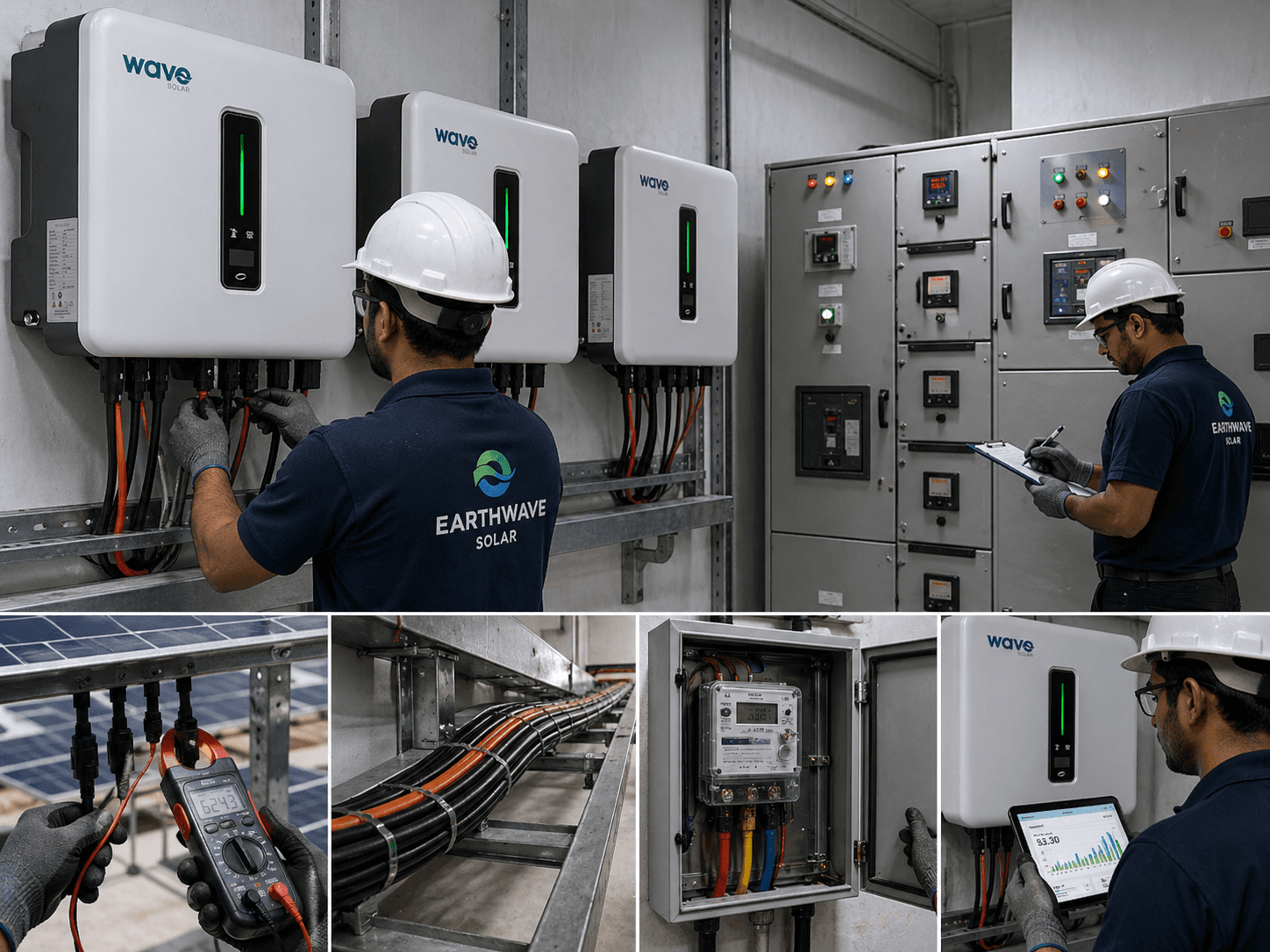
A full-service Industrial Rooftop Solar EPC project in Gujarat takes 6 to 12 weeks from site survey to grid connection, covering engineering design, equipment procurement, structural installation, DISCOM approval, and commissioning under one contract.
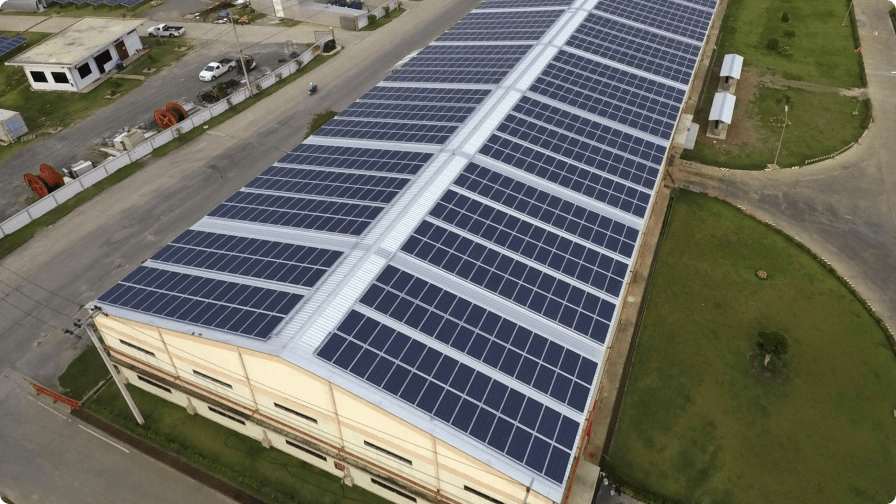
If your factory pays Rs. 5 Lakh or more every month on electricity, rooftop solar with a qualified EPC partner cuts that bill by 40 to 60% within the first year of operation.
Industrial rooftop solar EPC covers the entire project: design, procurement, installation, approvals, and handover
A 100 kW to 500 kW plant in Gujarat typically costs Rs. 35 to Rs. 45 Lakh per installed capacity (before depreciation benefits)
Timeline: 6 to 12 weeks for most industrial projects in Gujarat
Net metering approval through DGVCL, UGVCL, or GETCO is handled by the EPC contractor, not you
Section 32 accelerated depreciation (40%) makes the financial case significantly stronger for businesses

Rising industrial tariffs in Gujarat are compressing margins every quarter.
DGVCL and UGVCL revised commercial and industrial tariffs upward in 2024 and 2025.
Most medium-scale factories in Surat, Ahmedabad, Vadodara, and Bharuch now pay between Rs. 8 to Rs. 12 per unit for daytime consumption. Solar generation costs Rs. 1.5 to Rs. 2.5 per unit over the system lifetime.
A factory consuming 1,00,000 units per month at Rs. 10/unit pays Rs. 10 Lakh monthly.
Want to see exactly how much your factory can save? Read our detailed guide:
Every month without solar is money left on the table.
EPC means one company handles everything, so you do not manage 4 to 5 different vendors yourself.
EPC stands for Engineering, Procurement, and Construction. For an industrial rooftop solar project, this means:
Engineering:
Site survey, shadow analysis, roof load calculation, single-line diagram, layout design, yield simulation
Procurement:
Sourcing solar panels, inverters, mounting structures, cables, protection devices, and monitoring hardware
Construction:
Structural installation, electrical wiring, earthing, commissioning, DISCOM net metering application, and handover
Without an EPC company, you coordinate separately with a panel supplier, an installation contractor, an electrical consultant, and a DISCOM liaison. That model fails more often than it works on industrial-scale projects.
Not sure whether to go CAPEX or RESCO for your solar project? Read this first: CAPEX vs RESCO Solar Financing: Which Model Works for Your Factory
A turnkey EPC contract means one point of accountability from day one to final commissioning.
The process follows 7 defined stages. Here is exactly what happens at each one.

The EPC team visits your factory and collects:
Monthly electricity bills (last 12 months)
Sanctioned load and connected load from your DISCOM meter
Available rooftop area and roof type (RCC, PEB, Galvalume sheet)
Shadow mapping using tools like PVsyst or Helioscope
Structural condition of the roof
Output: A feasibility report with recommended system size, estimated generation, and indicative cost.
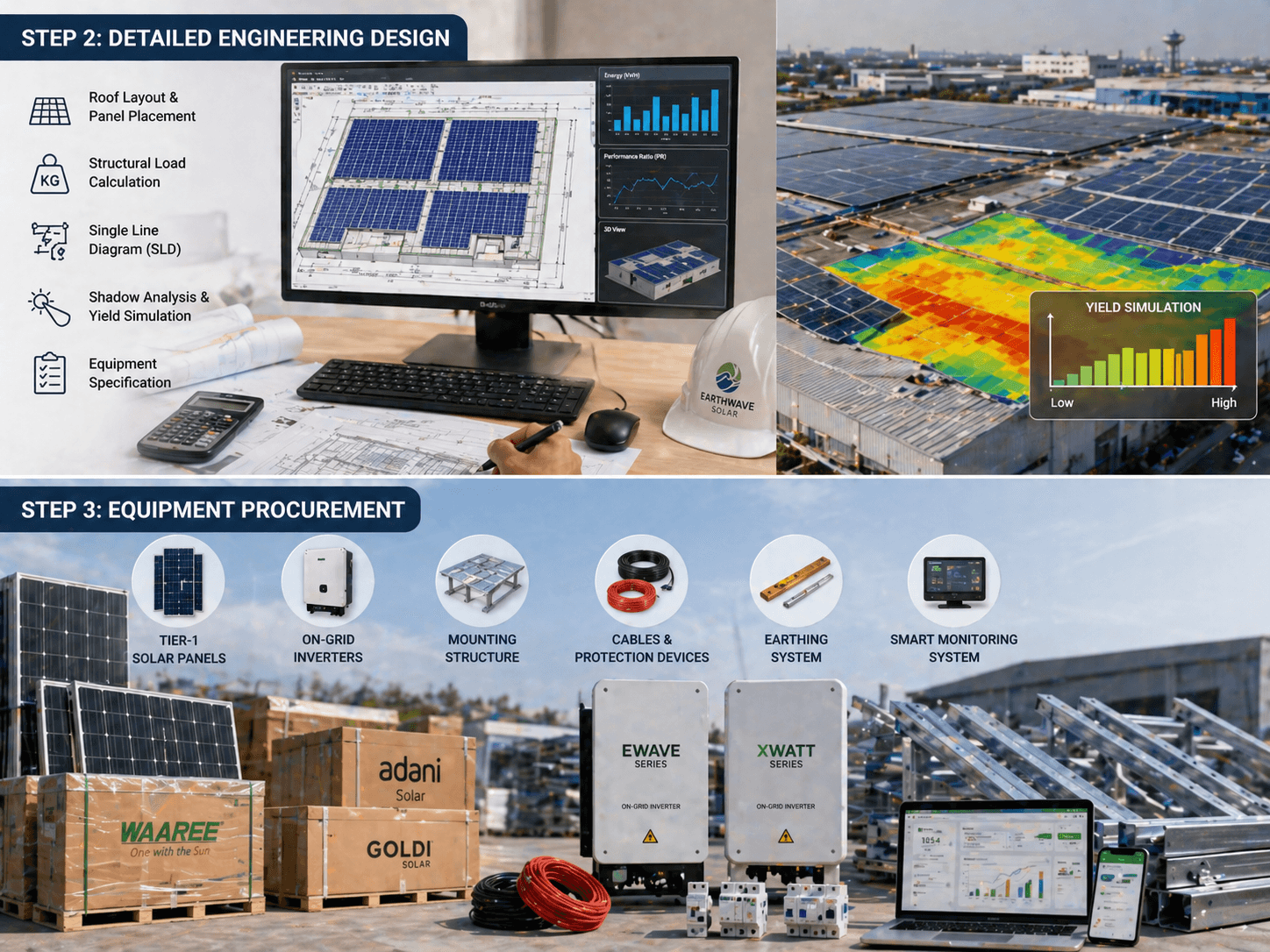
Once you approve the feasibility report, the engineering team prepares:
Roof layout drawing with panel placement and row spacing
Structural load calculation to verify roof can bear 12 to 15 kg per sq. meter of panel weight
Single-line electrical diagram (SLD)
Shadow analysis and yield simulation report
Equipment specification list with brand and model selection
Thinking about whether rooftop is right for your site or if ground-mounted makes more sense? Compare both here: Rooftop vs Ground Mounted Solar for Industrial Units
Your EPC company sources and delivers:
Solar panels:
Tier-1 brands such as Goldi Solar, Waaree, or Adani Solar with 25-year linear performance warranty
On-grid inverters:
String inverters or central inverters matched to system size
Mounting structure:
Hot-dip galvanized steel frames designed for your roof type
AC and DC cables, protection devices, earthing system
Smart monitoring system:
Real-time generation and performance tracking via app or dashboard
Earthwave Solar uses Ewave Series on-grid inverters (5 to 25 kW three-phase) and Xwatt Series inverters built for Gujarat's high ambient temperature conditions, both carrying a 10-year product warranty.
You can also download the full technical datasheets here.
Wondering which inverter brand to trust? Read our comparison: Best Solar Inverter Brands in India
Installation on an industrial roof typically takes 2 to 4 weeks depending on system size.
What happens on your roof:
Mounting structure anchoring (no drilling through roof sheets for PEB; saddle clamps used)
Solar panel placement and clipping
DC cable trunking along structure
Earthing and lightning protection installation
Production continuity: A competent EPC team schedules rooftop work in zones, so only a portion of the roof is active at one time. Most factories run at full production throughout installation.
The AC side connects the inverters to your main electrical panel (LT switchboard or main distribution board).
Key work at this stage:
Inverter mounting inside plant premises or in a dedicated enclosure
AC cable routing from inverter to main panel
Net meter panel preparation at the DISCOM meter room
Testing of each string for open-circuit voltage and short-circuit current
Inverter startup and output verification
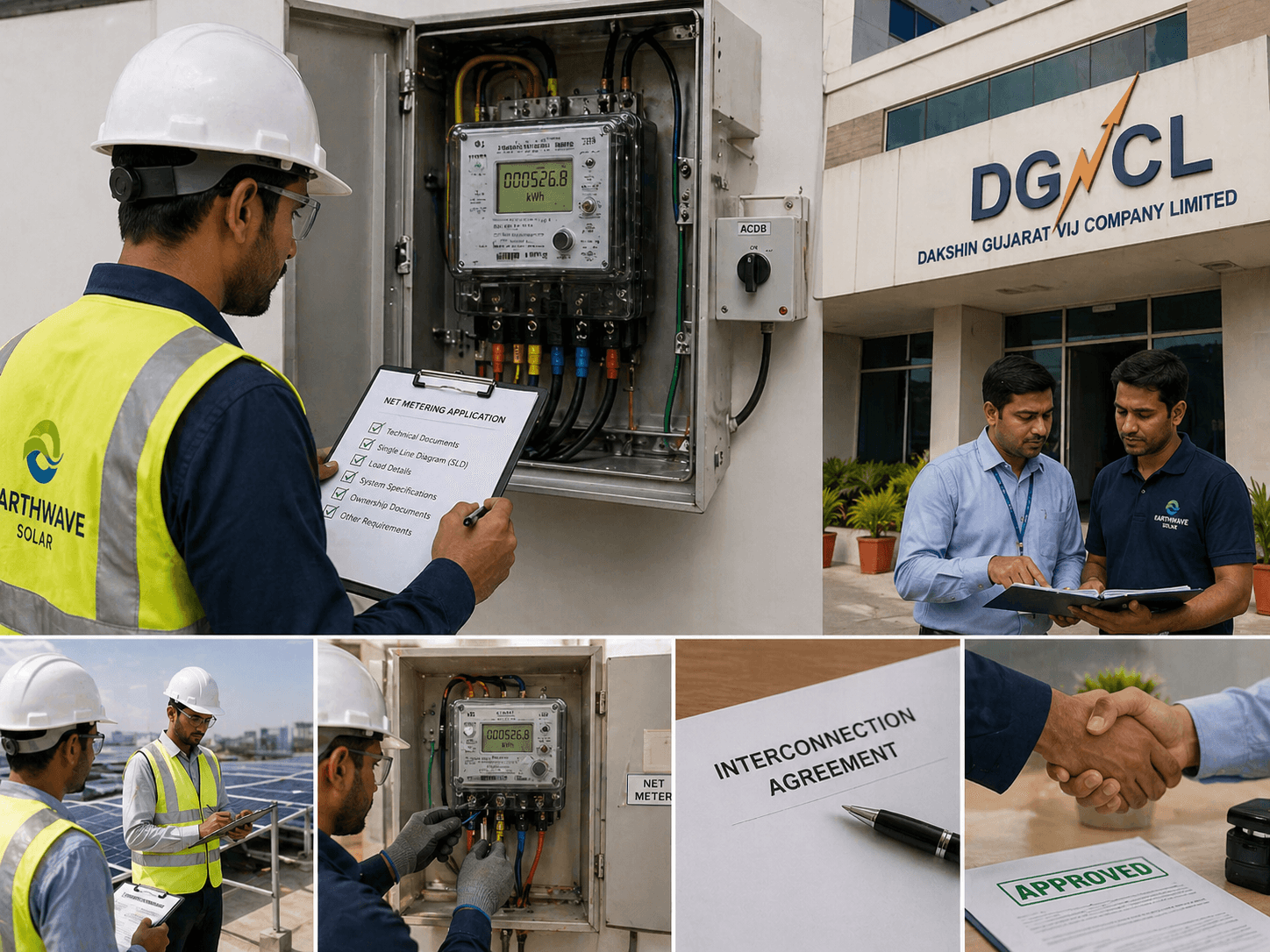
Net metering registration is handled entirely by your EPC contractor in Gujarat.
Your EPC company files the net metering application with the relevant DISCOM (DGVCL, UGVCL, MGVCL, or PGVCL) on your behalf.
The process includes:
Submission of technical documents and SLD
DISCOM technical inspection visit
Bi-directional meter installation by DISCOM
Interconnection agreement signing
Typical timeline: 3 to 6 weeks after application submission. Delays happen at the DISCOM end, not the contractor's end. A good EPC company follows up proactively.
Want to understand how net metering credits work on your monthly bill? Read this: Net Metering in Gujarat: How Solar Income Works
Final handover includes:
Full system performance test (generation vs. simulation check)
Monitoring app setup on your phone or plant computer
Handover documents: warranty certificates, as-built drawings, O&M manual
Explanation of net metering bill adjustment process
Your plant team needs 30 to 45 minutes of orientation on the monitoring dashboard. No dedicated solar operator is needed.
For long-term system care, read our post-installation guide: How to Maintain Your Solar System for Peak Performance
Stage | Duration | Who Does It |
Site survey and feasibility | Week 1 | EPC company |
Detailed engineering | Week 2 to 3 | EPC engineering team |
Equipment procurement and delivery | Week 3 to 5 | EPC procurement team |
Structural and panel installation | Week 5 to 8 | EPC installation crew |
Electrical wiring and commissioning | Week 8 to 9 | EPC electrical team |
DISCOM net metering application | Week 6 to 10 (parallel) | EPC liaison team |
Final commissioning and handover | Week 10 to 12 | EPC project manager |
Total: 10 to 12 weeks for most industrial projects.
Projects above 500 kW or sites with complex structural requirements may take 14 to 16 weeks.
You can view completed Earthwave Solar projects here to see real installation examples across different plant sizes.
Use this checklist before signing any EPC contract or during vendor comparison.
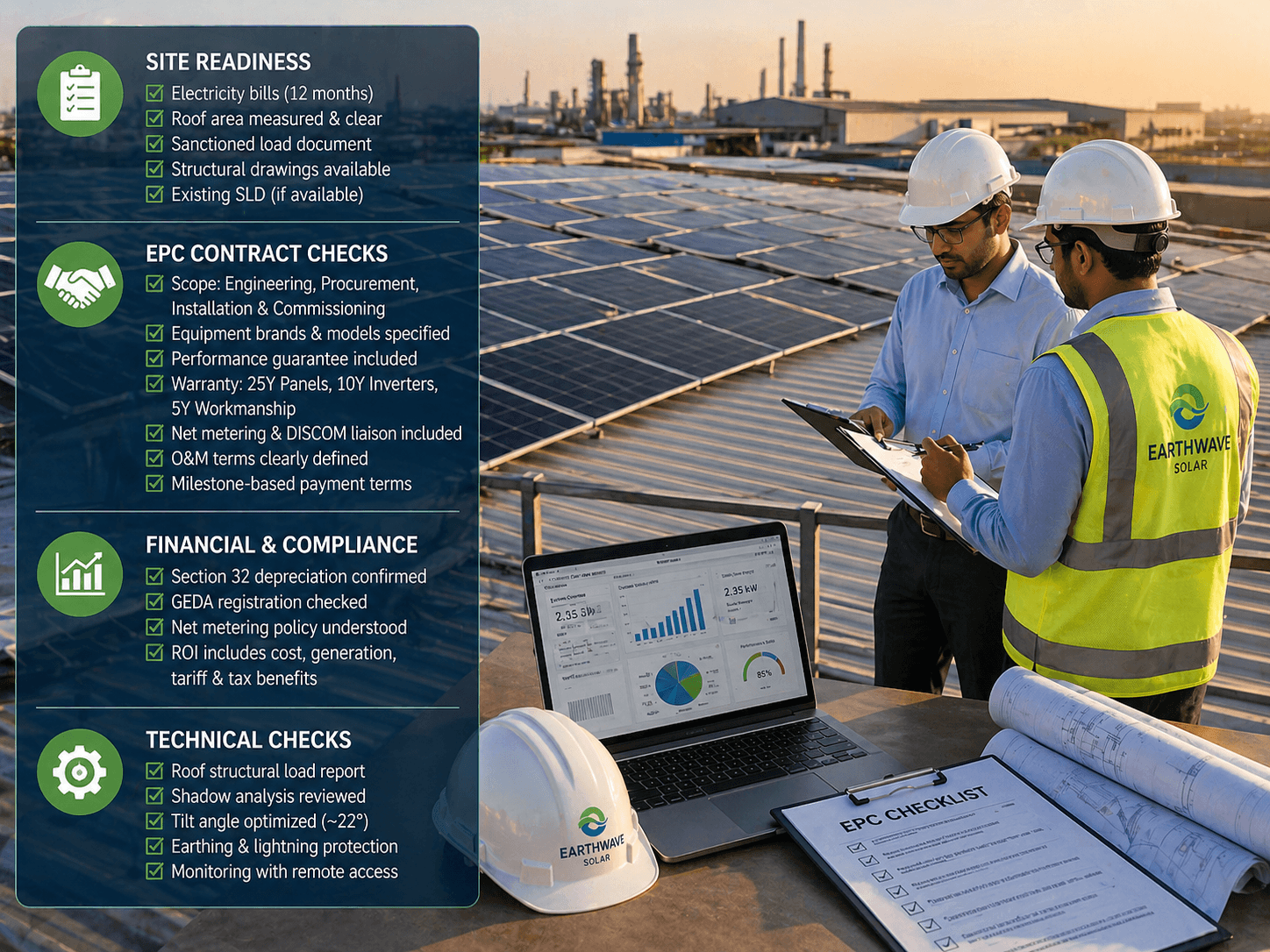
Last 12 months of electricity bills available
Roof structural drawing or as-built drawing available
Roof surface area measured and cleared of obstructions
DISCOM sanctioned load document available
Electrical single-line diagram of existing plant available (if any)
Scope of work clearly lists engineering, procurement, installation, and commissioning
Equipment brands and models named in the contract, not just "Tier-1 panels"
Performance guarantee clause included (minimum 80% generation against simulation)
Warranty terms stated: 25 years for panels, 10 years for inverters, 5 years for workmanship
DISCOM liaison and net metering filing included in scope
O&M (Operations and Maintenance) terms post-commissioning clearly defined
Payment milestones tied to project milestones, not calendar dates
For a deeper EPC vendor evaluation framework, read: Solar EPC Company Checklist India: What to Verify Before Signing
Section 32 accelerated depreciation applicability confirmed with your CA
GEDA registration requirement checked for your district
Net metering tariff and banking policy of your DISCOM understood
ROI calculation includes: system cost, generation estimate, tariff rate, depreciation benefit
For the full tax benefit breakdown, read: Solar Tax Benefits and Accelerated Depreciation in India
Structural load report for roof (solar adds 12 to 15 kg per sq. meter)
Shadow analysis report from EPC company reviewed
Panel tilt angle optimized for Gujarat latitude (approximately 22 degrees)
Earthing and lightning protection design included
Monitoring system with remote access confirmed

The right EPC partner has Gujarat-specific regulatory experience, not just installation capacity.
Ask every vendor these five questions before shortlisting:
Have you completed industrial projects above 100 kW in Gujarat? Can you share references?
Do you handle DISCOM net metering filing, or does that fall on us?
What performance guarantee do you provide in writing?
Who is my single point of contact from survey to handover?
What does your O&M scope cover after commissioning?
For sector-specific insights on solar for factories, see also:
Earthwave Solar delivers end-to-end EPC solutions for industrial, commercial, and residential clients across Gujarat and Madhya Pradesh.
Here is what Earthwave Solar brings to your project:
Full-scope EPC delivery:
Engineering, procurement, installation, DISCOM liaison, and commissioning under one contract
In-house inverter technology:
Ewave Series (5 to 25 kW three-phase) and Xwatt Series (2.3 to 6 kW single-phase) inverters built for high ambient temperature conditions in Gujarat
Smart monitoring systems:
Real-time generation tracking accessible from your phone
Industrial experience:
Rooftop solar projects for manufacturing units, warehouses, and processing facilities across Surat, Ahmedabad, Vadodara, and Bhopal
Local regulatory expertise:
Direct working knowledge of DGVCL, UGVCL, MGVCL, and PGVCL net metering procedures
Transparent contracts:
Performance guarantee clauses and milestone-based payment terms included as standard
Explore the full range of Earthwave Solar commercial and industrial rooftop services here.
Earthwave Solar does not just install panels. The team stays accountable from the first site survey to the day your net meter starts running.
Learn more about Earthwave Solar or meet the team behind your project.
A 500 kW system typically costs Rs. 1.75 Crore to Rs. 2.25 Crore installed, depending on panel brand, roof type, and DISCOM requirements. After Section 32 accelerated depreciation (40% in Year 1), the effective cost drops significantly and most factories achieve payback in 3.5 to 5 years. Read the full breakdown: Solar Payback Period in India 2026
No, a competent EPC team works in zones on the roof and schedules electrical tie-in work during planned shutdowns or weekends. Most industrial installations run alongside full factory operations with zero production interruption.
Your EPC contractor handles the entire net metering application, DISCOM inspection coordination, and bi-directional meter installation. You only need to provide authorization and sign the interconnection agreement when DISCOM requests it.
Yes. PEB roofs are among the most common installation surfaces for industrial solar in Gujarat. EPC companies use saddle clamps or rail-based mounting systems that attach to purlins without penetrating the roof sheet, preserving waterproofing integrity.
Any credible EPC company includes a performance guarantee clause in the contract, typically guaranteeing minimum 80% of the simulated annual generation. If generation falls short due to system deficiency, the contractor is obligated to rectify it. Always confirm this clause in writing before signing.
If your factory's monthly electricity bill is above Rs. 5 Lakh, the financial case for industrial rooftop solar is already strong.
Earthwave Solar offers a free site assessment and feasibility report for industrial units in Gujarat, including a generation estimate, ROI projection, and DISCOM-specific approval roadmap.
Contact the Earthwave Solar team today and bring your last electricity bill and rooftop dimensions. They handle everything else.
You can also explore completed solar projects across Gujarat and MP to see the scale and quality of work Earthwave delivers before you make any commitment.
FAQS
Can't find the answer you're looking for? Our team is here to help.
SUBSCRIBE NEWSLETTER
Switching to solar is easier than you think. Let us guide you to cleaner, more affordable energy.
