Industrial Solar Installation
Rooftop vs Ground-Mounted Solar for Industrial Sites
2026-05-15T00:00:00.000Z•9
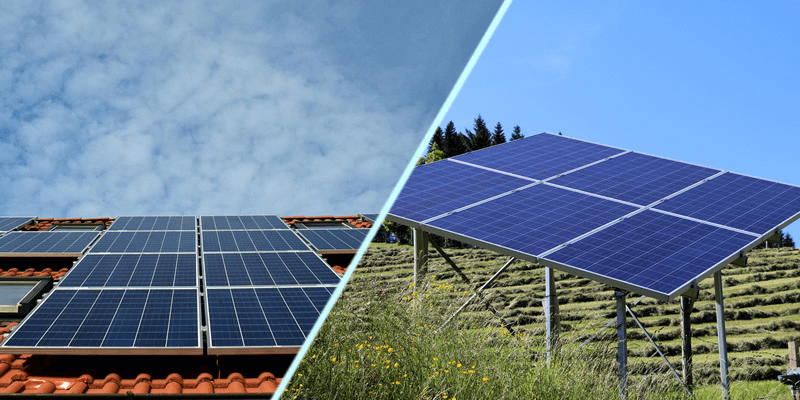
For most industrial sites with usable roof space, rooftop solar delivers faster ROI with lower land cost.
But if your factory has limited roof capacity or high energy demand, ground-mounted solar gives you the scale and flexibility to meet it.
Rooftop solar suits factories with strong roof structure and 500 kW to 2 MW energy demand.
Ground-mounted solar works best when roof space is limited, structurally weak, or expansion is planned.
Rooftop installation costs are typically 10 to 15% lower than ground-mounted due to savings on civil and mounting work.
Ground-mounted systems offer better panel orientation, easier maintenance, and higher long-term output.
Both options can achieve a payback period of 4 to 7 years for industrial sites in India when correctly sized.
Choosing the wrong solar setup costs you money for 25 years.
Most factory owners and plant heads focus only on the upfront cost.
But the real financial impact comes from system performance, maintenance downtime, scalability, and how well the system fits your site from day one.
This comparison gives you a decision framework built on cost logic, site practicality, and long-term ROI, not just technical specs.
Read our detailed guide on how solar reduces electricity costs for factories to understand the broader savings picture before choosing your system type.
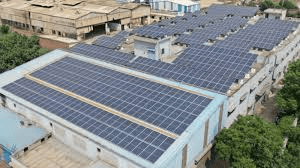
Rooftop solar installs panels directly on your factory or warehouse roof.
It is the most common solar setup for industrial and commercial buildings in India. The panels use existing structure, reducing land cost to zero and keeping the installation footprint entirely within your owned or leased property.
Panels mount on existing RCC, metal sheet, or Polycarbonate roofs
No additional land acquisition needed
System size depends on available roof area and structural load capacity
Most industrial rooftop systems range from 100 kW to 5 MW
Factories with large flat or low-slope RCC roofs
Warehouses and logistics parks
Multi-shift manufacturing units with consistent daytime load
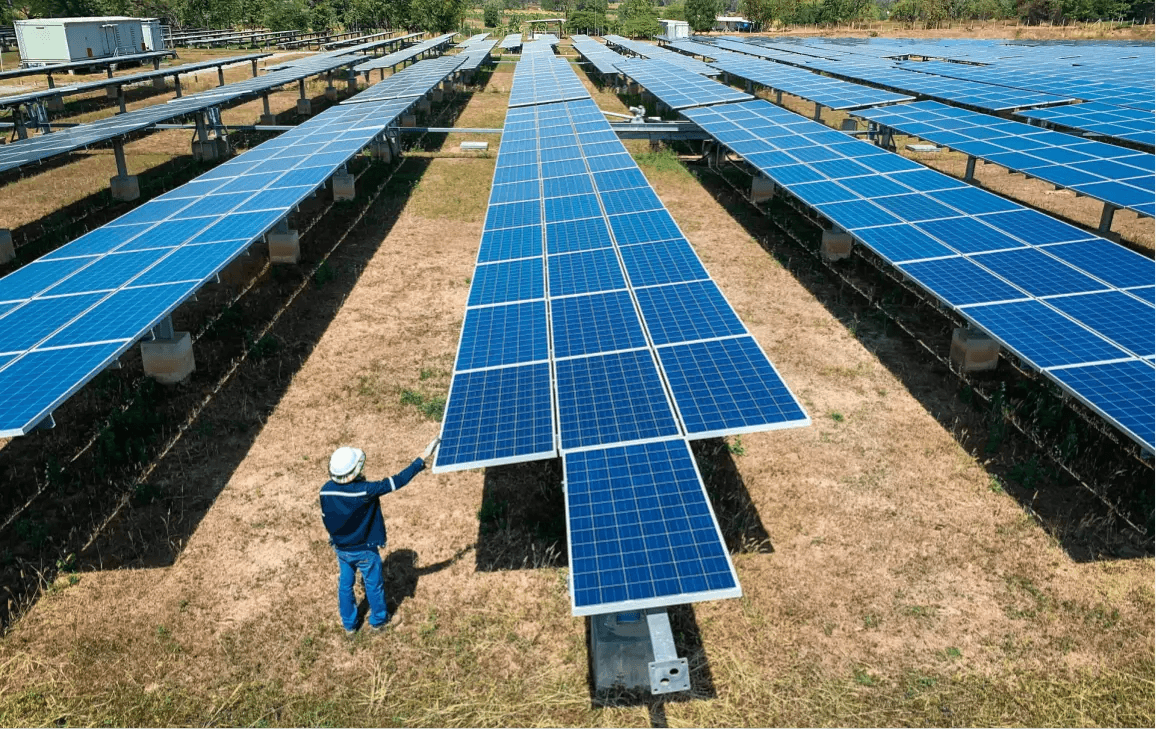
Ground-mounted solar installs panels on open land using dedicated steel or GI structures.
It is preferred when rooftop space is insufficient or when a business wants to build a larger solar plant independent of the building layout.
Ground-mounted systems give engineers full control over panel tilt and orientation, which directly improves energy generation.
For a full breakdown of how to plan a ground-mounted plant in India, refer to our ground-mounted solar plant guide.
Requires open land, either owned, leased, or part of the factory premises
Panel tilt and direction optimized for maximum irradiance
Easier access for cleaning, inspection, and module replacement
System size scales based on land availability, not roof constraints
Factories with limited usable rooftop area
Sites with open land adjacent to the facility
Businesses planning 2 to 5 MW and above capacity
Industries with heavy machinery loads that vibrate the roof structure
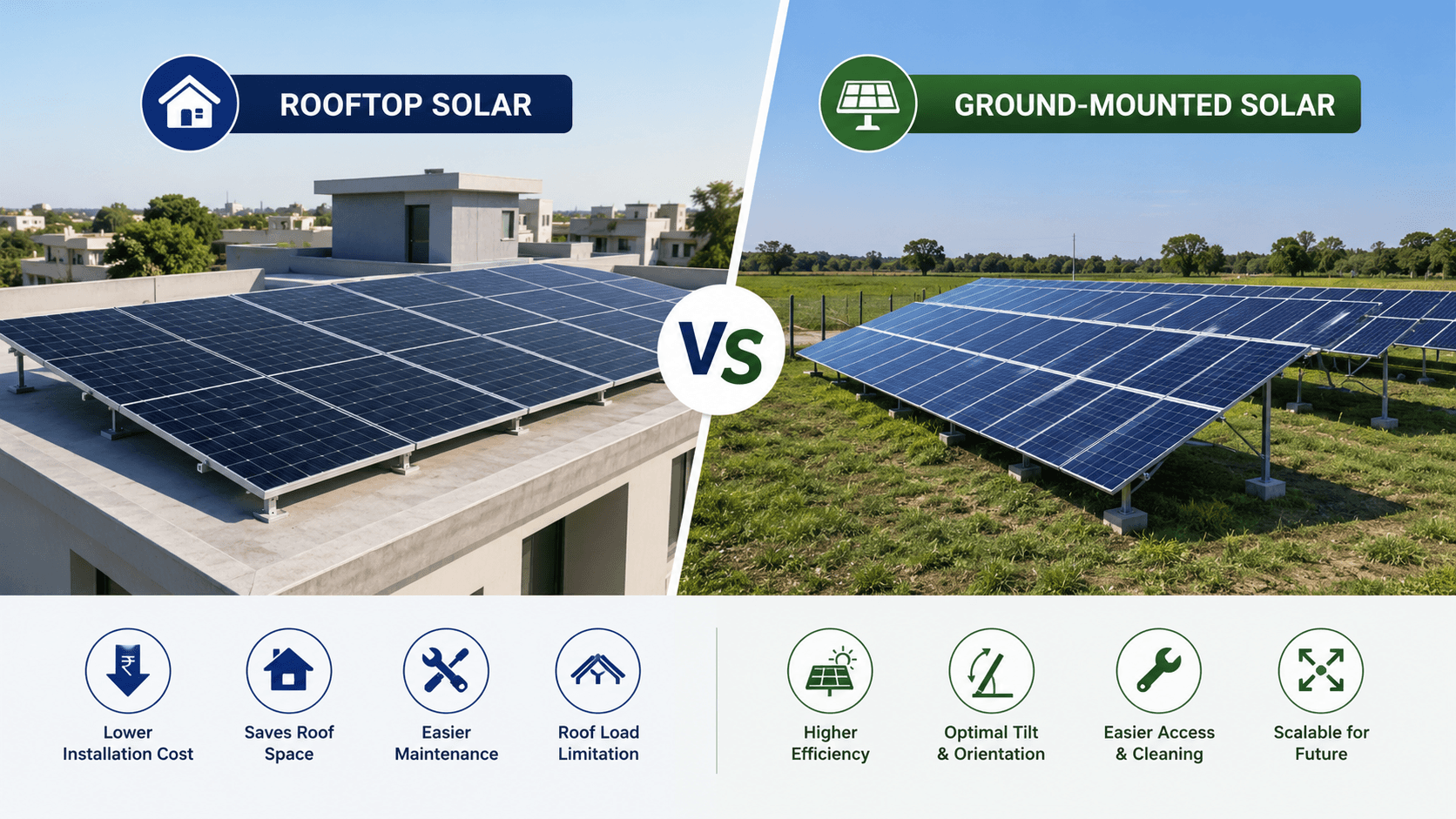
Parameter | Rooftop Solar | Ground-Mounted Solar |
Land Requirement | None | Required (owned or leased) |
Installation Cost | Lower (saves civil work) | Higher (structures + civil) |
Panel Orientation | Limited by roof angle | Fully optimizable |
System Scalability | Limited by roof area | Highly scalable |
Maintenance Access | Moderate (roof height) | Easy (ground level) |
Energy Generation | Slightly lower | Slightly higher per kWp |
Disruption During Install | Moderate | Low |
Payback Period | 4 to 6 years | 5 to 7 years |
Ideal System Size | 100 kW to 2 MW | 500 kW to 10 MW+ |
Rooftop solar has a lower per-unit installation cost in most industrial projects.
The civil and structural cost for a ground-mounted system adds roughly 10 to 20% to the overall project cost. Rooftop systems use the existing building as the base, eliminating this spend entirely.
For a broader view of what drives solar panel cost in India, including module prices and BOS components, refer to our detailed cost guide.
Typical cost benchmarks for industrial solar in India (2024 to 2025):
Rooftop solar: Rs. 35 to 45 lakh per MW (depending on roof type and system specs)
Ground-mounted solar: Rs. 40 to 55 lakh per MW (including civil, structures, and cabling)
Cost Factor | Rooftop Solar | Ground-Mounted Solar |
Base installation cost | Rs. 35 to 45 lakh per MW | Rs. 40 to 55 lakh per MW |
Land development and leveling | Not required | Rs. 2 to 5 lakh per MW |
Mounting structure (civil + steel) | Minimal (roof-based) | Rs. 4 to 8 lakh per MW |
DC cable runs | Short | Longer, adds cost |
Perimeter fencing and security | Not required | Rs. 1 to 3 lakh per MW |
Total estimated cost | Rs. 35 to 45 lakh per MW | Rs. 47 to 71 lakh per MW |
Land development and leveling
Steel or GI structure fabrication and installation
Longer DC cable runs from panels to inverter room
Perimeter fencing and security setup
For a factory evaluating both options with equal capacity, rooftop typically saves Rs. 5 to 10 lakh per MW on installation. This directly shortens the payback period by 6 to 12 months.
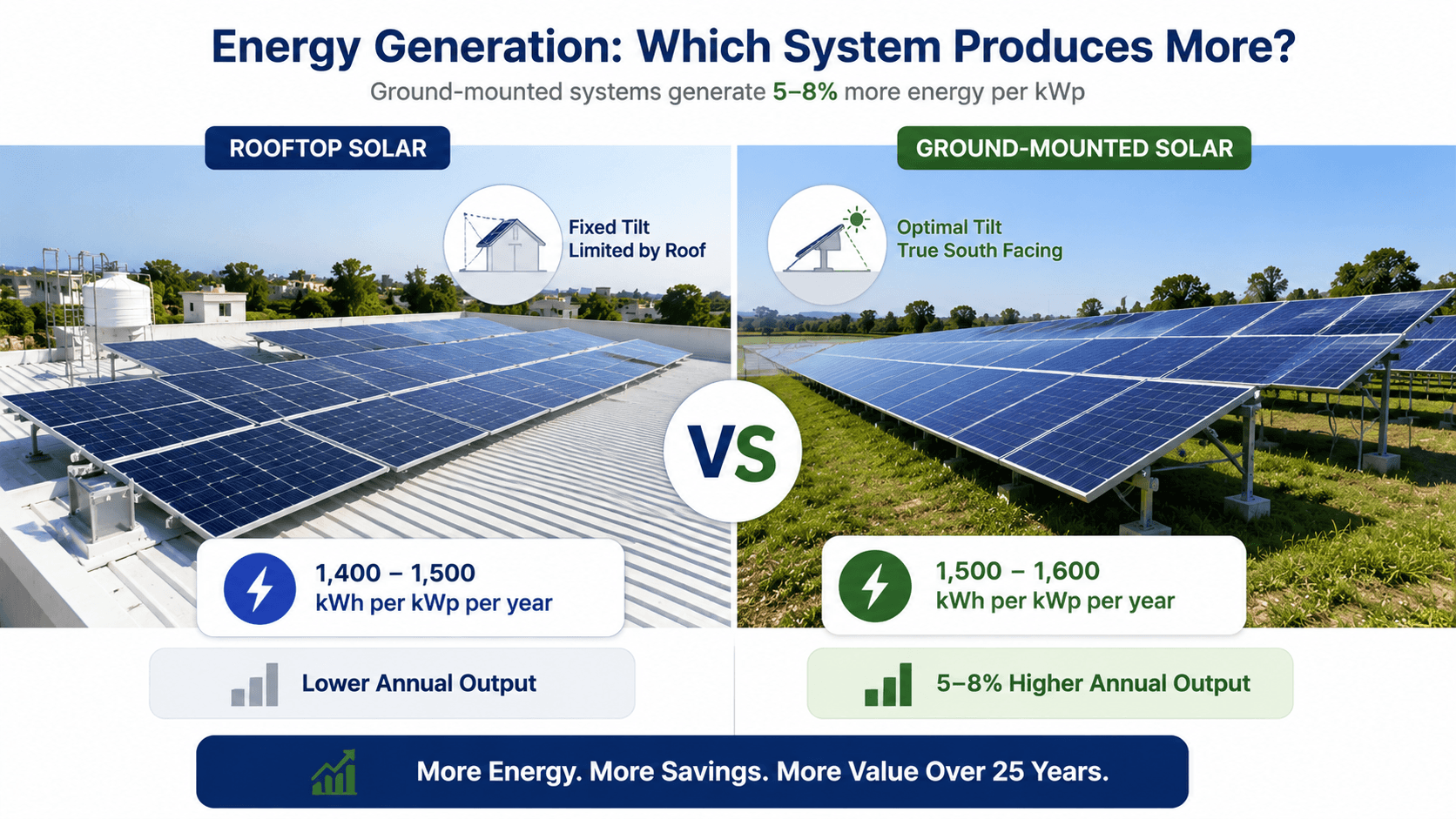
Ground-mounted solar generates slightly more energy per kWp installed over a year.
The reason is orientation control. Ground-mounted systems can be set to the exact optimal tilt (typically 10 to 15 degrees in Gujarat and western India) and face true south.
Rooftop systems are constrained by roof slope, direction, and shading from water tanks, chimneys, or adjacent structures.
Understanding how solar reduces peak demand charges also helps you evaluate which system type better covers your high-load hours.
A well-designed rooftop system generates approximately 1,400 to 1,500 kWh per kWp per year.
A ground-mounted system at optimal tilt generates approximately 1,500 to 1,600 kWh per kWp per year.
This translates to a 5 to 8% higher annual output for ground-mounted systems.
For a 1 MW plant running over 25 years, that difference adds up to a significant volume of additional free electricity.
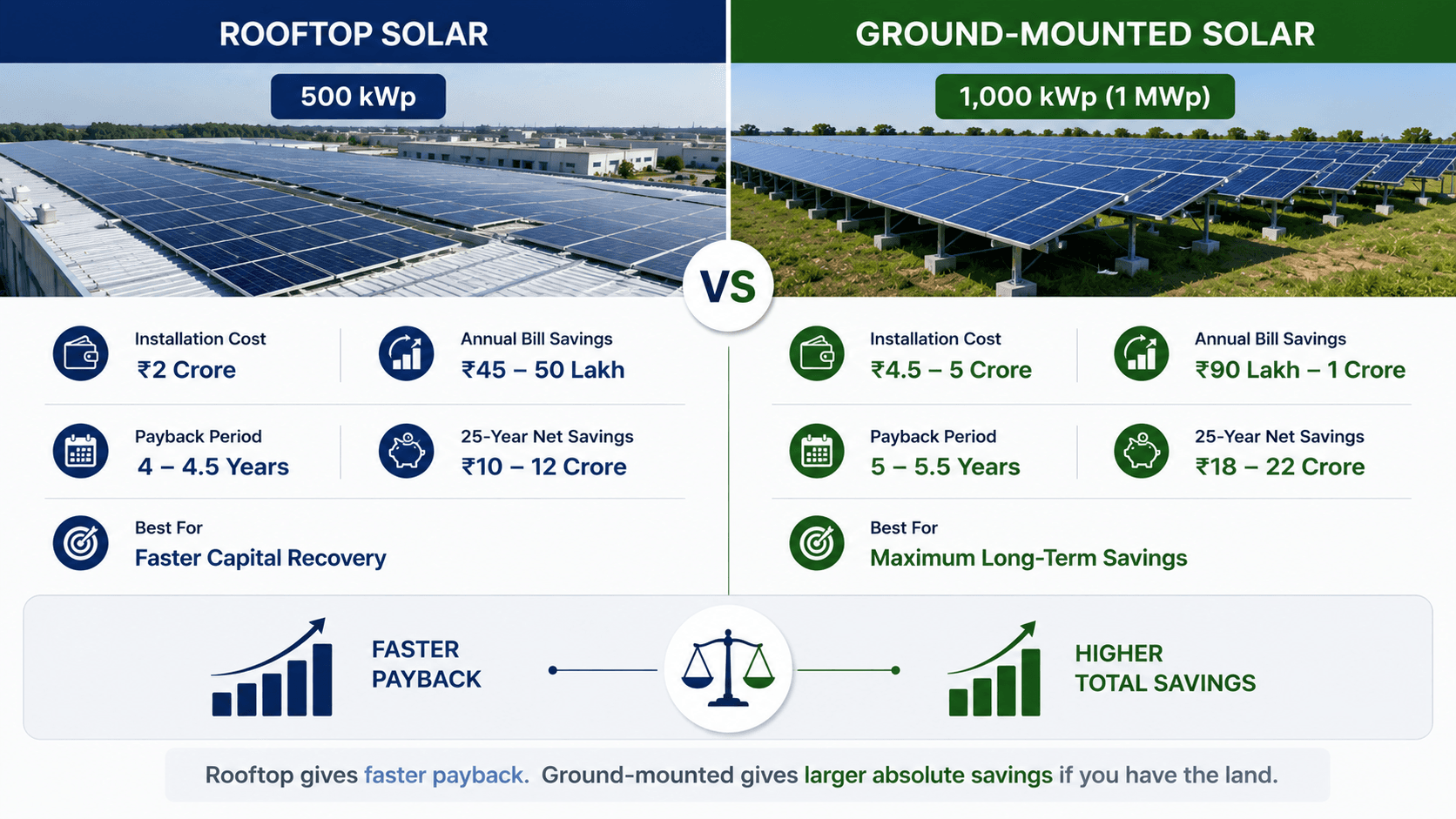
Both options deliver strong ROI for industrial buyers, but the path to payback differs.
Parameter | Rooftop Solar (500 kWp) | Ground-Mounted Solar (1 MWp) |
System Capacity | 500 kWp | 1,000 kWp (1 MWp) |
Installation Cost | Rs. 2 crore | Rs. 4.5 to 5 crore |
Annual Bill Savings | Rs. 45 to 50 lakh | Rs. 90 lakh to 1 crore |
Payback Period | 4 to 4.5 years | 5 to 5.5 years |
25-Year Net Savings | Rs. 10 to 12 crore | Rs. 18 to 22 crore |
Best For | Faster capital recovery | Maximum long-term savings |
A 500 kWp rooftop system for a manufacturing plant in Gujarat
Installation cost: approximately Rs. 2 crore
Annual savings on electricity bill: approximately Rs. 45 to 50 lakh
Payback period: 4 to 4.5 years
25-year savings: Rs. 10 to 12 crore (net of maintenance)
A 1 MWp ground-mounted system on factory premises
Installation cost: approximately Rs. 4.5 to 5 crore
Annual savings on electricity bill: approximately Rs. 90 lakh to 1 crore
Payback period: 5 to 5.5 years
25-year savings: Rs. 18 to 22 crore (net of maintenance)
For a deeper understanding of what affects your payback timeline, read our guide on solar payback period for industrial sites in India.
The key insight: rooftop gives faster payback, ground-mounted gives larger absolute savings if you have the land.
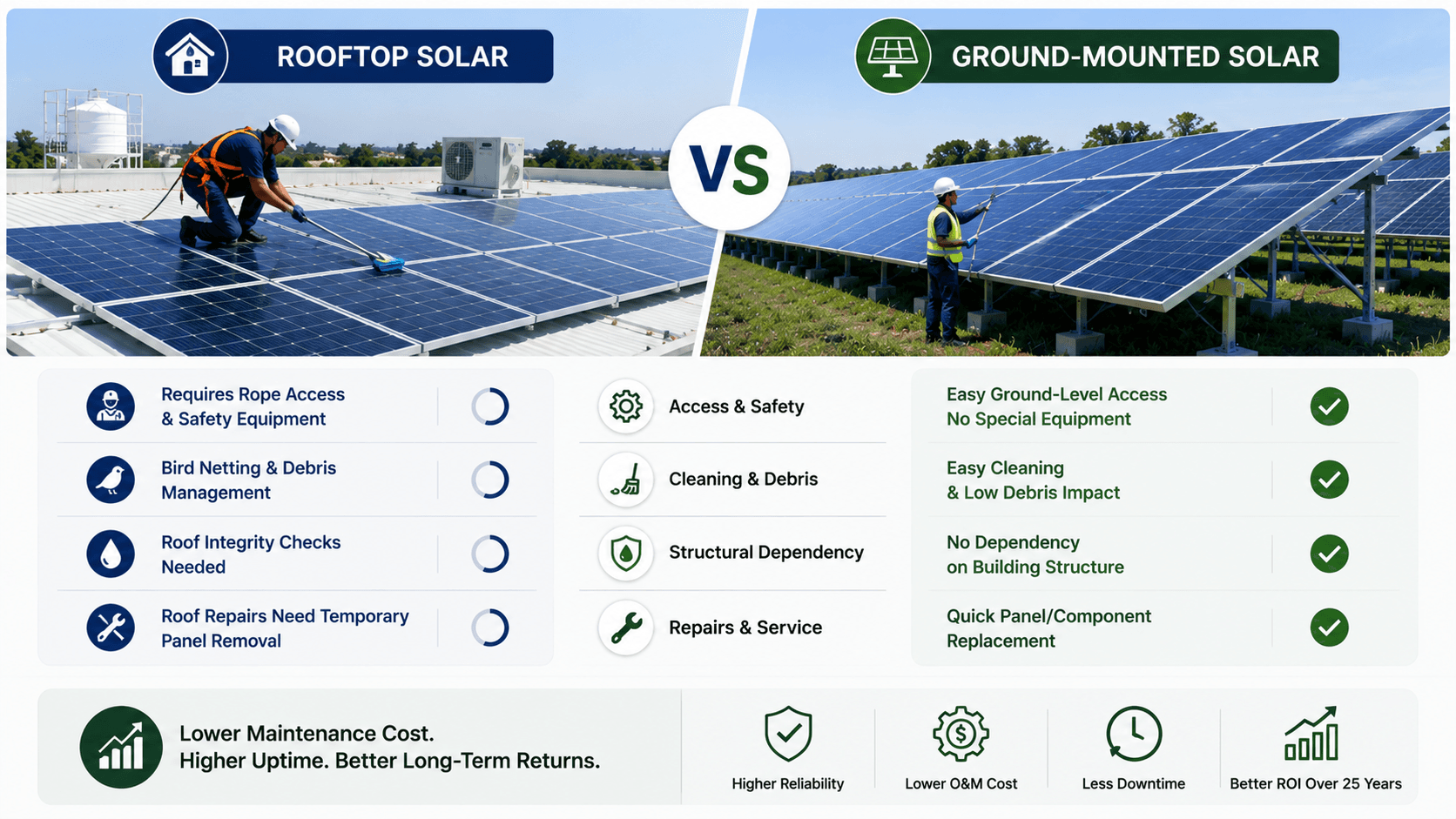
Ground-mounted systems are easier and cheaper to maintain over the long term.
Rooftop access requires scaffolding, safety harnesses, and scheduled shutdowns that depend on weather and roof condition. Ground-level access makes cleaning, panel inspection, and inverter servicing significantly simpler and faster.
For a complete maintenance checklist that applies to both system types, refer to our guide on how to maintain a solar system.
Panel cleaning requires rope access or scaffolding for high-pitch roofs
Bird netting and debris management adds recurring cost
Roof integrity checks needed annually to prevent water ingress
Any roof repair requires temporary panel removal in that zone
Direct access for cleaning crews and technical teams
No structural dependency on the building
Easier to replace individual panels or strings
Lower per-visit maintenance cost over the system lifetime
You should also evaluate whether accelerated depreciation tax benefits apply to your business, as they can reduce effective payback by 1 to 2 years for both system types.
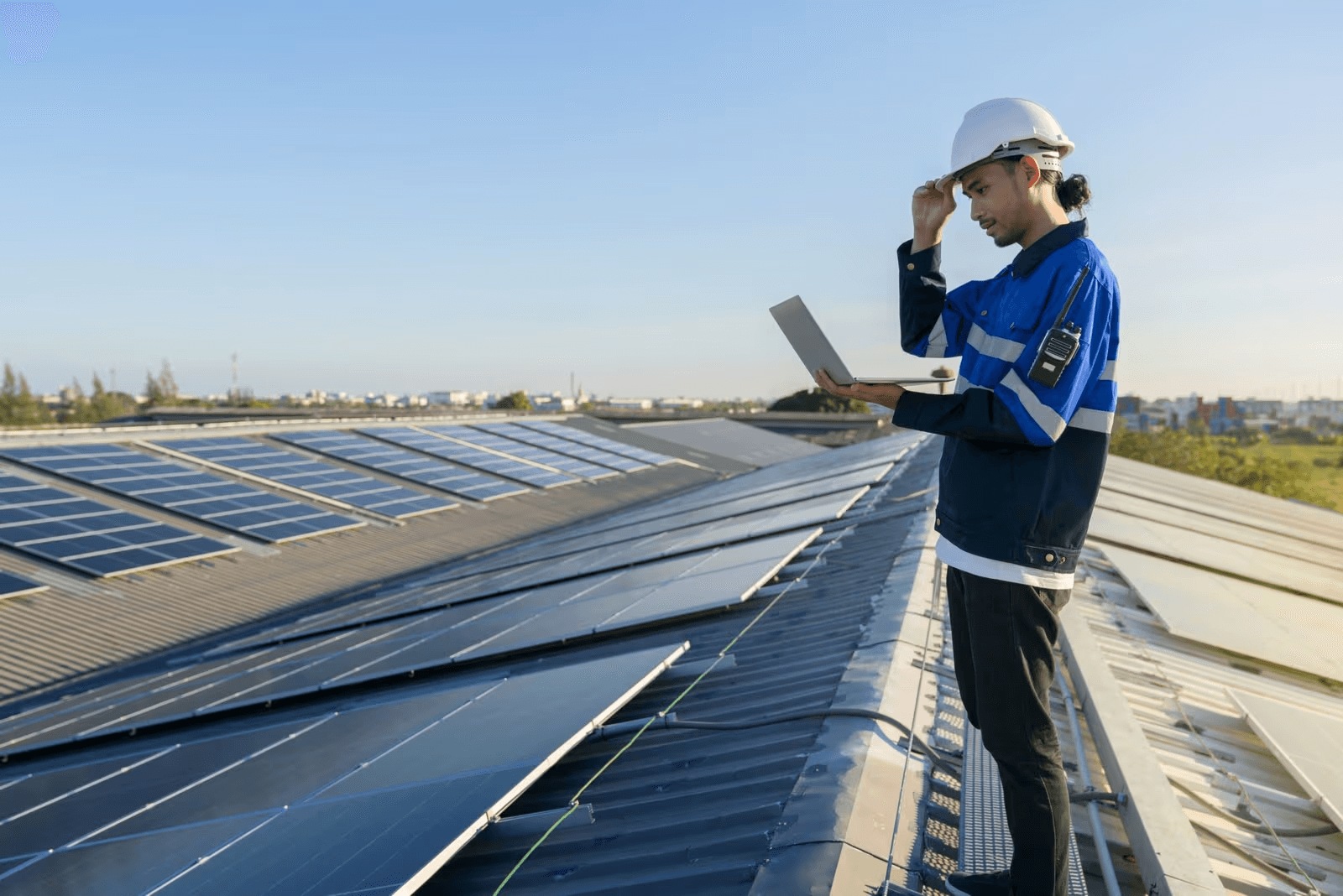
Skipping a structural load assessment is the most expensive mistake in rooftop solar planning.
Many older industrial buildings in India were not designed to carry the additional dead load of solar panels (typically 15 to 25 kg per square meter). Installing without an assessment can void structural warranties, create long-term roof damage, and in extreme cases create safety risks.
Age and material of existing roof structure (RCC slab vs metal sheet)
Residual load-bearing capacity after current equipment load
Roof waterproofing condition and expected service life
Presence of skylights, HVAC units, or ventilation shafts that reduce panel area
A certified structural engineer report costs Rs. 20,000 to 50,000 and can save crores in rework.
When selecting an EPC partner, use our solar EPC company checklist to verify that structural assessment is part of their pre-project process.
Ground-mounted solar scales more easily as energy demand grows.
Rooftop capacity is capped by your roof footprint. Once you have covered the usable area, expansion is not possible without adding new buildings. Ground-mounted systems can expand horizontally on available land, and additional inverter blocks can be added with minimal disruption to the existing plant.
If you are also evaluating financing models for future expansion, our guide on CAPEX vs RESCO solar financing explains which model suits phased investments better.
If your factory plans to add production lines in 2 to 3 years, ground-mounted allows you to reserve land for the expansion phase.
If your electricity demand is stable and your roof covers the load, rooftop is simpler and more cost-efficient.
Hybrid approach:
install rooftop now, reserve ground area for future capacity. Learn more about
and how they support phased industrial energy planning.
CEOs and MDs evaluating 5 to 10 year energy plans should factor scalability into the initial design, not treat it as a Phase 2 problem.
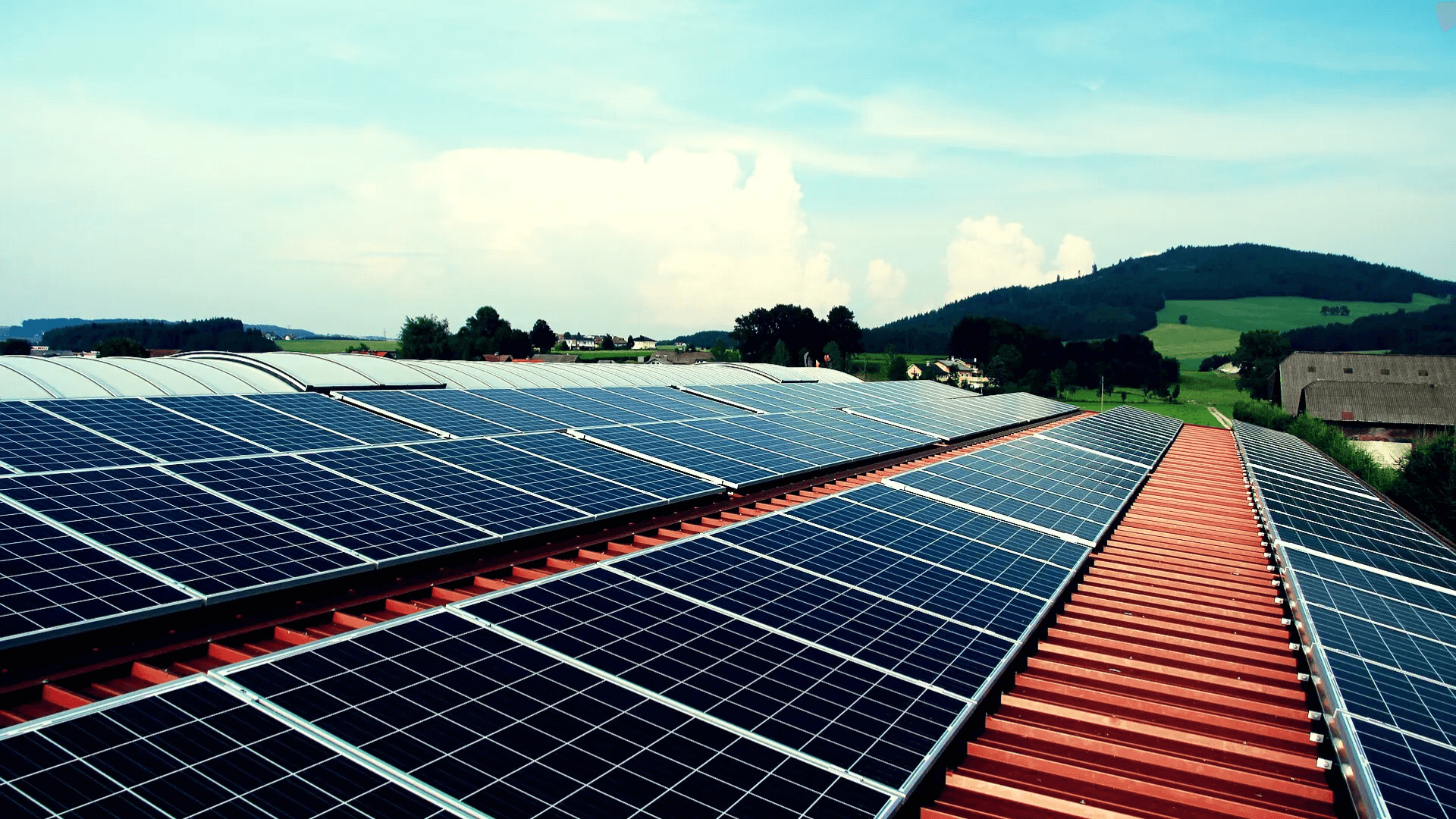
Textile mills and garment factories with large shed roofs
Pharma manufacturing units with RCC roofs
Food processing plants with stable daytime load
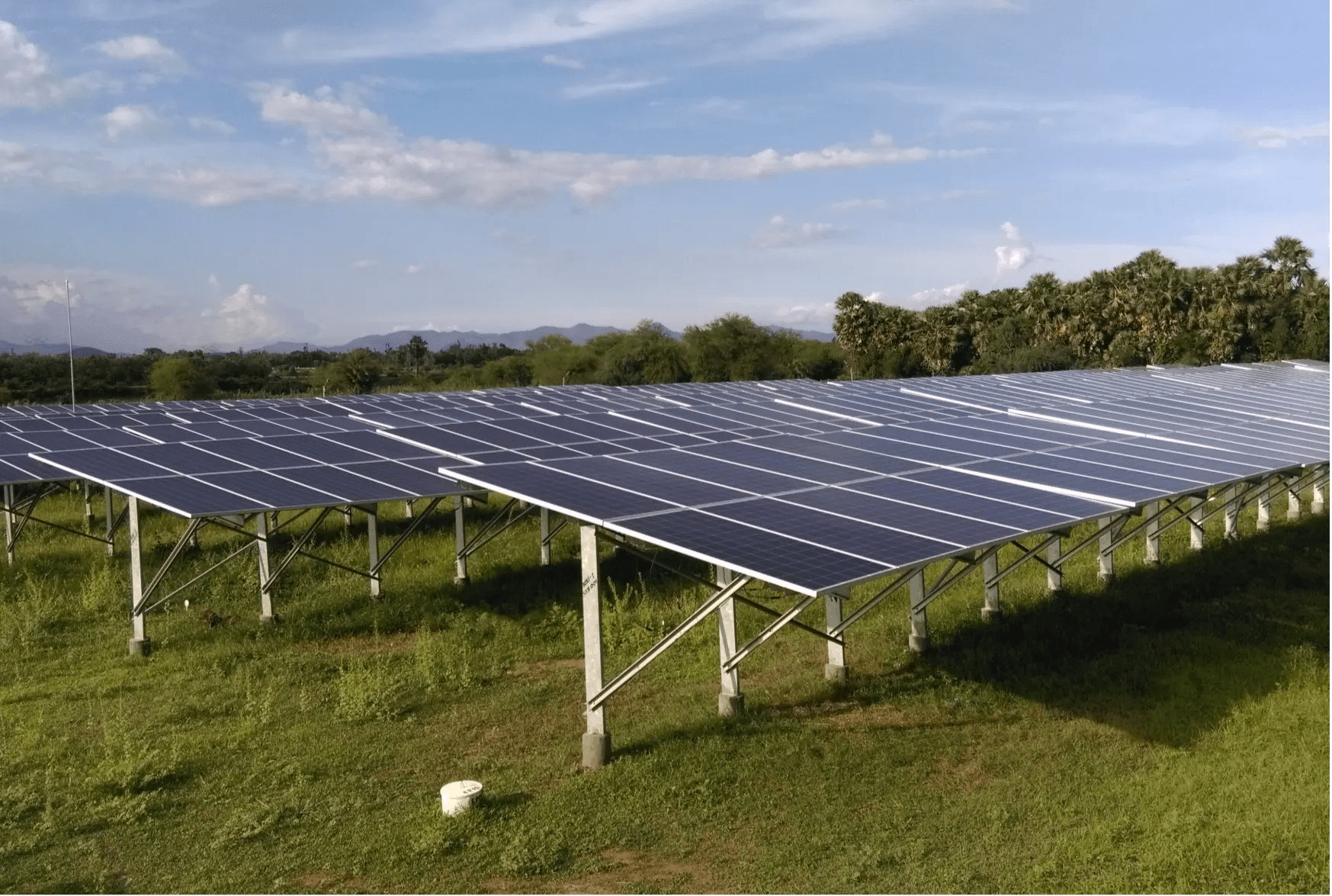
Cement, steel, and heavy manufacturing with very high load
Chemical plants where roof integrity is a concern
Agro-industrial units with open farmland adjacent to the facility
Logistics parks and industrial parks with low-rise spread-out footprint
For all of the above, commercial solar solutions from Earthwave are designed to match the specific load profile and site layout of each industry type.
Earthwave is a solar EPC company that specializes in industrial and commercial solar projects across Gujarat and India.
Their team of solar engineers, structural consultants, and financial analysts works with factory owners, CEOs, and plant heads to evaluate both rooftop and ground-mounted options against actual site data, not generic assumptions. You can view their completed industrial installations on the Earthwave projects page.
Free site survey and rooftop structural assessment
Shadow analysis and energy yield simulation
and
design and engineering
End-to-end EPC execution with turnkey project delivery
Net metering application and DISCOM coordination
AMC and O&M services for long-term system performance
Earthwave has delivered solar projects ranging from 100 kWp rooftop systems for mid-sized factories to multi-MW ground-mounted installations for large industrial clients.
Their approach is always site-first: they recommend the system that maximizes your ROI and fits your operations, not the one that is easiest to sell.
Your factory has a large, structurally sound roof
You want lower upfront installation cost
Your energy demand can be met within your roof capacity
You have no spare land or do not want to use it for solar
Your roof is too small, old, or structurally weak
You want to build a larger plant (1 MW and above)
You want easier long-term maintenance and better generation output
You are planning future capacity expansion
You have both available roof space and open land
You want to maximize total capacity across your site
Explore Earthwave's
built for exactly this use case
The best solar system for your industrial site is the one designed around your actual load, roof condition, land availability, and financial targets. That decision deserves site-specific analysis, not a generic recommendation.
If you are evaluating rooftop vs ground-mounted solar for your factory or industrial facility, do not rely on assumptions. Get a proper site assessment.
Contact Earthwave today for a free solar feasibility study.
Their team will assess your roof, land, load data, and financial targets and give you a clear comparison of both options with actual cost and savings projections for your site.
Visit www.earthwavetech.in or go directly to the contact page to schedule your free site survey.
Rooftop solar is generally 10 to 20% cheaper to install than ground-mounted systems. This is because rooftop projects do not require civil work, land preparation, or dedicated mounting structures. For a 500 kWp system, rooftop can save Rs. 10 to 20 lakh on installation cost compared to an equivalent ground-mounted setup. See our full solar panel cost guide for a detailed breakdown.
Rooftop solar typically delivers faster payback (4 to 5 years vs 5 to 7 years for ground-mounted) due to lower installation cost. However, ground-mounted systems generate slightly more energy annually and scale better for large capacities. If your energy demand exceeds your rooftop capacity, ground-mounted solar gives higher absolute savings over 25 years. Read our solar payback period guide for site-specific calculations.
A properly installed rooftop solar system does not damage the roof if a certified structural engineer assesses load capacity before installation and a trained EPC team handles waterproofing and mounting. Leaks typically occur when installation is done without a proper roof survey or by undertrained contractors. Always insist on a pre-installation structural assessment and use our solar EPC checklist to vet your installer.
A 1 MWp rooftop solar system requires approximately 5,500 to 6,500 square meters of usable roof area, depending on panel efficiency and mounting spacing. This accounts for spacing between rows, shadow clearance, and access pathways. Higher-efficiency panels (430 to 550 Wp) reduce the area required per kWp installed.
Yes. A hybrid approach is increasingly common for large industrial sites. Factories install rooftop solar on available building surfaces and supplement with a ground-mounted system on open land nearby. Both systems feed into the same inverter room or bus bar, and the combined output reduces the grid electricity bill. Explore Earthwave's Wave Hybrid solar service designed specifically for this combined deployment model.Share
FAQS
Can't find the answer you're looking for? Our team is here to help.
SUBSCRIBE NEWSLETTER
Switching to solar is easier than you think. Let us guide you to cleaner, more affordable energy.
